

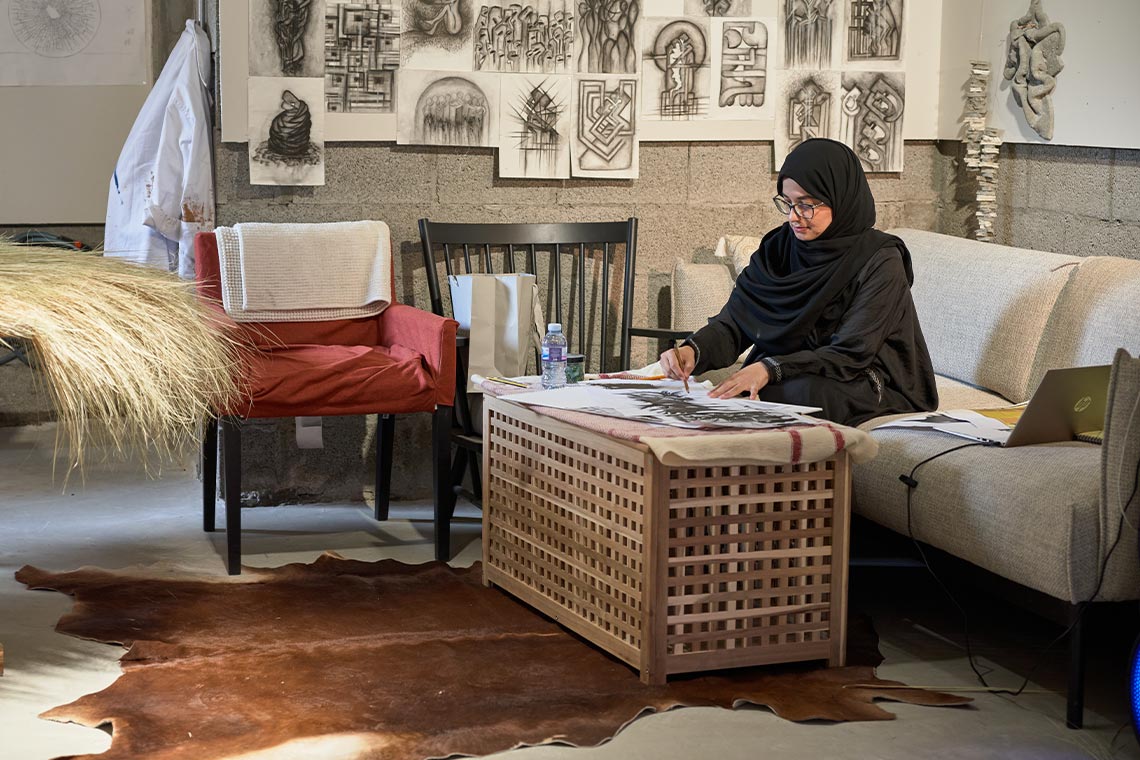
The Jeddah-based multimedia artist speaks new volumes to materials with familiar resonance, imbuing them with a theatrical mystery.
Canvas: Accumulation is an integral part of your sculptural process. Could you talk about the process of singularising a material and developing it into an orchestrated mass?
Zahrah Alghamdi: Accumulation is a fundamental part of my sculptural practice. In fact, it is the visual language through which I express myself. In most of my installations, I begin with a singular material – something that may seem simple or familiar – and through contemplative repetition and deliberate accumulation, this material transforms into a living, breathing mass with a visual rhythm of its own. I do not view repetition as mechanical replication, but as a meditative act that redefines my relationship with the material. Each repeated element carries an imprint of my spirit, and each layer added is charged with meaning that transcends form. The technique I employ is not merely a method of construction, it is an extension of myself – revealing something intimate with each unit. In this way, the work grows organically from within, embodying my personal experiences with memory, place and belonging.
You approach materials with both precision and an openness to their organic transformation. What are the chemical and narrative potentials of materials such as leather?
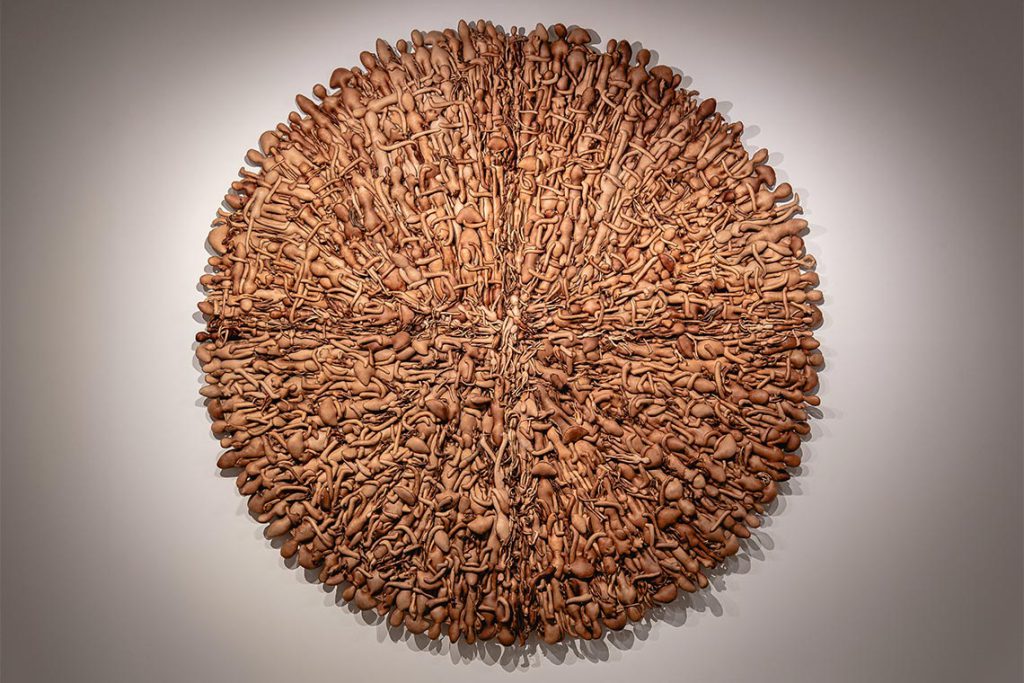
I approach materials as living entities, pulsing with their own memory, speaking their own language. I believe every material holds within its chemical structure and physical form a story – even layers of stories – that can be awakened through the act of making. Leather, in particular, occupies a special place in my practice. It carries profound contradictions, including strength and fragility, firmness and flexibility, organic and symbolic. I don’t treat leather as a mere visual element, but as an extension of the human body, a living memory marked by the traces of life and transformation. It holds the imprint of time, and carries with it the energy of the original being – animal, nature, loss. In that sense, the leather is not just a surface, but a vessel of narrative and chemistry. It is a site where meaning and memory converge.
How does your approach vary between outdoor public commissions and white cube exhibitions in terms of the chemical and physical attributes of your materials?
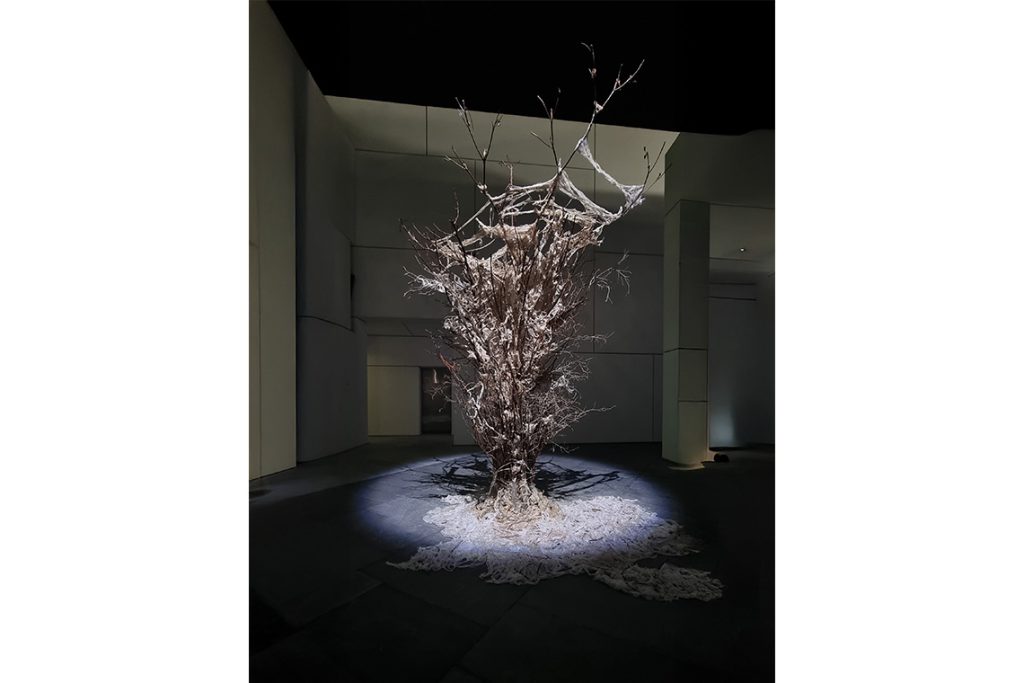
The environment fundamentally alters my relationship with material and therefore the nature of the work itself. When working in open-air contexts, such as Glimpses of the Past (2020) in Desert X AlUla or What Lies Behind the Walls (2021) in California, I’m in direct conversation with the elements, with sunlight, wind, humidity and shifts in temperature. This requires a deep awareness of the chemical properties of the materials. I choose those that can respond to their surroundings, and often allow them the freedom to erode or transform because that very transformation becomes part of the narrative. To work outdoors is to let the material resist, adapt or dissolve – and each choice tells a different story.
In contrast, white cube environments, which are more stable and controlled, allow me to focus on finer detail, rhythm and the inner life of the material. In works like Mycelium Running (2019), presented in indoor spaces, I work with leather in a more meticulous way, allowing the material to reveal its layers and quiet transformations without external interference. Indoors, the work breathes within a fixed spatial and temporal frame; outdoors, it’s in constant dialogue with the world, shifting as the sky and earth shift. Each setting offers a distinct experience, not just in outcome, but in process.
Memory and history have intertwined courses, both at odds with each other and feeding one another. Memory can be unreliable and biased. How do you keep them alchemised but wary of each other in your practice?
I treat memory and history as intertwined forces which shape both the emotional and conceptual architecture of my work, but I’m always careful that neither overwhelms the other. In my practice, memory is not just emotional recall – it is a tool for reconstructing a personal connection to place and identity. History offers a broader, more structured framework, but it too is incomplete. I seek the space where the two converge, a space of alchemy, where meaning is stirred without losing honesty. I don’t aim to document history, nor do I lean on memory as absolute truth. Instead, I use both as media through which I create contemporary narratives – layered with contradictions – that acknowledge absence as much as they celebrate presence. To me, this delicate balance is what gives my work its energy and sincerity.
Although abstraction is your overarching approach, the viewer can’t help searching for – and perhaps noticing – figurative accents that may be deliberate or intentional. Could you talk about this back-and-forth?
Abstraction is not an end in itself for me. It is a space of openness, a realm where interpretation can breathe freely. It allows viewers to weave their own narratives and personal connections with the work. I often begin with feelings, memories or spatial references deeply rooted in my own experience, and reconfigure them through repetition, accumulation and material transformation. The result is often a form that defies fixed definition, yet still holds a resonant presence. While I don’t intentionally create figurative forms, sometimes shapes emerge during the making – especially in works from my solo exhibition Between Memory and Matter – that hint at human figures, bodily masses or architectural remnants. This figurative presence is not always planned, but comes from my deep connection to place, body and memory.
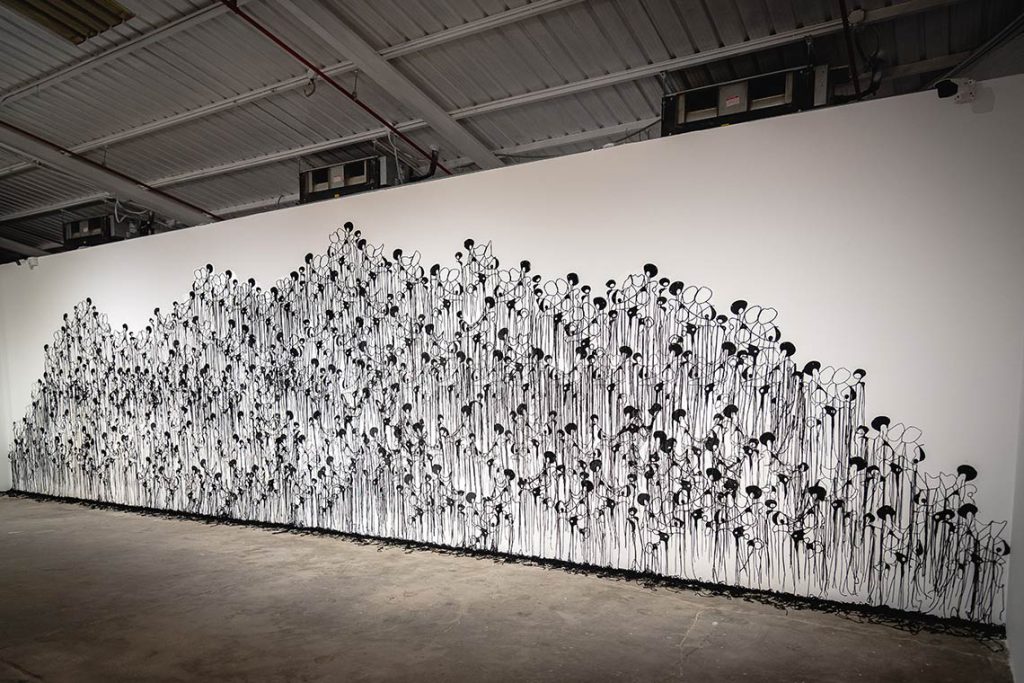
At times, I leave behind visual traces such as lines or shadows that suggest human outlines or organic structures, as seen in my works with black threads and leather. But I never offer direct answers.I prefer the work to remain ‘in-between’, meaning between abstraction and representation, silence and revelation, form and meaning. This tension is what gives the work its depth and invites each viewer to have a deeply personal encounter with it.
How has your sense of craft evolved over recent years with your projects growing in scale? What are the challenges and rewards of returning to different craft techniques that have resisted time?
My relationship with craft has evolved alongside my expanding perspective on material and temporality. As my projects have grown in scale and complexity, I’ve found myself returning more intentionally to the roots and traditional craft practices that shaped my visual memory and cultural foundation. Techniques like embroidery, weaving, working with clay and assembling leather are not just production methods, they are contemplative acts tied to bodily rhythm and emotional presence. This return is not nostalgic, but rather a conscious revival of values rooted in slowness, patience and the human touch – values that feel increasingly urgent in a fast-paced world. For me, craft is not simply about execution, it is a way of connecting, with memory, with self and with others. Each time I revisit an old technique, I feel as though I’m rediscovering something essential within myself.
This interview first appeared in Canvas 120: The Traces Left
