

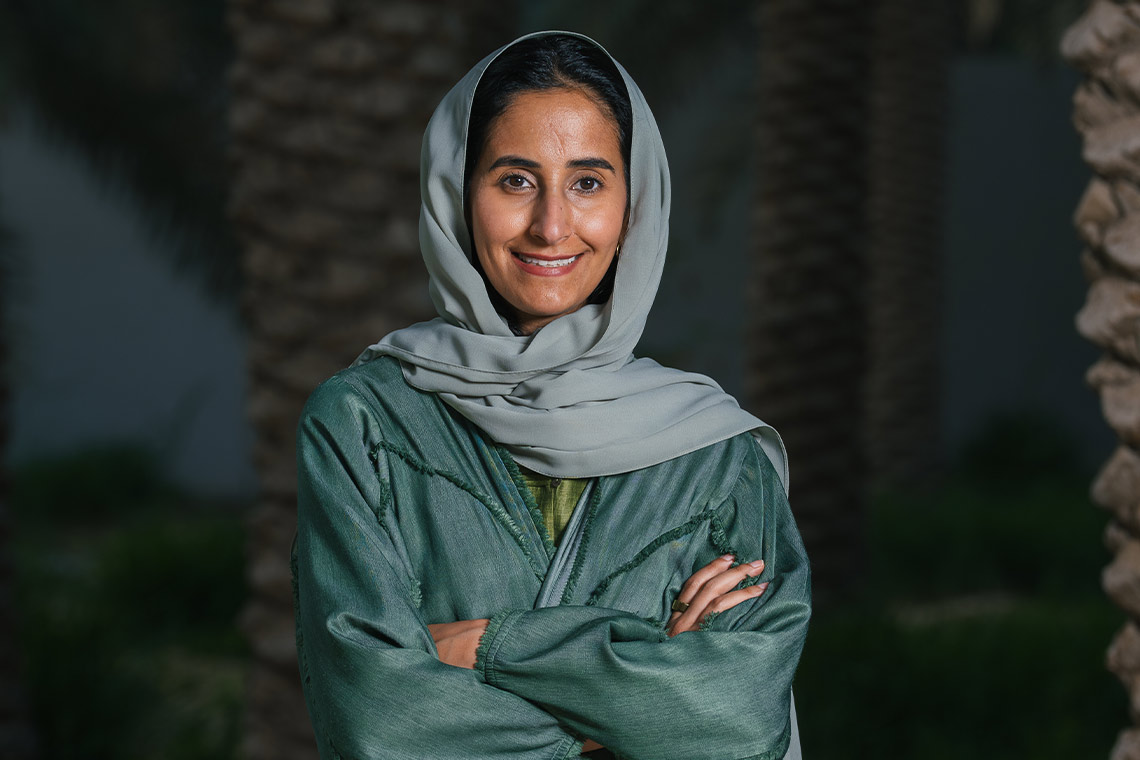
The Ithra Art Prize Advisor speaks about the upcoming edition and shaping the future of the award within the local and global art landscape.
Canvas: How do you envision the Ithra Art Prize evolving for this edition and in the future?
Sara Al Omran: It has been a privilege to work alongside the Ithra team on shaping the evolution of the Ithra Art Prize, which remains one of the most significant recognitions for artists from across the Arab world. I joined Ithra in early 2025, and the first phase of my advisory role was reflective. We spent time looking back at the prize’s first seven years, examining its impact on artists’ practices over time, the kinds of conversations it has enabled and the imprint it has left on the wider art ecosystem.
This process included in-depth conversations with past jurors and prizewinners, as well as curators from Ithra’s extended network and colleagues across the institution. That collective reflection generated important insights, which have informed both the recalibration of the current edition and a longer-term direction for the prize.
How has your experience shaped your approach in the advisor role?
My work has involved supporting institutions at moments of inception or transition, when mandates are being clarified, programmes rethought or new infrastructures for cultural and knowledge production are taking shape. My background combines strategy development, pedagogical and learning programmes for artists and curators, and building creative communities.
Alongside my advisory roles, I am involved in projects that operate both institutionally and independently. This includes my previous leadership role at Art Jameel, my work with JAX District in Riyadh, as well as Maghras, a community-based research and experimentation project that I co-founded in Al Ahsa and which looks at art, ecology and agricultural landscapes. Across these contexts, I have had a close view of how commissions, prizes and institutional frameworks can meaningfully support artistic development over time. That perspective has shaped the conversations that I bring to the Ithra Art Prize, particularly around focus on process, building institutional memory and continuity.
What distinguishes the Ithra Art Prize within the regional and global art landscape?
The contemporary art landscape in the region has shifted significantly in recent years, with the emergence of new biennales, art fairs, festivals and large-scale institutional commissions. Within this context, the Ithra Art Prize plays a complementary role. Rather than curatorial frameworks or exhibition thematics, the prize acknowledges independent pursuits of artists within their practice and long-term engagements. In its 7th edition, the prize has expanded to include five shortlisted artists whose work will be in dialogue with each other in an exhibition that opens at Ithra in the spring of 2026.
What role do you see the Ithra Art Prize playing in the support of artists in the region? How does the prize respond to the needs of artists working today?
The Ithra Art Prize is intended as a platform for artists across the 22 Arab countries, each shaped by layered histories and distinct cultural contexts. A key long-term ambition is for the prize to function as a point of congregation for practices emerging across these geographies. This involves strengthening on-the-ground relationships with galleries, independent spaces and institutions in different countries, enabling deeper exchanges and a more nuanced understanding of the artistic discourses shaping each part of our region. Over time, this approach can help position the prize as not only an award but also a space of convening and dialogue.
Who are you hoping to further engage with and how?
At its core, the Ithra Art Prize speaks to artists across the Arab region. At the same time, it has an important role to play locally, particularly for audiences in the Eastern Province by offering access to contemporary artistic practices and discourses that are unfolding across the region today. Part of the future aspiration is to have the exhibition travel to different institutions in the region and beyond, opening up possibilities to engage with wider audiences.
How were the jury members selected and what experience do they each add to the Ithra Art Prize?
The jury brings together senior curators and thinkers from the region and beyond, each with deep experience in shaping exhibitions, commissions and institutional programmes. Collectively, they offer a breadth of perspectives that reflect different modes of practice, research and engagement. The jury includes Dr Nada Shabout, whose work provides critical grounding in the art histories of the region; Tarek Abou El Fetouh, whose curatorial practice has been deeply engaged with performance and experimental platforms across the Arab world; Jérôme Sans, who has played a formative role in establishing major international institutions; Nadia Kaabi-Linke, a multidisciplinary artist and former recipient of the Ithra Art Prize, whose perspective brings an artist-led understanding of practice, process and what it means to engage with the prize from an artist’s point of view; and Farah Abushullaih, Head of Ithra Museum, who contributes an institutional and curatorial lens rooted in audience engagement, the institutional collection and Ithra’s broader mandate.
What is the jury looking for in the proposals?
The open call invites artists to submit works that are grounded in process, research and experimentation. This may take the form of an existing work or a new project that an artist wishes to develop through the opportunity the prize offers. Across both categories, the jury is looking for proposals that demonstrate depth, methodological rigour and a clear relationship between research and form. The emphasis is on coherence, continuity and the strength of the artistic enquiry.
What lessons have you learned so far from this edition that you will be looking to take forward?
One clear takeaway has been the strength and depth of the applications received this year, which signals that the adapted format has resonated with artists. Internally, this has prompted further conversations about how the prize can extend its role to include building knowledge around shortlisted artists and works, including through forms of documentation and publication that give their practices greater understanding and longevity.
What are you most excited about for the upcoming edition of the Ithra Art Prize?
This is the first time the prize comes together as an exhibition of five shortlisted artists and the second time it is unveiled in its home in Dhahran. I am particularly looking forward to seeing these works in conversation with one another, and to the insights and connections that emerge through that shared encounter.
This interview is in partnership with the King Abdulaziz Center for World Culture (Ithra).
