

In Houselessness at Zawyeh Gallery in Dubai, Palestinian artist Mohammed Joha transforms fragments of memory into landscapes of resilience.
Home has always been a question to which people return – a sensation felt in the body as much as in architecture, before walls, doors or the idea of a house even exists. Some say the first home a human ever knows is their mother’s womb, an environment of enclosure, warmth and absolute dependence. It is a place we do not remember consciously, yet its imprint lingers in the way we seek comfort, belonging and the sensation of being held by a space. This primal memory complicates the language we use for living. If ‘home’ is something felt, carried and internal, then a ‘house’ is only one of its possible containers.
This distinction, between the emotional terrain of home and the physical strcture of a house, forms the conceptual threshold of Zawyeh Gallery’s exhibition Houselessness by Palestinian artist Mohammed Joha. The title itself invites visitors to pause and think: What does it mean to be houseless, but not homeless? What remains when the material site of dwelling disappears, yet the idea of home persists with unwavering clarity?
For Joha, these are not abstract propositions but lived realities. Although he has spent more than 20 years in Europe, Gaza remains his central axis. His family, memories and losses are rooted there. Recently, with the ongoing genocide, he lost his own house with over 500 paintings, now buried under the rubble. The concept of ‘home’ becomes for him not a place one inhabits physically but a force that continues to inhabit itself.
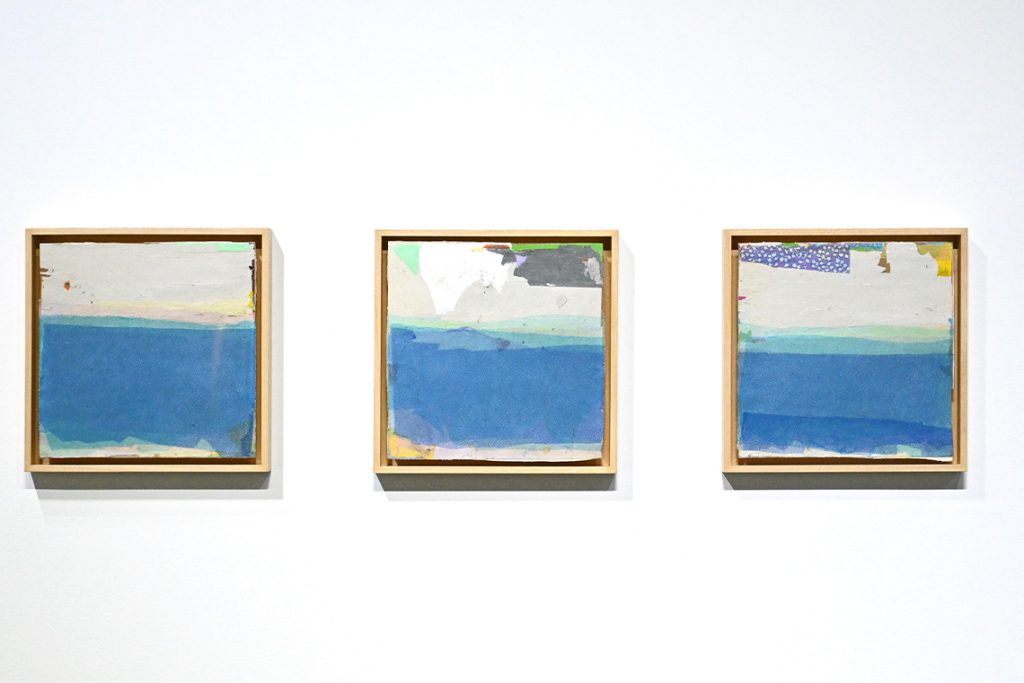
The gallery’s calm space holds Joha’s work like a pause between breaths. His collages, composed of mesh, cardboard, lace, paper, fragments of fabric and even pieces of his own clothing, often appear deliberately divided into two horizontal sections, evoking a horizon where sky meets ground, memory meets loss. Most of the works recall Gaza’s sky and the Mediterranean shifting surface, including The Sea is Mine (triptych) (2023), composed of three canvases where expanses of blue and white hues intertwine. Yet even these serene elements are built from torn remnants, assembled in ways that feel simultaneously tender and precious. Each fragment is now reclaimed and carries a trace of life lived, a poetic residue that transforms debris into a terrain of endurance and remembrance.
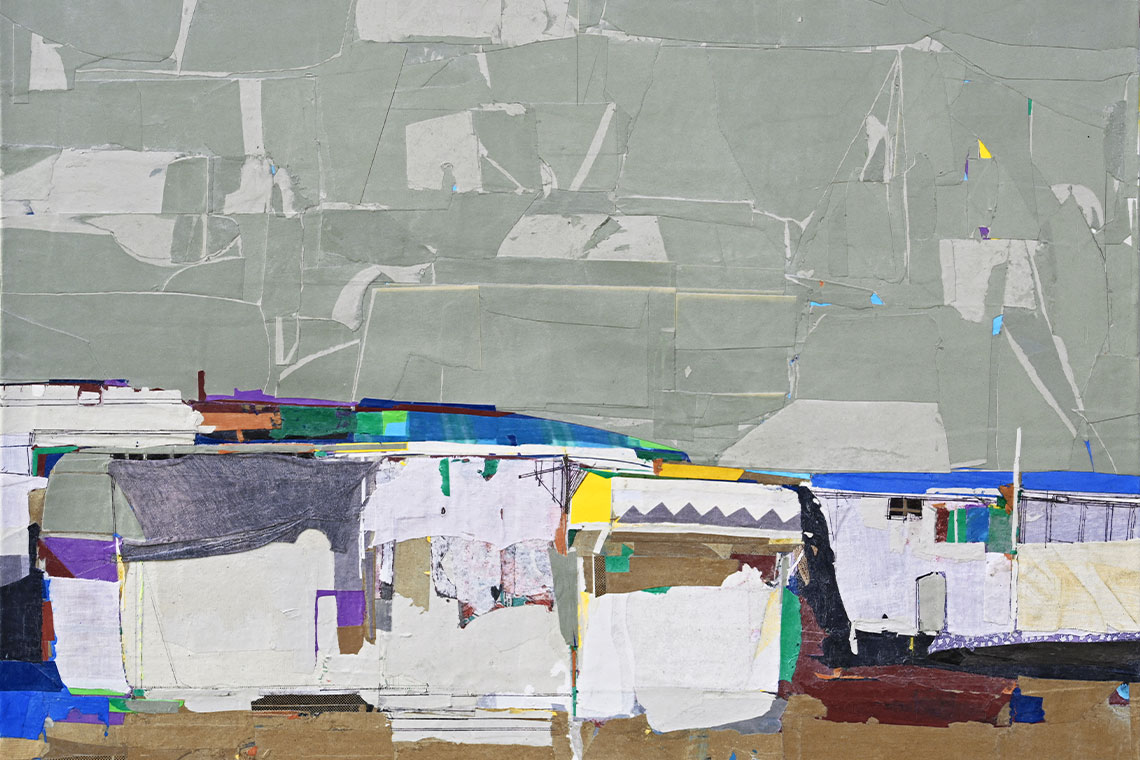
On a single wall, Houseless No.4 (2025) is displayed. Across a mute grey field, layered papers and fabrics create a surface of subtle cracks and seams. On the lower edge, clusters of colours gather – streaks of blue, purple and yellow, out of which fair architectural hints emerge, windows, a door, the shadow of a façade – not complete structures, but fragments held together through memory. Here the house appears as a collection of parts rather than a stable whole, echoing the larger condition of rebuilding from what survives.
In this folding vocabulary of fragments, Houseless No. 2 (2025) extends Joha’s language. Its upper section is composed from what appears to be an old navigational map, a surface marked by faint grids, dotted coordinates and faded topographical traces. The use of this map introduces a subtle suggestion of orientation, of paths once charted, now integrated within this work like a recollection of direction in a dislocated world. On the bottom part of the canvas, Joha constructs a pattern of rectangular forms, blocks of bright coloured scraps, layered into a fractured terrain. The composition feels both grounding and unsettling, a landscape attempting to recognise itself through the remnants it has left. Houseless No. 9 (2025) adds another trace of resonance. Composed of interlocking fields of colours, its upper band combines deep marine blues and patterned scraps. In the centre is a pale section marked with faint lines presenting stitched threads of red, green and black to trace paths that borders or attempt to repair. These stitches remember small acts of mending within a world that resists restoration.

In Houselessness, Joha dismantles the idea of the house as a mere shelter and instead reveals the deeper intangible architecture of home. These collages speak to the global diasporic experience and the resilience required to carry a home within oneself. Through Joha’s materials – stitched, layered, torn and reassembled, he builds not a literal house but the emotional architecture of belonging that lives in the acts of adaptation. In a world marked by ongoing displacement and forced exile, the exhibition reflects on the demanding strength needed to hold onto one’s roots while navigating new spaces – an ongoing tension between memory and survival, the difficult and often uncertain journey toward making a new place feel like home while carrying the weight of what was lost.
Houselessness runs until 11 January
