

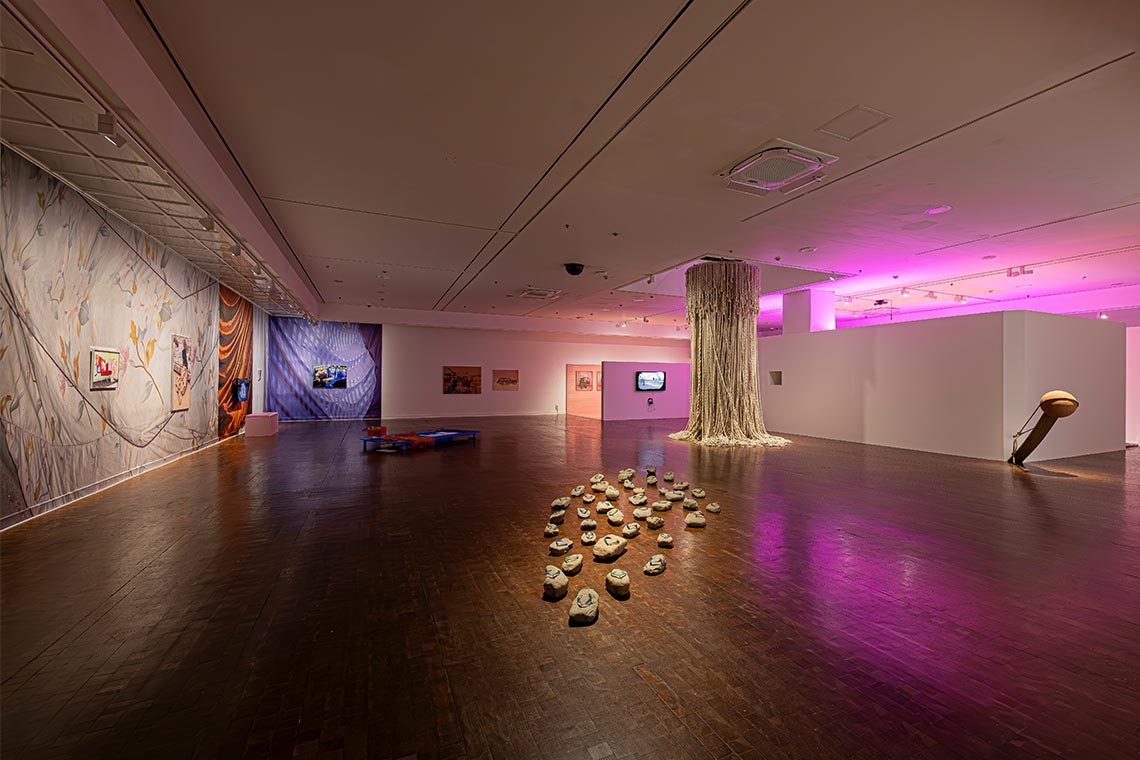
A partnership between Abu Dhabi Music & Arts Foundation and Seoul Museum of Art, the exhibition Proximities encourages viewers to think about how we navigate the world around us.
After last year’s landmark exhibition at Manarat Al Saadiyat in Abu Dhabi, Layered Medium: We Are in Open Circuits, which saw works by 29 Korean artists creating from the 1960s until today, Abu Dhabi Music (ADMAF) and Seoul Museum of Art (SeMA) have continued their collaborations. “SeMA and ADMAF have a lot in common,” says HE Huda Alkhamis-Kanoo, Founder of Abu Dhabi Music & Arts Foundation and Founder & Artistic Director of Abu Dhabi Festival. “We are both creative, agile institutions. We love to explore. We are also connected through our art scenes. Our nations emerged at light speed, and technology coexists with heritage. UAE-based artists and Korean artists have each explored this acceleration in their own ways and their art is where our organisations connected.”
Bringing together more than 110 artworks by 46 artists based in the UAE, Proximities marks the largest presentation of contemporary art from the UAE ever staged in Asia. This time, presented at SeMA, the exhibition does not aim to define a national art scene. Instead, it asks quieter but more expansive questions such as how do we engage with the world, where do we meet each other and how do we keep and convey memories?
Curators Maya El Khalil and Eunju Kim shared their approach with Canvas. “We designed the exhibition to work with constantly shifting meanings, rather than seeking to stabilise or fix them. Ideas emerge from the understanding that, when perspectives come into contact, proximities, juxtapositions and meetings are live, open processes which can remain generative – they produce new thinking precisely because they are irresolvable.”

Structured across three artist co-curated sections, the exhibition delves into notions of proximity – not just geographic closeness, but emotional, political and perceptual nearness. “The three sections propose subjective ways of encountering the world rather than documenting how meanings change,” El Khalil and Kim explained. “We don’t measure shifts and we do not direct audiences to see any one connection. The exhibition is designed as an ongoing conversation – audiences will find their own resonances, which we can’t predict or measure.”
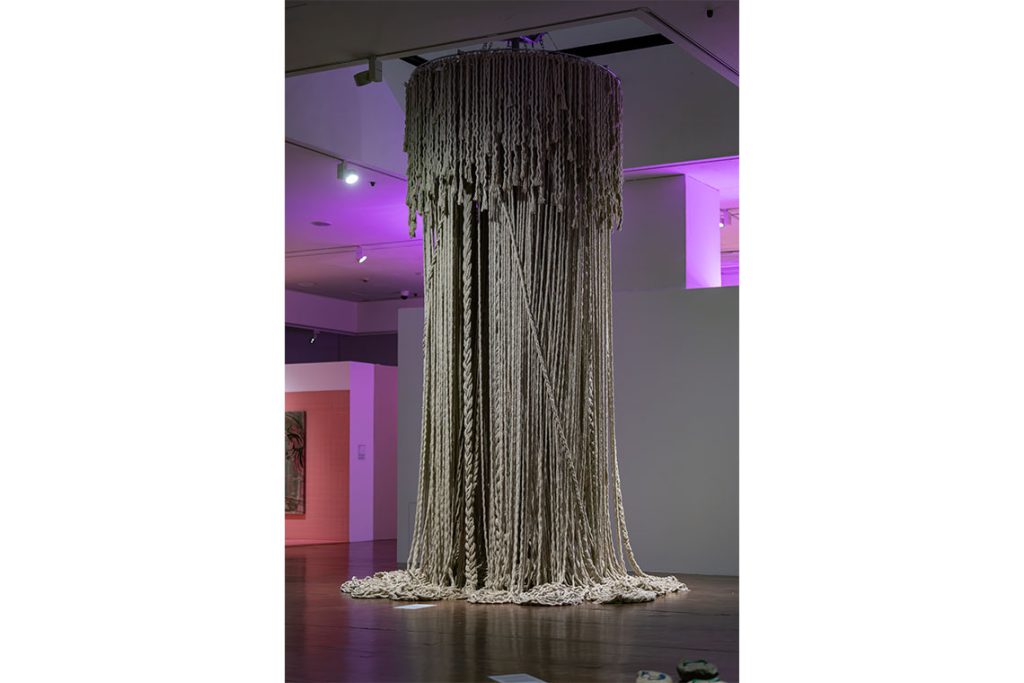
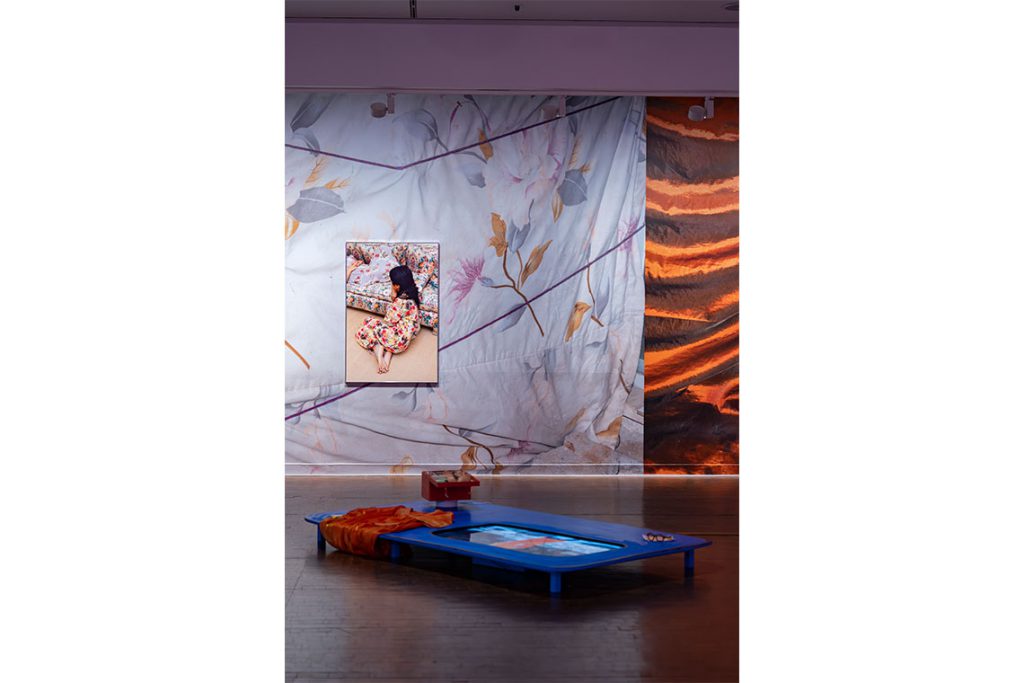
The first section, A Place for Turning, was proposed by Farah Al Qasimi (see page 32) and delves into the unseen realities and domestic domains that encourage new relationships with the world. A pinkish hue washes over the space, and there is an uncanny, whimsical exchange as interior realms are simultaneously familiar yet distant. They become sites for imagination and escapism, opening doors to new spaces as the social landscapes shift on the outside. For example, Shaikha Al Ketbi’s installation Book (2024) and Swinging (2020) blur fiction and reality, absence and presence, while Afra Al Dhaheri’s monumental installation, Jadael (Braids) (2021), blurs the lines between public and intimate relationships. Her work references hair braiding and also delves into hair as a vessel of memories and time. Al Qasimi’s photography, such as Drying Rack (2018) and Conversation (2023), leaves viewers with an uneasiness, as if stumbling upon private moments.
Intimacy in the section also moves beyond the physical, into other realms, dreams, cultural narratives, memories and myths. Works such as Jumairy’s interactive sound installation, Comma, in Arabic (2019), Rand Abdul Jabbar’s May It Be Remembered (2023) and Alaa Edris’s The Seven Jinnat of The Trucial States (2011) allow visitors the space to question the complexities of existence and act as witnesses to the passage of time.
Co-curated by Mohammed Kazem and Christiana de Marchi, the section Recording Distance, Not Topography maps the spaces between people rather than their coordinates. Vikram Divecha’s collaborative Road Marking (2017) fills an entire wall. Created with the workers who maintain traffic markers in Dubai, the panels were inserted into their maintenance process, allowing each board to become a sculptural archive of the city, with time, space, individual technique and road conditions impacting the textures.
A large-scale installation by Tarek Elkassouf, entitled Where Are You From? (2023), poses questions of individual, regional and global identity in a quest to understand belonging and safety in the face of loss and grief. Each sculptural piece in the work points in a different direction as compasses leading on unique journeys that remain linked. Meanwhile, Abdullah Al Saadi’s Camar Cande’s Journey (2010–11) consists of 151 watercolour paintings that tell the story of a trek taken by the artist and titled after the name of the donkey that accompanied him. The works became maps of roads and documentations of the landscapes encountered en route, serving as markers of his connection to his surroundings and those who live there. The works in this section highlight how landscapes carry memories of those who pass through and how the space between geographical distances and locational differences can bring us closer.
The artist group of Ramin Haerizadeh, Rokni Haerizadeh and Hesam Rahmanian brought together the section That Thing, Amphibian. Many of the works on show were created after the UAE’s 50th National Day in 2021, such as Kholoud Sharafi’s The UAE’s 50th National Day Brand (2021), who created the brand identity for the celebration, and Shaikha Al Ketbi’s The UAE’s 50th National Day Show (2021), for which she was one of the artistic directors. This flexibility challenges fixed definitions of what art is and how, and when, it happens. The various practices reflect an ecosystem in which artists are not merely observers but also active participants in shaping cultural images and narratives.
Across the three sections of Proximities, audiences meet the world through the eyes of artists who each share how they navigate culture, encounter change and experience community. “The structure prevents flattening precisely because it refuses singular narratives,” affirm El Khalil and Kim. “We did not want to sidestep or deny geographical categorisation – we are clear that these are works rooted in a particular context or dimension – but that perspective might be generational or the product of a specific micro-locale. Overall, we sought to develop and present a structure that avoids succumbing to stereotypes or reducing artists to representative types.”
For those of us who have encountered some of these works before, returning to them evokes layers of memory and prior connections. However, by bringing them to Seoul and allowing new audiences to experience them for the first time, new conversations are being sparked and questions raised over where our various understandings might overlap, and where we might meet one another in this particular process, as well as in life more broadly.
