

Ten artists of West Asian heritage strike dissonant notes in Rave into the Future: Art in Motion, currently showing at the Asian Art Museum in San Francisco.
Spaces vibrating in bass, flashing lights over closed eyes and open mouths, and a mass of bodies moving in tandem. All these images come to mind when listening to Reverie, a hypnotically repetitive, entirely beat-driven piece by Palestinian DJ and producer Sama’ Abdulhadi, a household name on the international techno scene. The 2021 song is part of the Youtube playlist that complements the group show Rave into the Future: Art in Motion at San Francisco’s Asian Art Museum this winter. Curated by Naz Cuguoğlu, assistant curator of art and programs, it brings together ten artists of West Asian heritage and follows a curated parcours in nine “Stages” that outline different phases surrounding its titular Rave, ranging from The Dance Floor and The House Party to A Place To Rest.
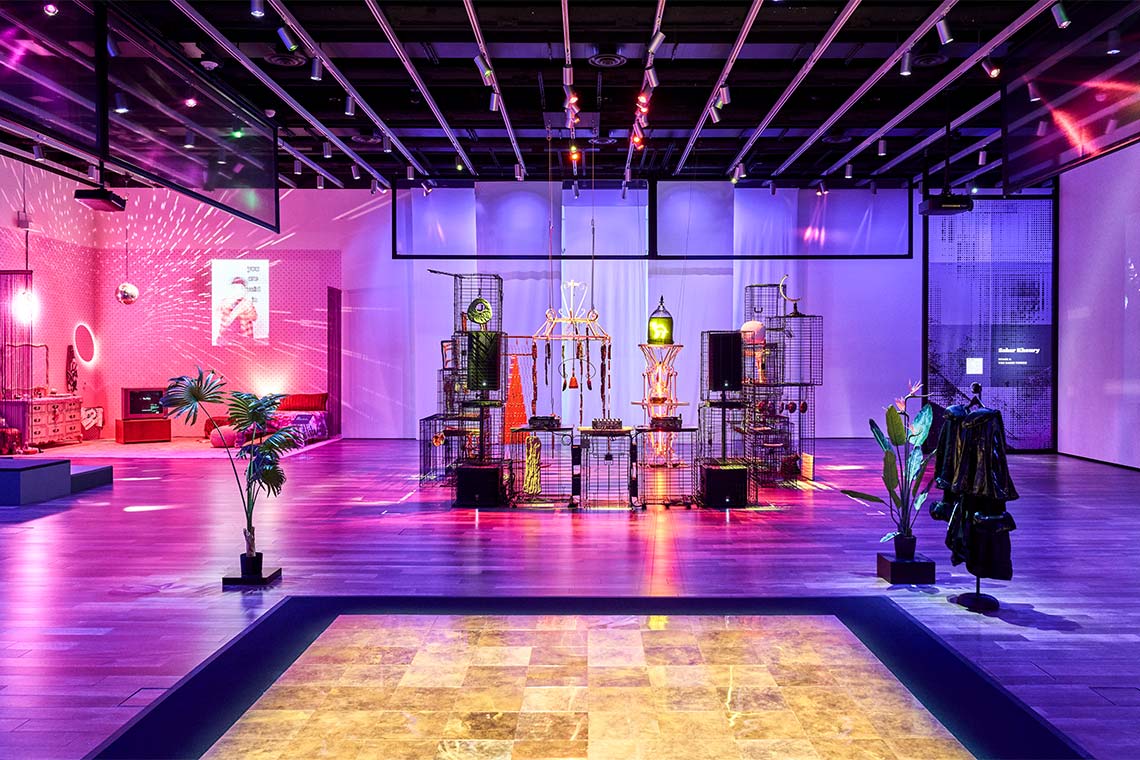
Unlike its ethereal and beat-heavy music accompaniment, the exhibition opens quietly in the museum’s main hall with Untitled (radio tower with accessories) by artist Sahar Khoury. As part of Stage 1: The Radio Tower, the 20-feet high structure made of steel beams, animal cages and multi-coloured jungle gym walls invites audiences to pass through its skeletal construction housing old boomboxes, oval ceramic objects and a life-sized plaster tower bell. From a radio, a heavy voice reimagines the poetry classic Al Atlal by the late Egyptian singer Umm Kulthum, featuring Khoury’s own aunt’s singing. Albeit an unexpected entry point to a rave-focused exhibition, Radio Tower reminds visitors of the sonic heritage and electronic airwaves that have carried us into our sounding present.
Anticipating a musical crescendo to Kulthum’s ballad inside the gallery, viewers are instead confronted with the party’s muted aftermath. In Puff Out M_2205_pink (2017–2025), the Brussels-based artist duo :mentalKLINIK de-programmed a fleet of robot vacuums to, instead of cleaning up, zigzag across a floor covered in glitter, blowing the shimmering material off the surface and at amused passersby. “TERRIBLY JOYFUL” is spelled out in big reflective wall lettering across the hall. :mentalKLINIK’s contradictory installation has audiences briefly ponder its meaning, although the possibly subversive message does not stick beyond the entryway – unlike the glitter.
The open main gallery is lit in an ambient purple hue, reminiscent of warehouses with strobe lights and bopping heads in techno metropolises like Berlin or Istanbul. Next to another of Khoury’s architectural cage installations – this time also equipped with a working DJ set for the exhibition’s public programme – visitors step onto a spotlit dance floor lined by a suspended puffer jacket and tall houseplants. Joe Namy’s Disguise as Dancefloor (2022–) serves as a meeting place and energy conduit for the listening and moving bodies on the copper-tiled platform. To the surprise of willing dancers, the work’s headphones tune into meditative sounds of harp and burbling water – no beats to move them and imprint on the shiny, malleable surface.
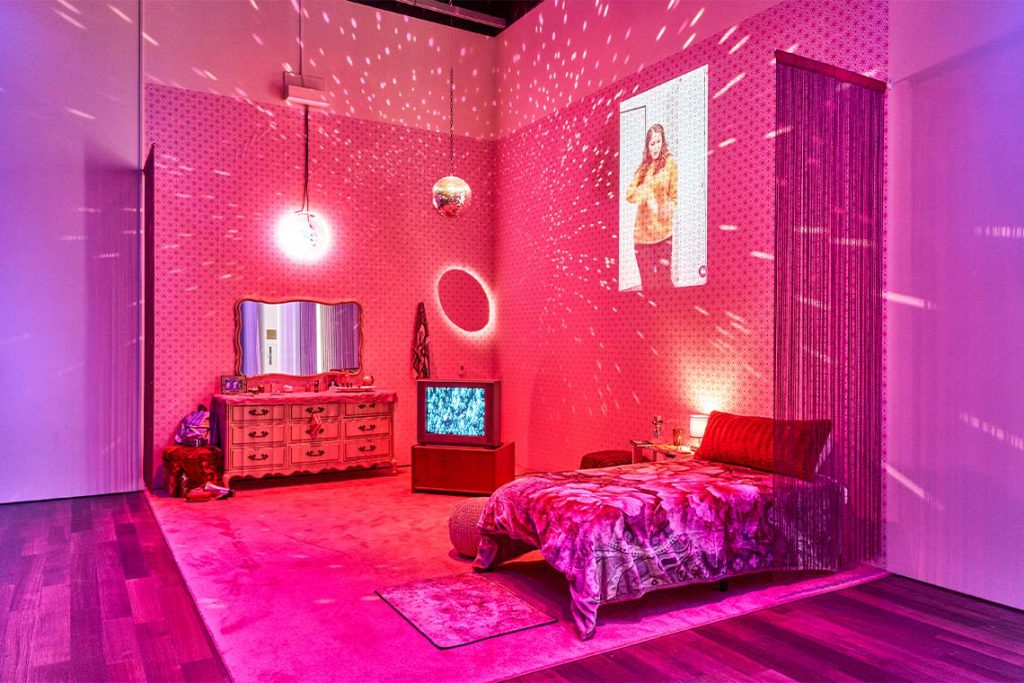
Moving past Stage 4: The Gathering with Moreshin Allahyari’s observant, 3D-printed goddess sculpturesQareen I and II (both 2022) and her metallic wall illustrations The Queer Withdrawings (2022–23), a dissonant mix of voices and music draws attention into the corner of the space. For Your Eyes Only (2021–) by Yasmine Nasser Diaz is a meticulous recreation of the artist’s adolescent bedroom, complete with velvet carpet flooring, a twin bed and a disco ball reflecting light speckles across the room’s pink wallpaper. Scattered paraphernalia points to a political outside life – a megaphone, the biography of Pakistani activist Qandeel Baloch and an old TV set playing montages of women-led protests in the Global South. Meanwhile, a vertical projection streaming selfie videos of people dancing in their bedrooms highlights stories on the inside. Examining the complexities of young adults navigating private spaces in the age of social media, For Your Eyes Onlycelebrates moments of online kinship against the backdrop of unjust realities in present-day politics.
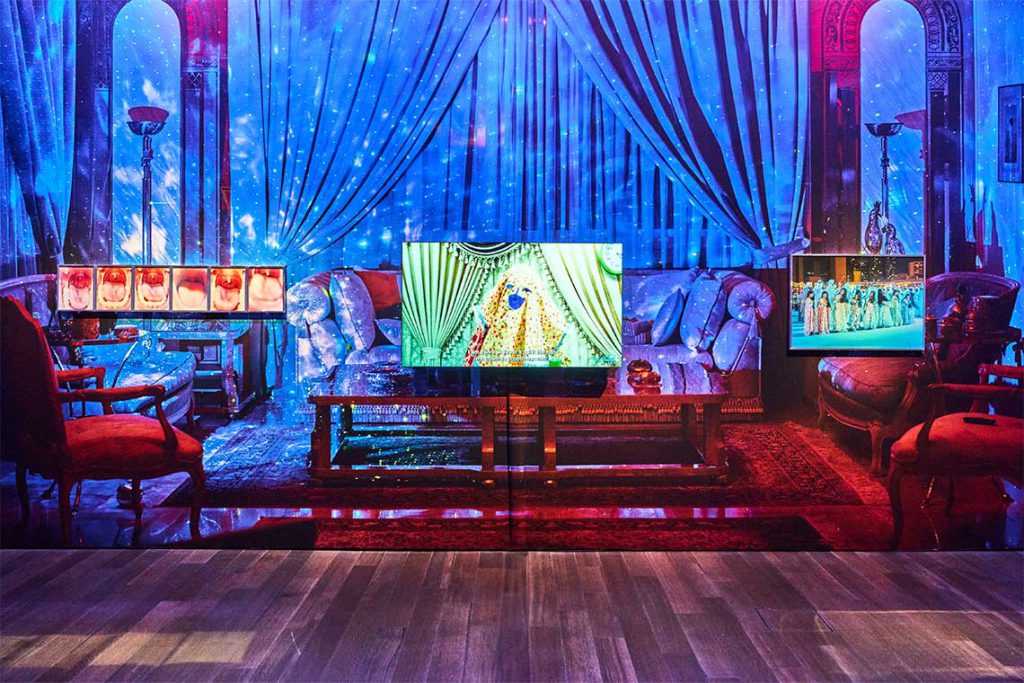
More video works abound elsewhere in the space. Next to Spiral (2016), a pulsing black-and-white belly dance-off by artist Sophie Al-Maria and musician Fatima Al Qadiri, Farah Al Qasimi’s uncanny horror-comedy Um Al Naar (Mother of Fire) (2019) provides unexpected comic relief. Following the story of a fictitious jinn who has grown weary of modern day lifestyle in the Emirates, the video pieces together real footage of exorcisms, trance dances and humorous pseudo-interviews with the bedsheet-clad jinn herself. The exhibition’s moving-image folly culminates in Meriem Bennani’s big screen Party of the CAPS (2018–19), a speculative reality show taking place at an island refugee camp featuring a holographic crocodile, teleportation and a wild Moroccan birthday party. The whacky screen crossover between migration politics, biotech utopia and choppy internet aesthetics overshadows the ultimate work in the exhibition: Maryam Yousif’s oversized cassette sculpture Juliana Jendo Vol. 2, Ishtar Records, Chicago, IL (2025) pays tribute to the titular Assyrian singer. Sitting in silence and monumental form near the exit, it presents a curious final outlier in the context of the show.
If Rave into the Future means to propose a thought experiment on collective diasporic explorations of movement, joy and resilience, its artists seem to be dancing out of step. Where some works highlight rich narratives celebrating the bizarre, the marginal and the audacious, others fall flat of the exhibition’s exultant and subversive ambitions. Germinating ideas on unruly, ecstatic joy are also undercut by the constrictions of the numeric “Stages” guiding through the exhibition. Yet, Rave offers meaningful throughlines to distant but harmonising histories driven by sound, whether from Kulthum’s melodic resonance with diasporic heritage, solidified nostalgia for music icons like Jeno or the live-streamed manifestations of popular dance culture. After all, a collective Reverie might only really be possible on the dance floor – or in one’s bedroom – with the bass carrying sound waves all the way from a Boiler Room in London, or Istanbul, or Marrakesh.
