

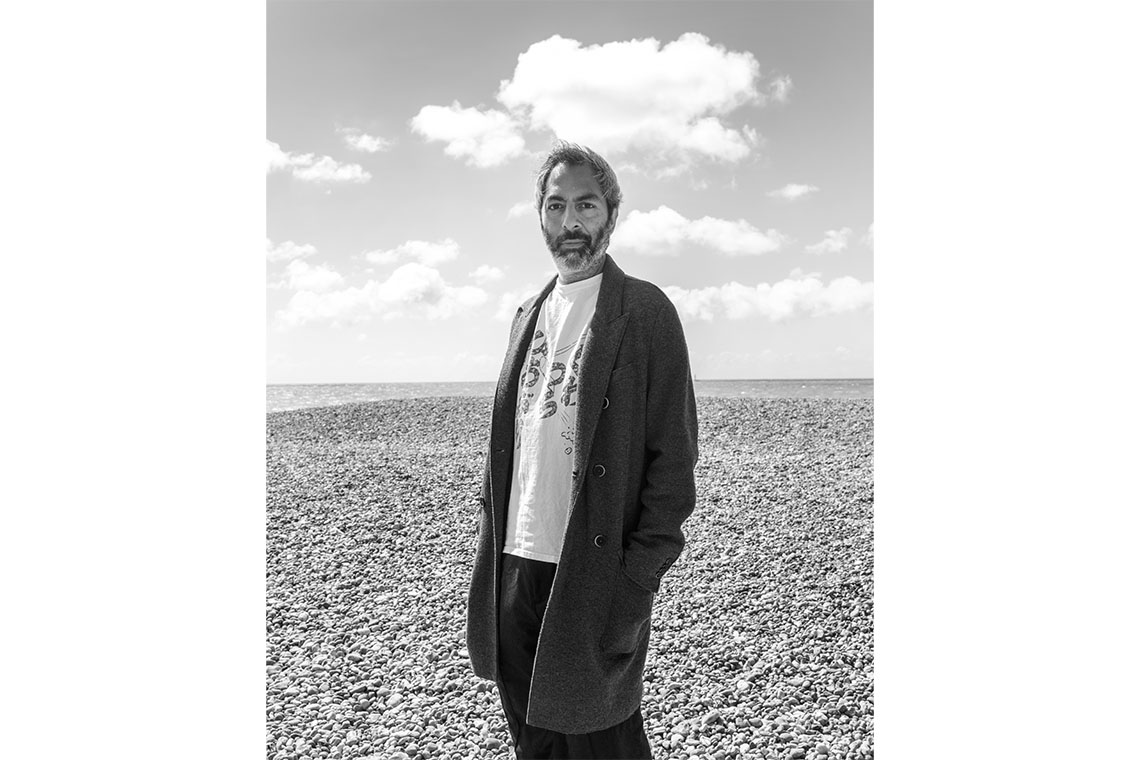
The artist speaks about his upcoming retrospective exhibition at the Cultural Foundation Abu Dhabi while giving a glimpse into another future project in the region.
Canvas: What have been the key themes and inspirations during your career?
Shezad Dawood: I remember getting told off during my studies for not being able to stick to one discipline. But for me, how these disciplines connect and influence each other is the most exciting thing about being an artist. A key aspect of my practice has always been the basic relationship between the frame in both film and painting and I do a lot of research and work across painting, textiles, ceramics, film and digital media.
I’m fascinated by modernist architecture in the Global South and the global social and political forces behind how we construct, imagine and inhabit it. I also have a very deep passion for marine ecology. One of my most powerful memories is going to the beach at night in Karachi, where I lived as a child, and hiding behind the rocks, shivering because of the cold, until the giant sea turtles came up and laid their eggs on the shore. That deep connection with the cycles of life and time is at the heart of my practice, underlined by the theme of transcendence. To me, art reveals the unseen and that fresh, childlike ability to be transformed, to have our consciousness expanded.
How do these key threads meet in your mid-career retrospective at the Cultural Foundation in Abu Dhabi, which opens in March?
The Cultural Foundation is one of the earliest cultural centres in the Gulf, which really resonated with me. I always want my work to be in dialogue with local histories and narratives. My grandfather was actually based in the UAE for many years, so I have family and cultural connections to the Gulf, despite doing my studies in the UK. It is also the most amazing example of what happens to modernism when it goes global. It’s where the Bauhaus meets Arab Islamic vernacular in the most dynamic way, late Walter Gropius in collaboration with Hisham Al Ashkouri, an Iraqi architect. This dialogue with the space became a guiding principle for how the curator Jessica Cerasi and I went forward with the exhibition design. I was interested in elevating the show to engage audiences, while also encouraging them to walk around the building, seeing it from different angles and reactivating a building that’s been used by so many generations.
What are some of the standout pieces in the exhibition?
Jessica wanted to focus on the last 15 years of my work while making a key feature of my painting practice, which she felt had been overlooked. There’s something quite generative about a moment to pause and look back. As artists, we’re often more focused on what we want to do next. In addition to my paintings, some smaller ceramics, video and film, we’re also restaging one of the key digital installations that was first exhibited at WIELS in Brussels in 2023. Called Night in the Garden of Love: Digital Seed Banks, it’s one of the most complex and yet greatest successes of my career. At the Cultural Foundation, it will comprise several hangings in the atrium as well as seven screens, each driven by a musical instrument and featuring a digital plant species adapted from my drawings. The project is based on about eight years of research I did on the late African American composer polymath, Yusef Lateef. Each sound piece is extracted from a two-hour musical symphony based on his musical method, recorded with musicians who had previously collaborated with him.
Will there be any new or previously unseen work in the exhibition?
We will present the final two episodes of my Leviathan Cycle series, which began in 2017 in Venice. It’s a 10-episode film cycle that goes around the world, imagining a climate future several decades from now and with each film informed by collaborations with local scientists, marine ecologists, writers and philosophers. The ninth episode is set in South Korea and looks at AI and hybridity based on cutting-edge research into the use of marine species in combating human ageing. The tenth and final episode, probably the most personal to date, is a commission by the Cultural Foundation. In it, I return to the Karachi of my childhood, to the ancient Sufi crocodile shrine of Manghopir, where I used to play as a boy and to Mubarak fishing village outside of Karachi, imagining a cybernetic cyborg future inflected by the region’s particular marine ecology and cultural specificity with the author Bina Shah, who collaborated on the script.
What does the title of the exhibition, Skin of Dreams, signify?
The Skin of Dreams is a metaphor for this relationship between painting and the moving image. It’s very important for me that a painting doesn’t become a static object. The title is taken from a Raymond Queneau novel. One of the key works in the show is called Through Pierced Flesh and Skin of Dreams, which is in the Guggenheim Abu Dhabi’s collection. Through Pierced Flesh and Skin of Dreams was the first time I took my painted textiles off the wall for my solo show at Parasol unit in London in 2015, encouraged by the curator Ziba Ardalan. The imagery in the five textile panels relates to everything from choreography and anthropology to cinema and personal family recollections. It is a very powerful work in terms of breaking open my practice and reference base.
Your practice also extends to large-scale outdoor installations, such as the Doha Modern Playground work in Qatar. Do you have any plans to take your practice further in this direction?
Doha Modern Playground really tells a story of modern architecture in Doha as a form of nation building, a sort of imaginary of self. This public commission and my retrospective speak to context, to audiences, to communities, which is very important to me. Even today it’s still so popular with families, which just makes my heart sing, actually. We’re actually working on a new commission for another corner of Al Masrah Park. It’s based on an unrealised architectural project by Arata Isozaki for the National Library in Doha that we wanted to commemorate, particularly in the wake of his passing. It’s another play object, a children’s carousel entitled Isozaki Carousel, which will be launched during Art Basel Doha.
