

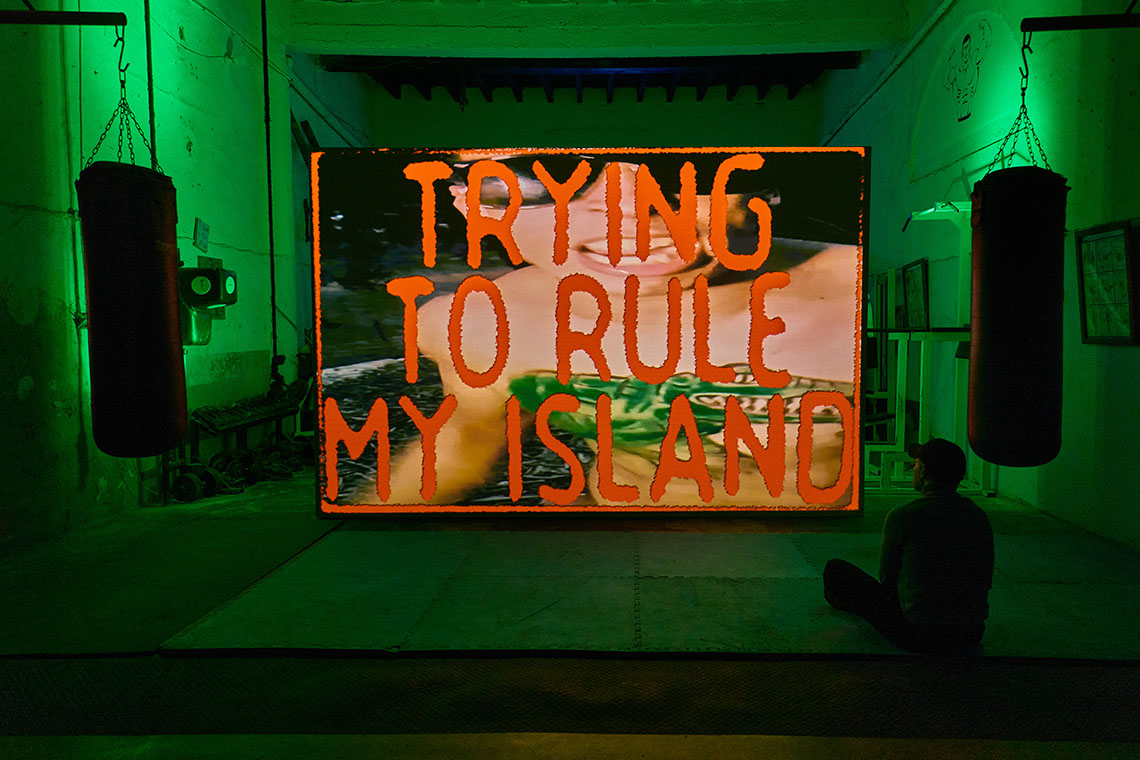
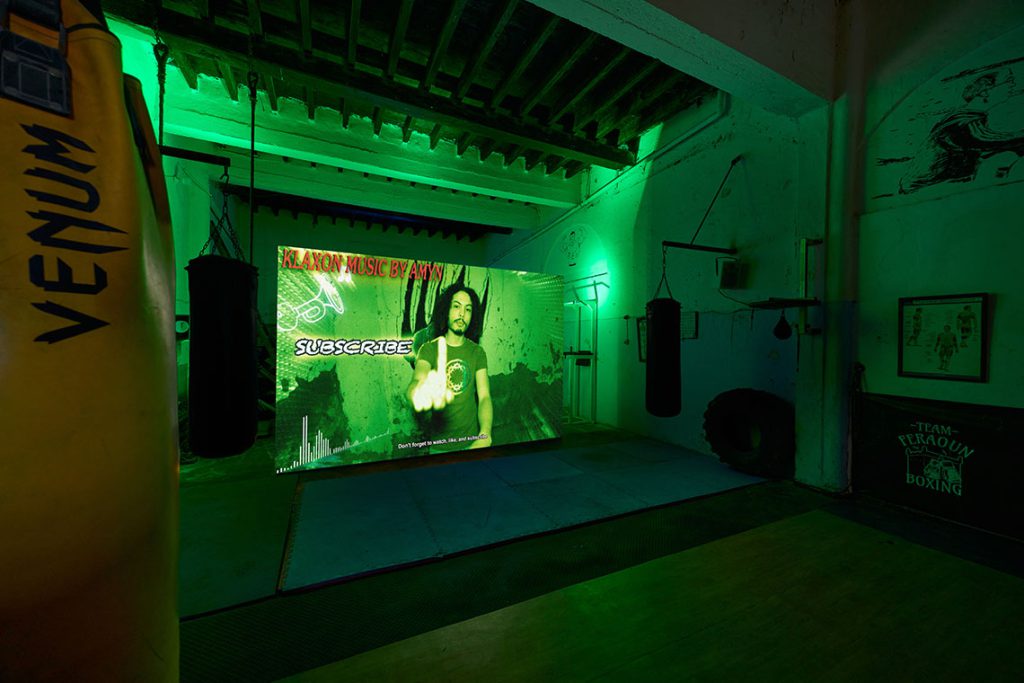
Installed inside an active boxing gym in Essaouira, Life on the CAPS Trilogy by Meriem Bennani unfolds as a porous encounter between fiction and lived space.
There are places that resist the neutralising impulse of contemporary exhibition-making. In Essaouira, inside a boxing gym that continues to host daily training sessions, Meriem Bennani’s Life on the CAPS Trilogy unfolds not as an isolated artwork but as a disturbance: subtle, porous, and unresolved. The Atlantic air seeps into the images, the sounds of the city linger, and the bodies that inhabit the space refuse to disappear. What Bennani stages here is less an exhibition than a condition: a friction between fiction and lived reality.
The artist’s first solo exhibition in Morocco marks a symbolic return, though one carefully stripped of nostalgia. CAPS – the fictional island at the heart of Bennani’s acclaimed science-fiction trilogy – was never conceived as a homeland. It is a non-place, an in-between, a site of forced confinement where migrants intercepted for illegal teleportation develop hybrid cultures and improvised forms of resistance. As the artist notes, “CAPS itself is a project of non-place. It’s about the in-betweens, but it’s deeply rooted in Moroccan culture.”
This rootedness does not stem from explanation but from continuity. Long before the language of contemporary art, Bennani grew up drawing, observing, absorbing images – television, cartoons, family stories, everyday gestures – without yet naming them as material. There was no moment of revelation, no sudden decision to ‘become’ an artist. “I was always making art,” she says simply. What followed was not a rupture but an extension: a practice that kept expanding, from drawing to moving images, from writing to filmmaking, carrying fragments of lived experience rather than fixed narratives.
The choice of venue is central to the work’s critical force. Installed in one of the oldest boxing gyms in the country, still active throughout the exhibition, Life on the CAPS Trilogy refuses the protective rituals of the white cube. “Spaces come with rules,” explains the artist, whose work moves fluently between speculation and lived experience. “Every space carries a history and a category of behaviours. Art is always treated in a very specific way”. The gym, by contrast, operates according to a different logic – one of discipline, repetition, bodily effort and catharsis. Here, the artwork relinquishes authority.
The coexistence is carefully negotiated. Boxers continue to train; the videos are shown when the space allows. Yet disruption remains inevitable. “It’s still disruptive, and that’s what I was interested in observing because no one is going to bullshit you in that kind of space,” Bennani remarks. In such a setting, the work is no longer protected by institutional codes. It must hold its ground.
Visually, the exhibition thrives on collision. Reality television, documentary footage, animated avatars, music video aesthetics and smartphone images coexist in a deliberately unstable mix. The artist has described this strategy as a form of “hyperactivity of genre”, reflecting the fractured condition of contemporary mediation. Rather than resolving these visual languages into coherence, the work amplifies their contradictions, producing a world that feels at once familiar and estranged.
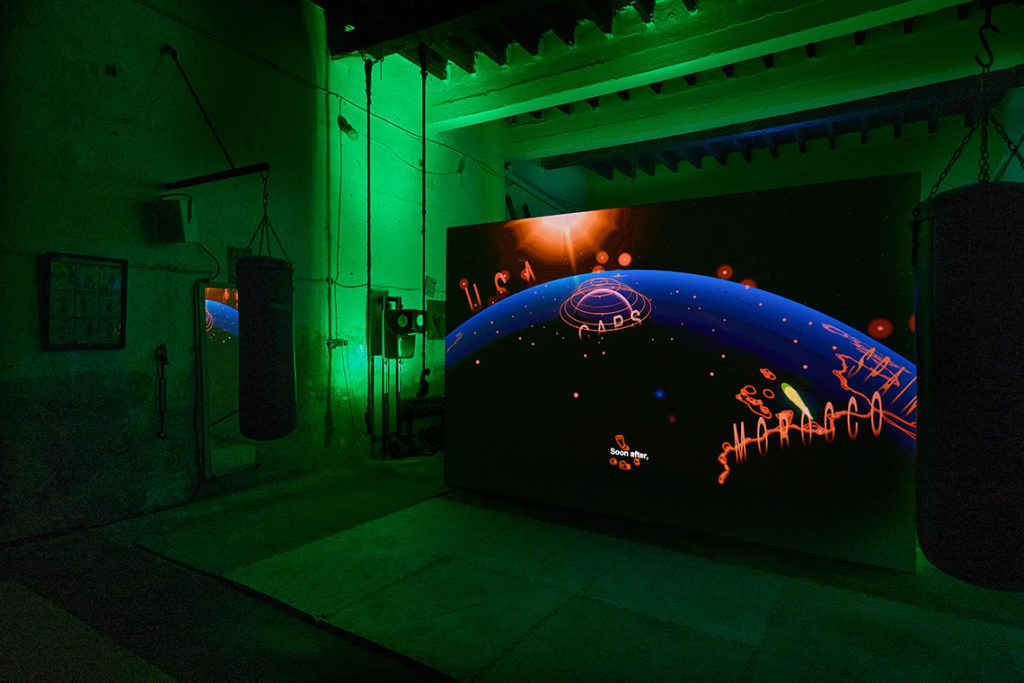
Some sequences were filmed in Essaouira, further complicating the boundary between fiction and geography. CAPS may be imaginary, but it unfolds here in a port city historically shaped by Atlantic circulations of goods, people and memory. The proximity to real migration routes subtly reorients the work, without anchoring it to a single narrative. “I don’t want my work to explain my culture. I want anyone to be able to see it and feel that there’s something they can take from it,” Bennani insists.
This refusal of explanation is central. While Moroccan audiences may recognise gestures, rhythms or tonalities invisible elsewhere, the artist resists framing this reception as a definitive decoding. For Bennani, meaning is never fixed. “Anything only has meaning because people give it meaning. Meaning is fully realised when it comes into contact with someone’s subjectivity,” she affirms.
At the level of production, the exhibition reflects a similar openness. Developed by NG, the platform founded by Samy Ghiyati and Nicolas Nahab, the project embraces permeability rather than enclosure. Events surrounding the exhibition are open, free and unfiltered, allowing artists, boxers, local residents and visiting art-world professionals to occupy the same space without hierarchy. “In certain contexts, galleries or museums might seem too elitist or foreign. Our intention is to choose spaces that are embedded in the local community,” says Ghiyati.
Ultimately, Life on the CAPS Trilogy in Essaouira is less about arrival than about exposure. Exposure to bodies that train and sweat in the same space. Exposure to viewers who do not necessarily share the codes of contemporary art. Exposure, finally, to the instability of meaning itself. By refusing closure, the New York-based Moroccan artist opens a political space that is neither didactic nor detached, one where fiction does not escape reality, but rubs against it, insistently.
