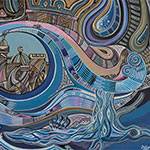

The Visual Arts Commission is pleased to announce Bedayat: Beginnings of Saudi Art Movement—a seminal exhibition that celebrates and documents the formative years of Saudi Arabia’s art scene and the emergence of a pioneering generation of artists between the 1960s and 1980s. The exhibition will be on view from 27 January through 11 April 2026 at the National Museum of Saudi Arabia, Riyadh.
Bedayat: Beginnings of Saudi Art Movement traces the evolution of artistic practices in the Kingdom, as shaped by the cultural, social and economic transformations that began in the mid-twentieth century.
Extensive research initiated by the Visual Arts Commission—encompassing more than 80 site visits as well as 120 comprehensive artist reports and recordings from 50 interviews—informs the exhibition. Developed with an advisory team that includes Abdulrahman Alsuliman, Dr Muhammed Alrusais and Dr Charbel Dagher, the research draws on academic expertise alongside firsthand accounts from artists and key figures of the period to capture early exhibition history, educational activity, and the locally-rooted language of expression that emerged during these decades.
Curated by Qaswra Hafez, the exhibition spans painting, sculpture, works on paper and diverse archival materials—many exhibited publicly for the first time. Focusing on the pivotal decades of the 1960s through 1980s, it charts how practitioners of this generation engaged Saudi Arabia’s deep-rooted heritage while participating in international artistic exchange. Developing distinctive visual languages that brought modernist currents into dialogue with local contexts, they established cultural institutions and artist networks via grassroots initiatives alongside public and private patronage and support for the visual arts.
Presented at the National Museum of Saudi Arabia in the historic Al Murabba’a district the exhibition brings together the work of key figures across three decades, highlighting a pivotal period in which modern and abstract artistic practices emerged within the Kingdom.
Bedayat: Beginnings of Saudi Art Movement is structured in three parts, each charting the thematic and contextual development of the scene through archival material and artworks. The opening section, The Foundation of the Modern Art Movement in Saudi Arabia, studies the emergence of the visual arts scene in the interplay between individual initiative and state support. Currents of Modernity, the expansive central section, explores the artistic concerns that shaped Saudi artistic production, including influences of modern life and art movements mediated through local contexts. The final section, Modernist Pioneers, spotlights four artists—Mohammed Al-Saleem, Safeya Binzagr, Mounirah Mosly and Abdulhalim Radwi—who shaped the movement and were indispensable to the nascent scene.
Reflecting on the significance of the exhibition, Dina Amin, CEO of the Visual Arts Commission, stated: “We celebrate here the history of modern art in Saudi Arabia, and we are proud to foreground its rich legacy by honoring the pioneering figures as well as the public and private initiatives whose collective efforts shaped the art scene of this era. We hope this exhibition contributes to an enduring continuum, offering meaningful access to the depth and diversity of our visual arts history.”
Qaswra Hafez, curator of the exhibition, said: “Through Bedayat, we are presenting a comprehensive and research-driven account of Saudi modern art. Through archival study, pioneering artworks and firsthand narratives, we are preserving the foundations of our modern art movement for future generations. This project is both a tribute to our early artists and a lasting cultural legacy that will continue to inform and inspire audiences across the Kingdom and beyond.”
Bedayat: Beginnings of Saudi Art Movement forms part of The Visual Arts Commission’s broader efforts to archive and document Saudi visual culture, advancing the historical record and supporting ongoing research in the field. The exhibition will be followed by a comprehensive publication and an original documentary film, offering an in-depth perspective on the foundations of Saudi modern art and a long-lasting resource for the public and researchers. An extensive public program of talks, workshops and masterclasses will further explore key themes, including early art education, the role of pioneering teachers and institutions, and archival preservation practices.
Press release from The National Museum of Saudi Arabia, Riyadh
Image: Mirza Alsaleh. Ornaments. 1984. Acrylic. 79 × 140 cm. Image courtesy of the Museums Commission, KSA