

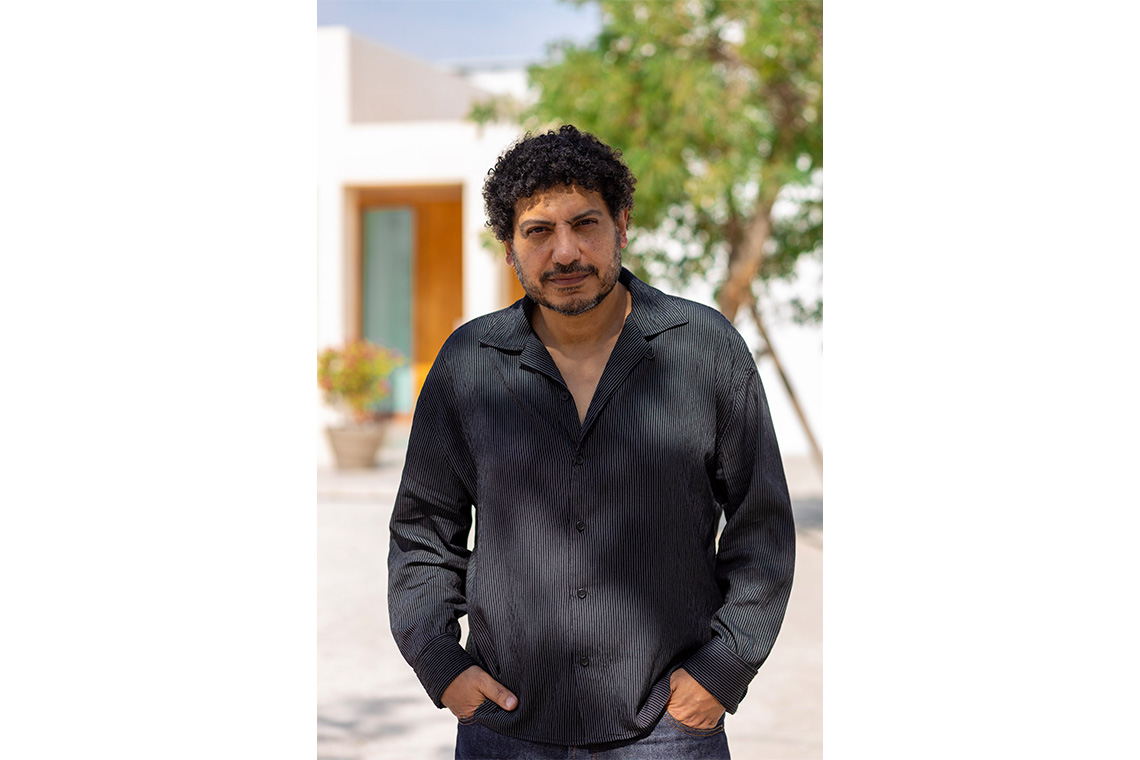
As a new Art Basel host, Qatar is further developing its reputation as a dynamic global art hub. We spoke to artist Wael Shawky, artistic director for the inaugural Art Basel Qatar, about his perspective on this first edition and beyond.
Sophie Kazan Makhlouf: The fair’s central theme is Becoming. What does the word mean to you and how do you expect it to guide the public experience of the artworks in Doha?
Wael Shawky: In general, the whole Gulf has a metaphor of this dream that people have for development. The idea that we want to evolve to a higher system, even if this is just a dream, not even real. From a nomadic and agricultural society to an urban one, taking on technology. The theme of Becoming is a metaphor for this dream of humanity to evolve to something higher, the idea that we can connect it to anything in our art. I hope that a lot of the presenters and the visitors will see that and live that experience.
Under your direction, Art Basel Qatar will abandon conventional booths in favour of an open-format, multi-venue layout. What risks and opportunities do you see in this departure, and how do you think your involvement will change the ways in which collectors, curators and the public will encounter art?
I am an artist from Egypt and as such, developed with a non-profit mentality. We do not have a professional art market, and most professional artists don’t like to get involved with art fairs. I feel my role here is to break the gap between the artistic creative process and the professional market. There is clearly a disconnect, in that it means that galleries are going to art fairs and presenting artwork that is out of its context.
So, you want to bring artists back to the art fair?
I’m not saying that artists should run art fairs! But I have loved being part of the first edition of Art Basel Qatar. My mission here – supporting each gallery in showing only one artist – has made it more artistic, and it’s certainly more conceptual. I think it is really interesting to try to keep this connection between the artist’s ideas, the world and the market. I don’t think an art fair should be the only place to sell art, it’s not an exhibition. It’s just one way of doing it.
Is this a way of changing how people think about art and artists in the region? Do you feel that by presenting perhaps fewer artists overall but more from the Middle East, North Africa and South Asia, that you will be helping their voices to be heard?
I would like to try to bring back the connection between artists and the market. We really need professional markets across this whole region. Of course, there is Art Dubai, and now Art Basel Qatar, and Frieze Abu Dhabi is coming up later this year. But we still don’t have enough professional galleries in the region. In this edition of Art Basel Qatar, we are making sure that there are lots of galleries from the region. For many of them, it’s the first time that they are participating in an Art Basel fair – that was also very important to me. I think the idea of having one presentation for each artist is also underlining the idea that it’s not just about the sales. It makes things clearer for the viewer and allows them to see each artist’s work in greater depth, which will be good for both the galleries and the artists.
The list of artists and galleries this year is fantastic! Let’s hope that all of this ends up working well, both artistically and commercially. The concept is very exciting and I’m extremely happy with this format for now. I think it will present an art fair that is more connected to both artists and audiences alike.
What about the programming? The main Basel Qatar fair is at M7 in Msheireb and Doha Design District, but there are also a lot of educational events and residencies going on in the city for artists and architects. Also, the Fire Station venue will be a platform for education and hands-on learning at the fair, for artists and artistic direction students from Qatar and around the world.
Yes, there will be many different performances and public events as part of the fair. The Fire Station is not part of Art Basel, but we have developed a whole programme to run alongside it. We have invited many international emerging artists and so are supporting collaboration and cultural cooperation. We are also creating a platform for intellectual discourse by hosting many curators, architects and philosophers to speak and to discuss with students and the wider public – this sort of connection between the art fair and the market is really needed. That is how we can convince a young person to make art his or her career, because many of them do not yet see it as a viable career path. This is really important in a country that is building such incredible infrastructure for museums. We need to fill all the gaps and I’m very optimistic about us doing that!
