
If memory and technique had a shape, how would it take form, unfold, endure, or collapse?
Curated by Taiwanese curators Tsou Ting and Wang Han-fang, Of Thread and Stone draws on New Taipei City’s textile and mining industries to reimagine a museum in progress. Bringing together objects, materials and artistic practices from different geographies and historical moments, the exhibition traces cultural narratives that echo one another while remaining distinct.
When a strand of thread and a piece of stone intertwine, the story of a century-old mining industry and a booming modern textile industry unfolds. Two seemingly parallel narratives intersect, at the mining pit and the factory, underground and aboveground, in the labor experiences of men and women, coalescing into a singular urban fabric and cultural memory. As the city grows, industries pivot, populations gather and disperse, fragments of stories linger, awaiting rediscovery.
Fusing traditional craft and contemporary art, Of Thread and Stone traverses imagery, literature, objects, archives, crafts, and artworks. As cultural relics, thread and stone are at once natural and industrial, sediments of time and space. From Neolithic spindle whorls and the hand-twisted ramie of Austronesian peoples, to pineapple leaf fiber of the colonial industrial era and denim garments from textile factories; from the improvised mine carts of Taiwan’s east coast and handwoven rattan mats of the Amis, to rubble from an ancient city along the Syrian border and an heirloom rug gifted by the Bedouins—these materials no longer betoken a single culture or place. Instead, they belong in an archaeological palimpsest of objects that unsettle the established order of history, craftsmanship, and labor.
These threads and stones also attest to disaster and resistance: the bundles of cotton that ignited a fire at a textile factory in Pakistan, gravel thrown from Lebanon at border military camps in Israel, inscribed stones from Taiwan’s east coast placed along Ketagalan Boulevard, and flags from social movements that once flew over the streets of Poland and Iran. The artistic narratives ensconced in these objects are anything but mainstream, yet they lend a lens through which to apprehend modernity and contemporary life.
“A part of something is for the foreseeable future going to be better than all of it. Fragments over wholes.” — Edward W. Said
When an exhibition serves as a site of discourse, display becomes the starting point of relationships. Through a curatorial prism detached from the grand narrative, a strand of colored thread, a small piece of gravel, these visual clues lead away from the genealogy of collecting and toward the traces of resistance left behind by colonial industry, labor, and local experience. Amidst the temporal dissonance of modern life, Of Thread and Stone excavates the light and shadow of contemporaneity.
With works by: Jam WU, Kieren KARRITPUL, Forensic Architecture, CHIU Chen-hung, KAO Ya-ting, CHEONG See-min, Akac ORAT, Slavs and Tatars, HUANG Po-chih, Rayyane TABET, jiandyin, Nii Nami.
Press release from New Taipei City Art Museum
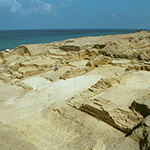
Image: Forensic Architecture. Living Archaeology in Gaza. Hellenistic Emporium. Image courtesy of the École Biblique, Mission Archéologique de Gaza: Coopération Franco-Palestinienne 1995-2005, p. 182-183