

Rays, Ripples, Residue looks back across more than a decade of art-making in the UAE, tracing the practices and structures that took shape before the country’s currently thriving institutional moment.
The UAE’s contemporary art landscape has travelled a considerable distance to arrive at its present state of creative and financial success. Abu Dhabi, Sharjah and Dubai sit firmly on the international cultural map today with their many major institutions, calendar of biennials, fairs and commissions, and ecosystem of galleries, foundations and artist-run spaces running year-round programmes. Yet this institutional density is relatively recent and much of its groundwork was laid decades earlier through self-organised efforts, staged in borrowed spaces and sustained through personal networks.
One of the first grassroots initiatives of its kind in the city, Abu Dhabi’s 421 Arts Campus came about a decade ago at a point when these informal modes of working were beginning to intersect more consistently with public support structures. It soon positioned itself as a space attentive to artistic process, experimentation and learning, and this year celebrates its anniversary with a milestone exhibition, Rays, Ripples, Residue. The show reflects on these shifts and evolutions through three, non-linear curatorial perspectives.
Munira Al Sayegh’s opening chapter, Leading to the Middle, speaks to the metaphoric “ripples” of the exhibition title by looking to the early “nuclei” that sparked creative momentum that still resonate today. She particularly centres individuals, spaces and publications that created shared conditions for creativity to take hold over this period.
Bait 15 is one such example of a “nucleus”. The independent institution founded in 2017 by Hashel Al Lamki, Afra Al Dhaheri and Maitha Abdalla turned an artist’s villa into a shared home for a growing creative community, later evolving to host studios, exhibitions and residencies. It also anchored Art Dubai’s inaugural UAE NOW section with the installation The Bed (2019) – recreated at 421 – which activated a domestic symbol of comfort and intimacy into a space for talks and performances.
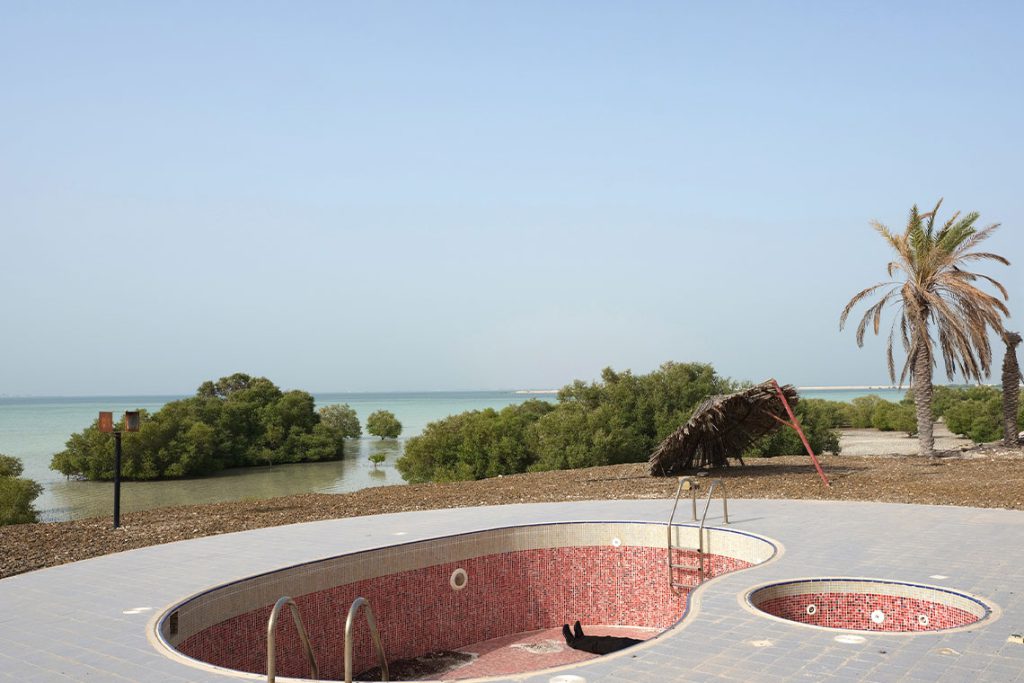
Alongside collective initiatives, Al Sayegh places equal emphasis on the formative role of individual mentorship. She identifies Tarek Al-Ghoussein as a key catalyst for this chapter, for the impact of his teaching and practice on a generation of UAE-based artists. His Odysseus series (2015–22) presents photographs of some of the 200+ islands that form part of Abu Dhabi’s geography, yet remain largely on the periphery of its cultural identity. Attentive to the psychological and political dimensions of space, the series approaches landscapes as mediators of spatial identity through inclusion or displacement – a way of thinking echoed nearby in Adele Bea Cipste’s drawings exploring the relationship between body and environment.
Nadine Khalil’s chapter, Ghosts of Arrival, moves the exhibition toward a more reflective register, shaped by her experience of arriving at the UAE’s art scene after many of its most experimental, artist-led moments had already taken shape. She takes this position as one from which to examine the structures that continue to shape the present, while glancing back through performance and partial restagings.
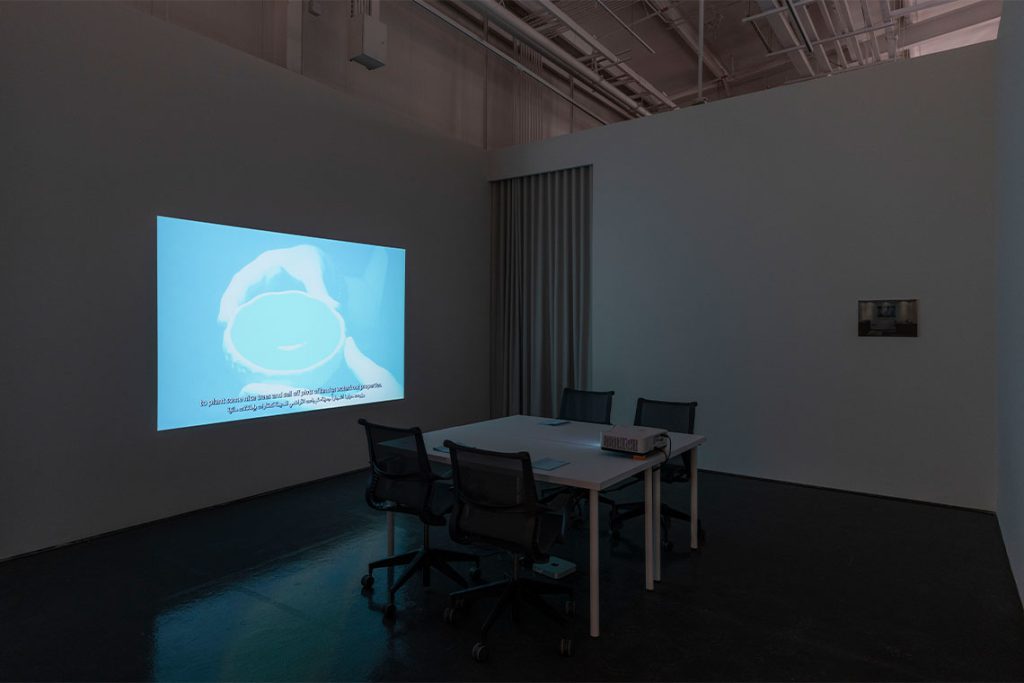
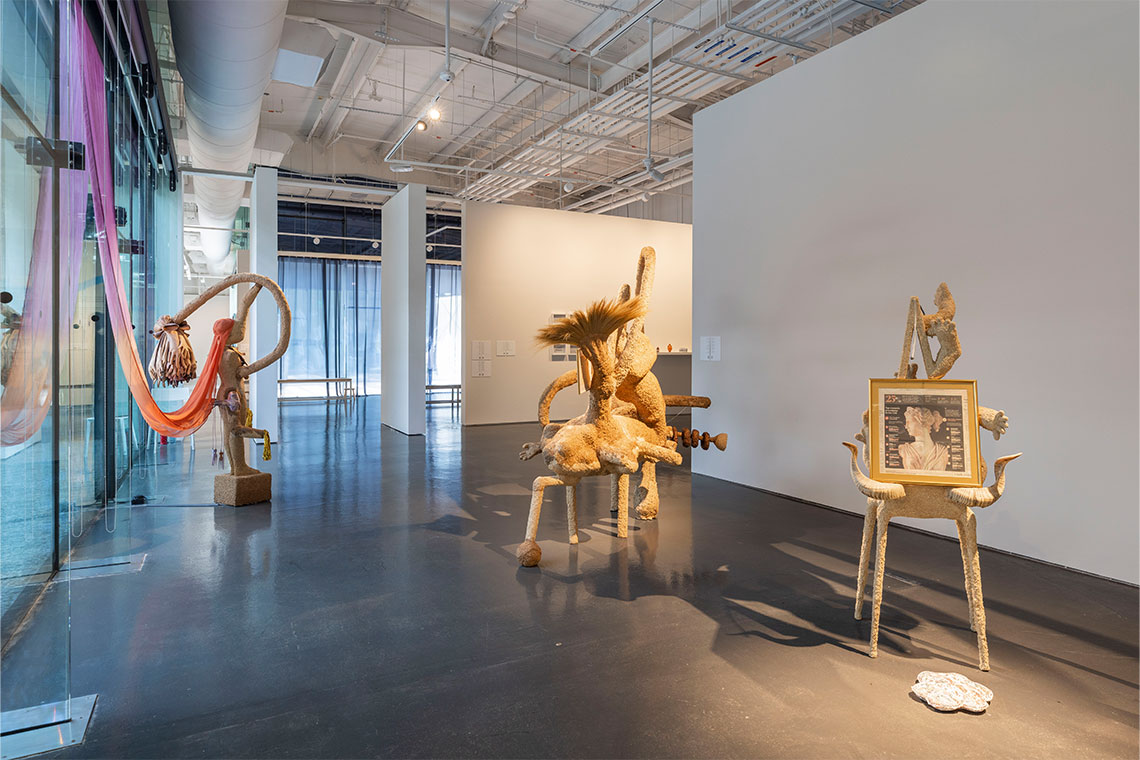
Hashel Al Lamki’s ongoing sculptural series (2016–) Space Is Holy is shaped from materials accumulated in and around his studio over several years, assembling fragments of packaging, discarded matter and residue from earlier processes into provisional forms. Shaped by continual reconfiguration, the works carry the sense of a practice in motion, attentive to what is left behind and how materials circulate after their initial purpose has passed. Elsewhere, Mona Ayyash and Nadine Ghandour’s Partial Sea View revisits Office Run (2025), a series of day-long exhibitions staged in rented office spaces across Dubai during 2018–19. Presented as a constructed workspace, it reflects on how artists once activated bureaucratic, non-art spaces to create visibility and encounter.
The concluding chapter, SUN™, curated by Murtaza Vali, turns to the ever-present solar element as a condition of life. Approached through image, data and material, the works expand the exhibition’s frame to encompass the environmental and economic systems that shape making. Across this chapter, questions of energy, consumption and sustainability surface alongside reflections on renewable technologies, exposing tensions within contemporary narratives of modernity.
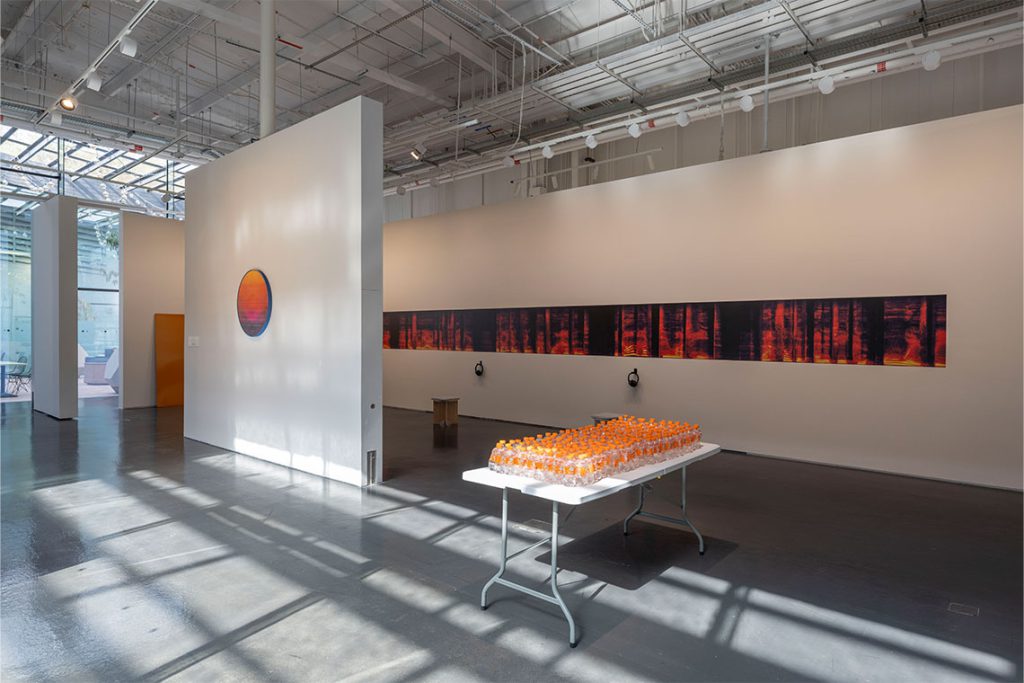
One of the most playful yet pointed perspectives appears in Liham Mula Sa Araw (Letters from the Sun) (2025) by Sa Tahanan Co., responding to Modesh, the yellow mascot of Dubai Summer Surprises, a shopping festival conceived to draw people into the city during its most inhospitable season. Returning to this detail and treating the sun as a branded promise, the work reflects on how symbols of happiness are mobilised to encourage consumption and shape national identity. Echoing this with a satirical register, Lantian Xie’s SUNSHINE (2018) lays out a table of expired bottles from a local, discontinued vitamin D–fortified water. The gesture points to the irony of packaging sunlight and marketing it as something to be consumed in a city with no shortage of the real thing.
Alongside, we also encounter the industrial connotations of the sun through sculptural forms. In High Noon (2016), Raja’a Khalid gives form to the UAE’s oft-unbearable heat with two steel panels coated in iridescent automotive paint, their surfaces glowing like molten fields under intense light. Pratchaya Phinthong’s We are lived by powers we pretend to understand (2024), meanwhile, renders solar panels as painted grids on polished granite, transforming a technology of futurity into something closer to a data field or artefact.
Across its three chapters, the retrospective remains attentive to the various ways in which artists have navigated shared conditions without framing the past decade through singular turning points. Its focus rests on the smaller pivots and provisional gestures, bringing into view an accumulation of the decisions, experiments and returns that shaped how art has been made and encountered. In holding these trajectories together, it opens a reflective pause within the UAE’s rapidly expanding cultural landscape, asking which ways of working might still matter in the years ahead.
