

The Diriyah Contemporary Art Biennale opened in January with works by 65 artists and more than 20 special commissions, presented under the title In Interludes and Transitions. Yet now, with the region plunged into conflict, reflecting on such concepts strikes a different chord from a few weeks ago.
Reflecting on transformation and movement in the current context of the world is an odd feeling. As I write this, the region is entangled in a war. Movements of jets, drones and missiles fill the skies, flightradar24 tracking in real-time, cancellations, repatriations and Reddit threads on how to cross the borders – an unsettling backdrop against which to contemplate and evaluate this year’s Diriyah Contemporary Art Biennale.
Curated by Nora Razian and Sabih Ahmed, the title In Interludes and Transitions references a preoccupation with transformation and movement, with the world in a state of constant change on both micro and macro levels, from humans and machines to sound and micro-organisms – whether we like it or not. With the new global situation, it brings up questions around what happens when movement stops, who decides, and what ensues when one rebels against change, whether societal, personal or environmental?
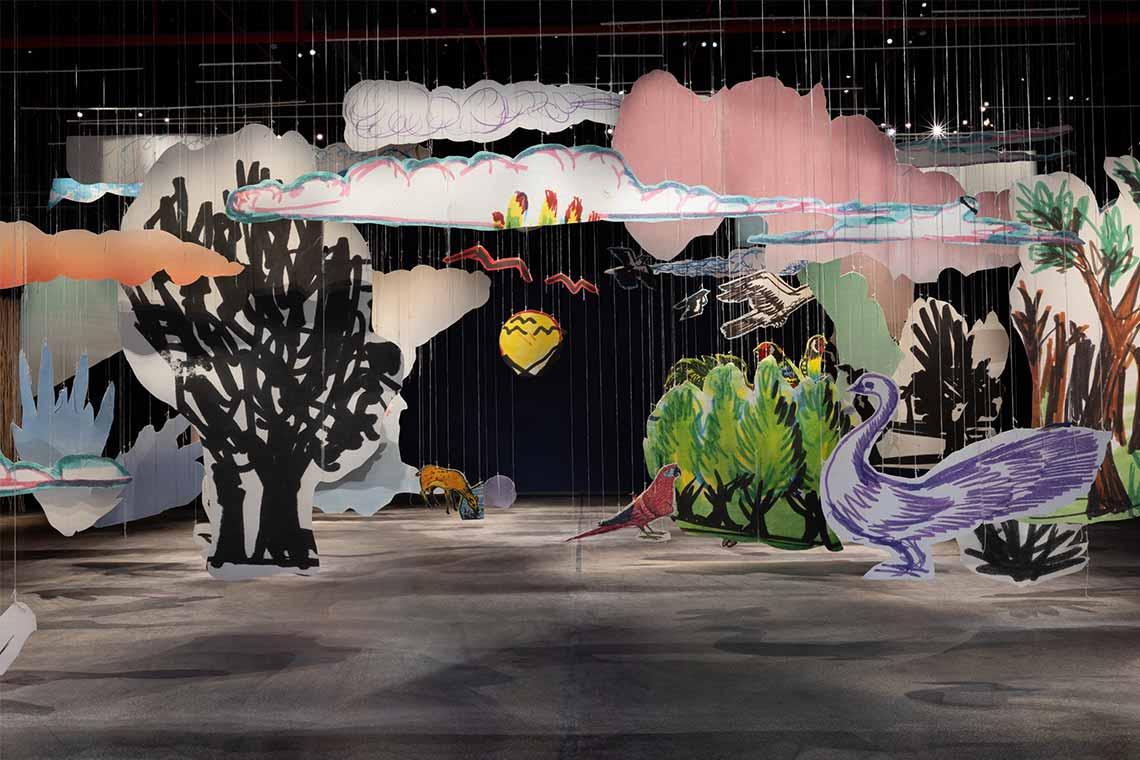
Petrit Halilaj’s immersive large-scale installation, Very volcanic over this green feather (2021), brings together lived realities of conflict and his imagination. Hanging almost as a part of a theatre set, layers of drawings on felt fill the space, which I felt created a heavy sensation despite their seemingly happy façade. These are drawings created by Halilaj when he was a 13-year-old living in Kukës II refugee camp in Albania during the Kosovo war of the late 1990s. Facing the entrance of the space are depictions of animals, birds and plants, while the reverse side of the installation unveils soldiers, destruction and the atrocities of war, navigating the fluidity of private and communal memories and experiences, and how those are expressed and shared.
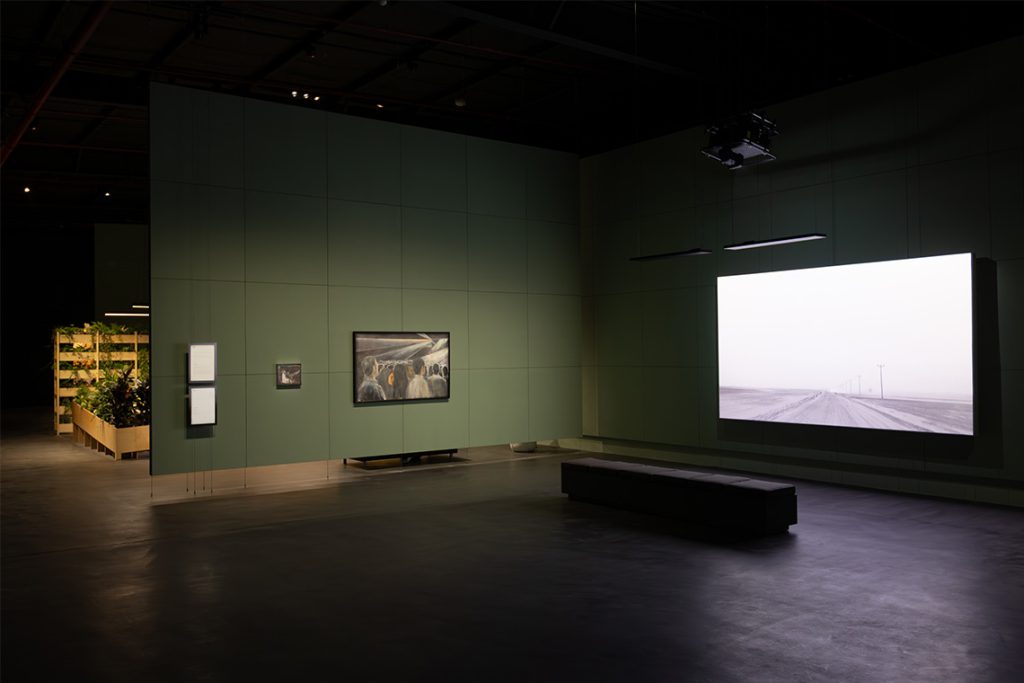
The Remnants series (2024–¬ongoing) by Taysir Batniji are oil paintings that also capture a moment in time, illustrating loading images, lagging and appearing blurred before their true forms are revealed. The series was initiated as Gaza faced continued Israeli attacks, with Batniji capturing news being shared and the delayed downloads due to internet network disruptions. The works exemplify a moment of pause and suspension in the movement of information, a shield and distance from reality – for just a moment – and the anticipation of the horrors that the image brings. It also highlights how events are shared, consumed and remembered between individuals and the collective.
Similarly, Abdelkarim Qassem’s work addresses fragmented memories. The artist spent time in the Saudi Arabian armed forces, which sent him to the border with Yemen for duty in 2009. Inspired by his service, his film installation The Final Scene (2017) was shot on his phone, capturing a grey-scale road, endless, empty and uncertain. The feeling of vastness is also felt in Lulua Alyahya’s Untitled (2026)new commission, with a face turned away from a crowd, alone yet sharing a space and a moment with a group. How many are feeling that sensation currently, contemplating the ambiguous horizon yet connected via WhatsApp groups and sending Instagram reels? Individuals sharing the uneasiness of the unknown future.
Occupying an entire warehouse in JAX, Ivana Franke’s commissioned Entanglement is a Fragile State (JAX Edition) (2026) simultaneously creates a sense of enormity and vulnerability. The disorientating installation toys with perception through the use of a singular light and aluminium ropes; I could not help but feel distracted like a small fry drawn to an anglerfish’s lure or a moth to flame. The sense is that of eerie insecurity as one silently contemplates, waits and shifts within the dark space, questioning how we might relate to others who inhabit the same void.
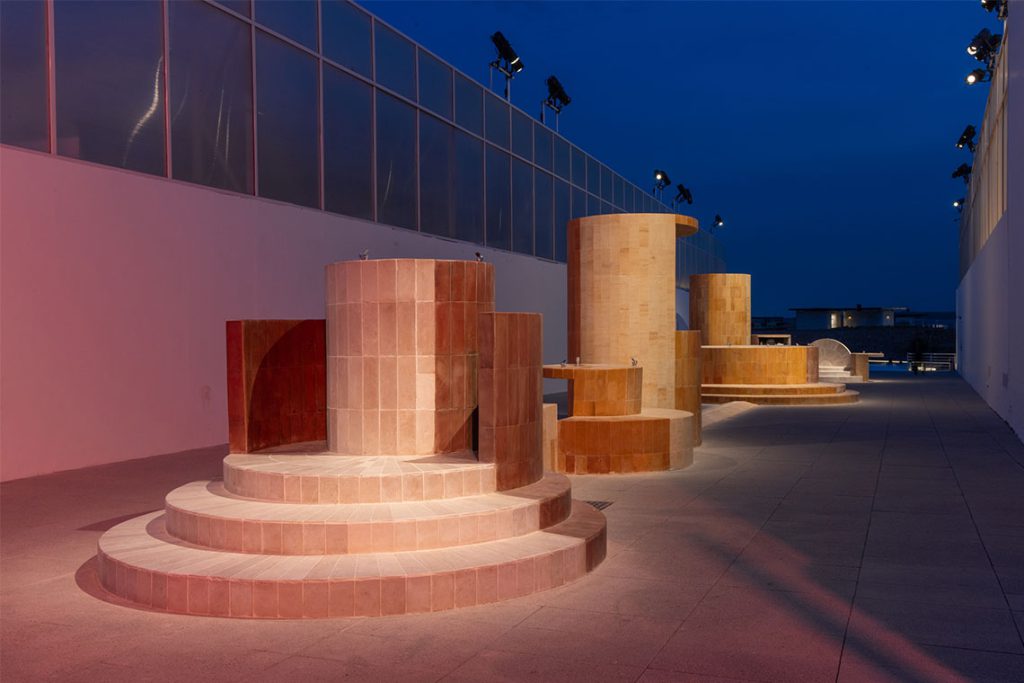
With Iran embroiled in flames after its oil facilities were targeted by the USA-Israeli strikes and with talk of the acid rain to follow and what happens when it leaches into the ground, the biennale’s focus on the links between movement and the environment seems uncannily timely. Agustina Woodgate’s The Source (2026), features site-specific drinking fountains that uncover systems of power and the politics of infrastructure. Woodgate’s ongoing series of public fountains calls to attention water availability and how the complexities and regulations of access impact daily life. The outdoor commission references the Al Ahsa oasis in the Eastern Province of Saudi Arabia, where traditional irrigation networks have been managed for centuries and engender collective responsibility in the distribution of water.
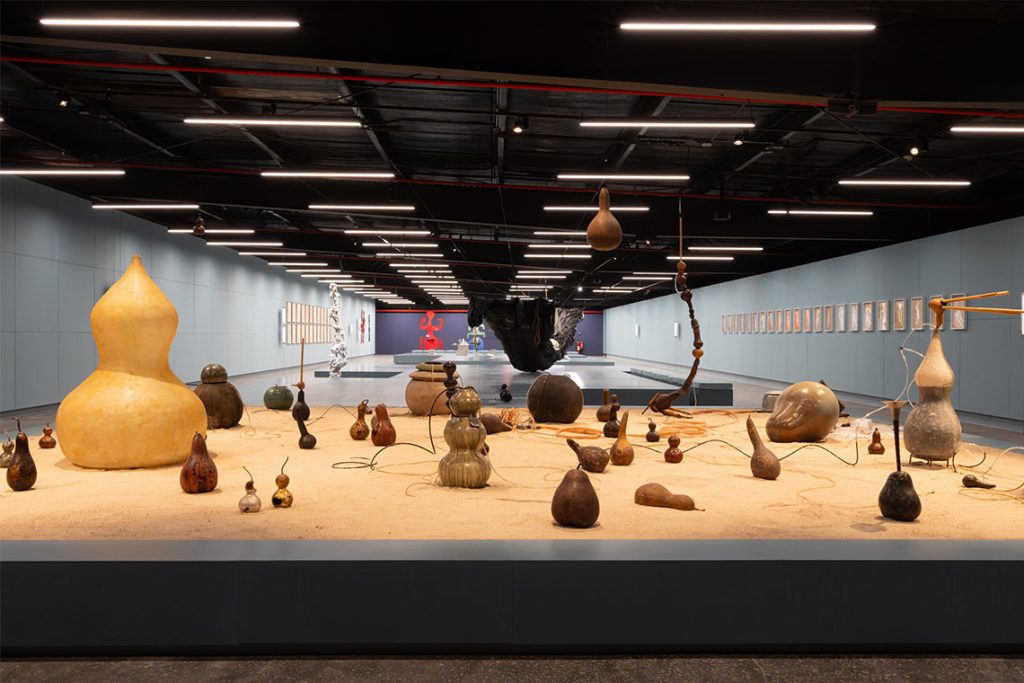
The imperative of community action also struck me when faced by The State of Absence…Voices from Outside (2020–ongoing) by Trương Công Tùng, a series of interconnected gourds, a sandbox garden linked via plastic tubes carrying water. The commission draws on the artist’s memories of coffee-producing villages in Vietnam, referencing the irrigation systems of the plantations. Some of the gourds bubble away, some overflow, others need to be filled, linked in a co-dependent relationship that questions what would happen if the ecosystem were disrupted.
Similarly highlighting the detrimental impact of how shifting power structures affect those on the peripheries, Echoes of the Earth (2026) by Daniel Otero Torres is a commissioned sculptural installation that continues the artist’s ongoing investigation into rural communities, communal resistance. The wooden frame of a house features sculptural elements, snakes, birds, hammocks and vessels filled with water, partnered with sounds of the rainforest. It is a tribute to environmental defenders around the world who have dedicated, and some who have lost, their lives in the pursuit of protecting others.
While transformations are inevitable, current regional conflicts have provided a new lens for thought. Through the vast geographies and contexts represented by the artists in this edition of the biennale, a space for reflection emerges in a world racked by uncertainty and disruption. They underline how this is not a world of isolated geographies and that, even as bystanders, we are implicated in the transformations that happen around us. While eyes, ears and attention are trained on skies and seas, awaiting uncertain changes in the future, the works in the exhibition serve as a quiet but powerful negotiation around transition on many levels.
