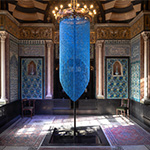

In Spring 2026, as a central part of Leighton House’s 100-year anniversary programme, the museum will present the first major exploration of its 19th century Arab Hall, one of London’s most iconic interiors, through three site-specific art installations, a specially commissioned short film, and an exhibition and new publication. Created by Victorian artist Frederic Leighton (1830-1896) following extensive travels across North Africa and the Middle East, the Arab Hall was conceived in 1881 as a spectacular extension to his Kensington studio-house. From 21 March to 13 May 2026, London-based Lebanese multidisciplinary artist Ramzi Mallat will present Atlas of An Entangled Gaze, a major new site-specific installation commissioned for the Arab Hall as part of Leighton House’s centenary.
Mallat debuts his first institutional commission in the United Kingdom while inaugurating the museum’s The Arab Hall: Past and Present programme, where three newly commissioned installations will offer contemporary perspectives on the Arab Hall, each engaging with its architecture, materials and layered histories. Atlas of An Entangled Gaze transforms the historic interior through a suspended canopy of thousands of luminous blue ceramic ‘eyes’, weaving together Levantine folklore, Islamic craft traditions, and the space’s architectural and symbolic language to create a contemporary meditation on perception, protection, and cultural transmission.
Mallat states: “This work functions as a threshold between histories, geographies and inherited legacies through the power of the gaze.”
Hovering above the Arab Hall’s fountain, Atlas of An Entangled Gaze draws on the Syriac evil eye charm as its primary visual and symbolic element. Mallat constructs the installation from thousands of glazed ceramic discs linked through chainmail-like techniques inspired by Medieval Ottoman Islamic helmets. The modular structure forms an elevated cylindrical mashrabiya that aligns with the Hall’s central dome while subtly echoing the grape motifs embedded within the surrounding Damascus tiles. Suspended overhead, the constellation of blue forms reflect and refract the room’s own luminous surfaces, entering into dialogue with the mosaics, tiles and water below.
Rooted in the geometric discipline of Islamic ornament and the communal role of the evil eye amulet across Syria and the Levant, the repeated charm becomes both shield and signal, at once safeguarding and destabilizing, Positioned above the fountain, the installation situates the gaze as the central locus of enquiry, invoking both the universal belief in the malevolent gaze and the myth of Narcissus. In doing so, Mallat establishes a visual and allegorical feedback loop between the Arab Hall and the adjoining Narcissus Hall, bridging cultural and temporal registers while highlighting Leighton’s longstanding fascination with Middle Eastern craft traditions.
Mallat expresses: “The evil eye is often dismissed as folklore, yet it speaks directly to pressing contemporary anxieties of visibility, protection and erasure. Through repetition and suspension, this work becomes an architecture of collective memory, a reminder that the act of looking is never neutral.”
Encountering Atlas of An Entangled Gaze as both a protective canopy and a network of watchful ‘eyes’, prompts reflection on visibility and vulnerability: who is being looked at, who is being protected, and how cultural symbols travel and transform across centuries. The visual interplay between the blue charms and the Arab Hall’s own Damascus tiles create a dialogue linking historical craft and living heritage.
The commissioned installation operates simultaneously as ornament, talisman, and sociopolitical commentary, bridging tangible artifact and intangible belief. Atlas of An Entangled Gaze carries layered cultural resonance, fusing Levantine imagery, Islamic traditions and European reflections. Its meaning not only emerges from the dialogue between these cultures but also from visitors’ exploration of the museum, intertwining personal experience with universality. The artwork is a convergence point for the museum’s many cultural lineages which merges traditional craftsmanship, hybridized histories, and contemporary expression.
Press release from Ramzi Mallat Studio and Leighton House
Image: Ramzi Mallat. Atlas of an Entangled Gaze. 2026. Installation view at Leighton House. Photography by Jaron James © RBKC