

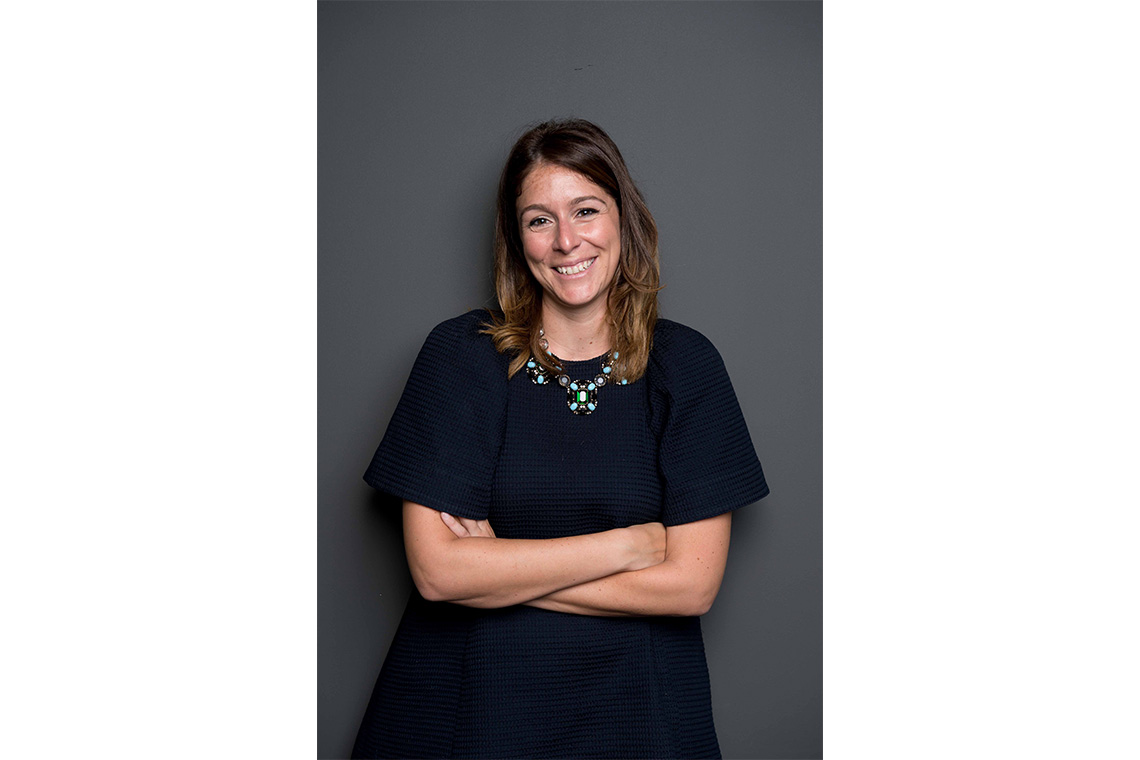
The executive director at Art Dubai Group provides an overview of the fair’s role over the years while also giving us a glimpse of what to expect for this year’s 20th anniversary edition and beyond.
Canvas: What does your role at Art Dubai Group entail?
Benedetta Ghione: As executive director, I am responsible for setting the strategic direction across all of Art Dubai Group’s art programming, working closely with fair director Dunja Gottweis and Alexie Glass-Kantor, our executive director, curatorial. This includes our annual Art Dubai Fair, as well as year-round initiatives across the public and private sectors aimed at building lasting infrastructure. A large part of my focus is ensuring that we move beyond annual cycles through long-term partnerships. At heart, however, my role is about protecting the qualities that have defined Art Dubai from the beginning, which are curiosity, independence and responsiveness. The fair has always evolved in dialogue with the city and the wider region. My hope is to lead the next chapter in a way that strengthens that instinct, remaining entrepreneurial and globally engaged while also continuing to champion artists and galleries from the region within a broader global conversation.
How has Art Dubai evolved over the years?
The fair began in 2007, under the patronage of His Highness Sheikh Mohammed bin Rashid Al Maktoum and with around 50 galleries participating, all at a time when Dubai’s cultural infrastructure was still very much in formation. What has shifted most noticeably since then is the confidence and a sense that artists, galleries and audiences are no longer passing through but actively building something longer lasting, and have been for over 20 years – as a company we are proud to play a part in that
New curatorial sections have been introduced over the years to create space for practices that did not fit within conventional frameworks, including the launch in 2022 of Art Dubai Digital, the first dedicated fair section focused on digital art. The Covid-19 pandemic clarified the need to think beyond the annual edition towards a year-round role in supporting local and regional art scenes. Throughout this evolution, Art Dubai has remained independent, which is central to its ability to adapt, take risks and build trust over time.
How has the fair played a key role in linking the regional art scene to the world?
From the outset, Art Dubai created the first consistent international meeting point for the Middle East within the global art calendar, positioning the region as an active contributor to contemporary discourse. One of the fair’s most important interventions has been to challenge the traditional West-centric art fair circuit by foregrounding Global South modernisms and contemporary practices, which historically have been underrepresented in global market narratives. At a market level, the fair has functioned as a bridge between regional galleries and international collectors, institutions and curators, enabling long-term exchange rather than episodic visibility. At a discursive level, initiatives such as the Global Art Forum have convened artists, thinkers and policymakers to help expand the role of the fair into critical dialogue.
With more and more art fairs taking place across the region, how does Art Dubai set itself apart?
For 20 years Art Dubai has developed its homegrown model in Dubai, working to support and build local ecosystems and infrastructure while also acting as a catalyst for the development and expansion of both the region’s art market and the art scene more broadly. Alongside the annual fair, we have developed extensive year-round programmes that support the region’s creative economy at multiple levels.
The fair maintains deep ties to local and regional cultural networks, forged over decades through collaborations, commissions and institutional and governmental partnerships. Art Dubai’s role within that environment remains on connecting regional practices with international conversations while contributing to a broader, mutually reinforcing ecosystem. As the region’s cultural landscape expands and matures, our commitment remains focused on context, community and the sustained development of the UAE’s cultural landscape.
This year’s edition marks 20 years of Art Dubai. Why is it such an important milestone?
This is both a reflective and forward-looking moment. In a city that is still relatively young in the broader history of global cultural capitals, sustaining an event of this scale and ambition over two decades carries particular significance. Art Dubai has grown alongside Dubai itself, becoming part of the city’s cultural fabric. The special edition taking place this May reflects both that history and the present moment. Bringing together around 75 presentations from galleries, institutions and partners across nearly 20 countries, with around 60 per cent drawn from the region, it foregrounds the galleries, artists and communities who have contributed to the region’s art scene over the last two decades. It includes new voices alongside galleries and collaborators who have been part of the fair since its earliest editions, reflecting our continuity and renewal. Current circumstances mean that this isn’t the edition we had originally planned to mark our 20 years, but in many ways it speaks even more directly to what makes Art Dubai what it is – the resilience of the UAE’s cultural scene, the power of collaboration, and the role of convening at a moment when that role feels more important than ever.
Across the programme, and particularly within the 20th anniversary edition of Global Art Forum (GAF), which has run alongside the fair since its earliest editions and brought together over 650 voices from across art, academia, technology and policy, the tone is intentionally reflective, considering the distance travelled while also asking what comes next. It is a transition point that celebrates the people, geographies and ideas that have shaped the last two decades, while setting the foundations for the next phase. Through Art Dubai Projects, our year-round cultural platform, we will continue to develop and support ongoing opportunities for learning and exchange.
What are the new additions this year in terms of the fair’s programming and structure?
This year’s edition has called for a degree of agility, prompting a shift towards a more focused format that builds on the core elements that have defined Art Dubai over the past two decades. The programme leans into the strength of the community around the fair, bringing together galleries, institutions and artists who have played a sustained role in the region’s cultural landscape.
The programme, led by Alexie Glass-Kantor, is framed by the guiding thread Things we do together, thinking about how artists, galleries, institutions and audiences come into relationship across the fair. We look forward to the institutional partner programme, developed in collaboration with the UAE’s leading cultural institutions, including Alserkal Avenue, Art Jameel, Barjeel Art Foundation, Dubai Collection and Sharjah Art Foundation. This brings different forms of practice into closer dialogue and shifts the balance of the fair toward a more connected field where commercial presentations, curated programming and institutional partnerships sit alongside one another. Complementing this is a programme of large-scale installations, new commissions and site-responsive artworks integrated across Madinat Jumeirah, with works by Khalid Al Banna, Hashel Al Lamki, Rashid Bin Shabib and Ahmed Bin Shabib, Rami Farook, Kevork Mourad, Yaw Owusu, Neda Razavipour and Sudarshan Shetty, reflecting our desire to think spatially and conceptually about how a fair can function.
This is joined by a performance-led programme with Sharjah Art Foundation and a moving image programme co-curated with Alserkal Avenue, screened at both venues. Alongside the curatorial work, this edition also marks the launch of an innovative risk-sharing model, whereby galleries’ booth costs are payable based on success.
What are your hopes for the future of Art Dubai?
I hope that we build on the groundwork of the past two decades with greater depth and long-term impact. The region’s cultural ecosystem is maturing quickly, and our responsibility now is to help strengthen that maturity in a thoughtful and sustainable way. The commercial energy of the fair is important, as it creates opportunity and momentum, but it must be balanced with intellectual seriousness and institutional responsibility. I see the future as being increasingly year-round, through education, commissioning, research and strategic partnerships, deepening our contribution to the ecosystem in ways that are cumulative.
