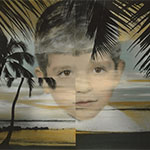

The Musée d’Orsay has played a prominent part in the body of work developed with a distinctive visual style by the Franco-Egyptian photographer-videographer Youssef Nabil (born in 1972) since the 1990s. When he visited France for the first time in 1992 and admired this museum’s collection, he found a source of inspiration that has been infusing his work for more than thirty years, as seen in his self-portrait The Dream (2021), in continuity with Le Rêve by Pierre Puvis de Chavannes.
The artist colours his works by hand to bring a nostalgic aesthetic back to life, nourished by archives and intimate narratives. His images question exile, identity and the desire to belong, often feeling melancholic while building a poetic, dreamlike universe blurring the lines between fiction and autobiography.
Nabil is the first living artist to exhibit in the Artists in North Africa rooms of paintings. This exhibition is the opportunity to place his films and photographic works in perspective with the Orientalist paintings that form, together with symbolism, the core of this aesthetic convergence.
The black and white silver prints, enhanced by Youssef Nabil’s use of an old hand-coloring technique, evoke the glorious, fantasised Egypt of his childhood, the artist’s birth country, and conjure up velvety-toned visual ambiences. His body of work, which borrows from the registers of dream and nostalgia, seeks to escape from questions of identity alone in order to embody an idealised, fantasised Mediterranean world without borders. In the artist’s eyes, Egypt is the setting for an accepted, sensual orientalism, with images that make fresh use of its codes: warm, bright colours bathing in a tranquil atmosphere composed of desires and dreams, depicting a free Orient, without prohibition or censure.
In addition to this orientalism, the aesthetics of his uncluttered settings, summoning up blues and whites and uniting them to produce effects of transparency, reflect the artist’s symbolist influences. The themes of exile, rebirth and dream are omnipresent in his work. The back postures in his faceless self-portraits are tinged with melancholy and have an air of mystery about them.
The exhibition title To Dream Again (De r.ver encore) highlights the central role of dreams in Youssef Nabil’s work, as well as in the Orientalist and Symbolist movements that inspire it. The selected quotation, drawn from Act III, Scene 2 of The Tempest by William Shakespeare, concludes the monologue of the character Caliban. This passage, which has become emblematic of Anglo-American literature, is attributed to this mixed-race and enslaved figure, often interpreted as a symbol of Indigenous populations in the Mediterranean colonized by Northern Europeans. Its lyricism is striking in contrast with the coarse language Caliban typically uses throughout the play. The scene is illustrated by Odilon Redon, whose iconic work Sleep of Caliban is featured in the exhibition.
Act III, Scene 2 of The Tempest by William Shakespeare
“Be not afeard; the isle is full of noises, Sounds and sweet airs, that give delight, and hurt not. Sometimes a thousand twangling instruments Will hum about mine ears; and sometime voices, That, if I then had waked after long sleep, Will make me sleep again: and then, in dreaming, The clouds methought would open, and show riches Ready to drop upon me; that, when I waked, I cried to dream again.”
Press release from Musée d’Orsay
Image: Youssef Nabil. Memory of a Happy Place. 2021. Colour silver gelatin print by hand. 26 x 39 cm
Collection Particulière © Youssef Nabil