

A collaboration between Hunna Art and Hayaty Diaries explores the emotional and cultural symbolism of hair in What Touches the Scalp is Close to the Bone.
“Hair is autobiography,” posits the exhibition text for What Touches the Scalp is Close to the Bone. “It is often the first thing we alter when something shifts with us.” Such a take is culturally widespread, popular within media targeting female audiences (as in ‘How My Long Hair Represents My Journey to Womanhood’, Teen Vogue, 2 May 2018) as well as in more generalist publications ( ‘A moment that changed me: I shaved off my hair’, The Guardian, 4 February 2026). Whether this involves cutting, growing, reshaping, balding, greying or refusing to remove body hair, every follicle is one to reinvent at best or to fret over at worst. Solange Knowles famously sang about the way in which perceptions of hair are problematised through a racial lens and are ultrasensitive universally: “Don’t touch my hair / When it’s the feelings I wear.”
The exhibition is a collaboration between Hunna Art in Kuwait and London-based nomadic gallery Hayaty Diaries. Both share a robust engagement with contemporary artists from the Middle East. Curated by Christina Shoucair, the show brings together ten creatives who highlight, some more literally than others, that “the scalp is not just another part of the body – it is the skin stretched directly over the architecture of the self”. The show focuses mostly on hair as a celebration of femininity, although a few artists allude to how expectations of femininity can create undue pressure.

The work of Yasmina Hilal provides one of the more inventive approaches. This Body Remembers, and Continues (2026) is a sculptural approach to the hair as filigree, with prayer beads and a hair locket. Portrait d’Identité 1976/2026 (2026) features a montage on semi-gloss paper in which sliced-up passport photos fan out a fractured being against velvet capishon and swirled copper wire ornamented with pearls. Hilal captures the prismatic – almost Cubist – rupture of a holistic self, hair being a principal component of that fracture.
Some artists show hair more classically, long and abundant, like the oil painting by Maliha Abidi of women plaiting each other’s hair in a circle, or the braids dripping off a woven canvas by Raya Kassisieh. But Mahsa Merci’s In and Out Is An Illusion (2024) alludes to hair as more forbidding and outlandish, in the form of spiky dark eyelashes ‘growing’ out of a white pump. Through this faux-organic germination on an inanimate accessory, the work poses questions of prescriptive femininity. Fake lashes and high heels are used to exaggerate, lengthening existing silhouettes of the eye and the leg respectively. Creating a hybrid between them, they become freakish and absurd, skewering codes ascribed to satisfy a male gaze.
Merci’s oil-on-wooden panel piece I Am Carrying You From My Childhood to Adulthood (2025) pivots from absurdism to a sense of mystery. It shows a blond woman, seen from the back with a short haircut and a longer wig or alternative haircut dangling from her left hand. The figure is set against a bleak grey landscape with the gentle burn of orange-lit horizon. Like Hilal, Merci creates a multiplicity of faces, presented here through plural line-drawn profiles, like a visual echo. That range of selves emphasises the diversification of who we could be – or who we feel we have to outwardly adapt to.
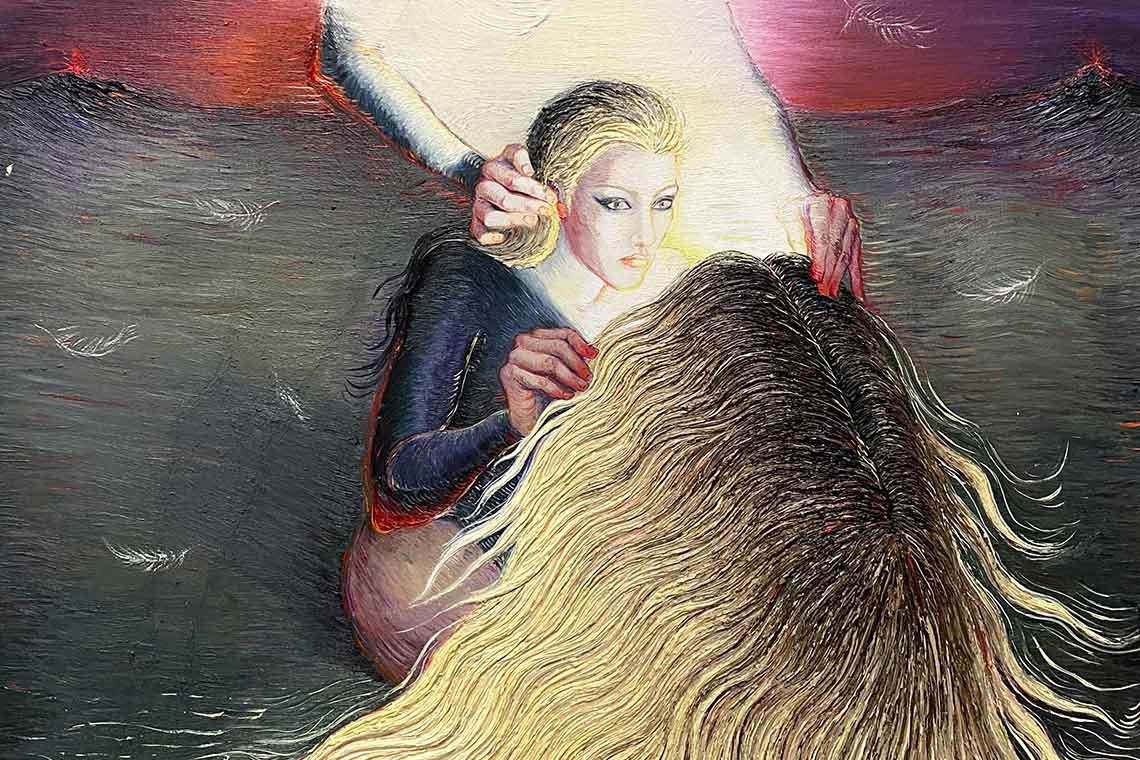
Another oil-on-wooden panel work by Merci, 1+1 Finding the Shape of the Violence (2025), shows a woman facing a hairpiece. Shown from the back, its dark roots splay into blond tresses. The front radiates light outward, like a portal to another world. The luminosity emanating from it is a strange cypher: Is it the light of epiphany? Is it the glow of something sinister? The warm pull of comfortable compliance?
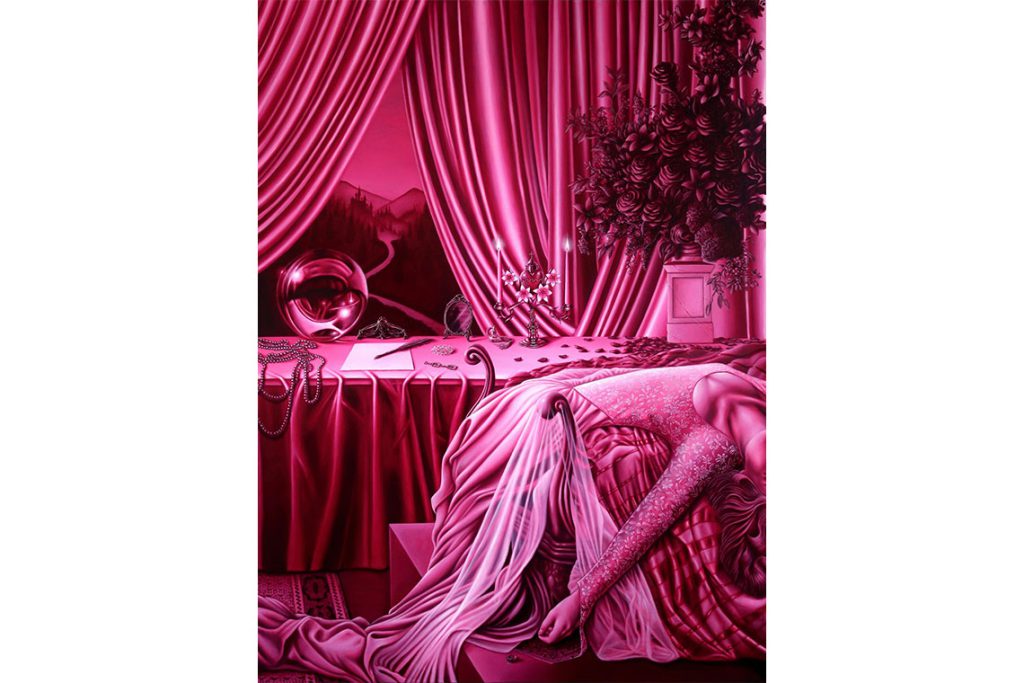
A similar sense of eeriness is evoked within a painting by Samo Shalaby. The Other Woman (2023) is a fluorescent pink scene in which a female figure seems to have fainted in the bottom right corner, her face unseen, her body pliable over a bed. Nearby is a table covered with flowers, lit candles, a crystal ball and a fresh sheet of paper next to a quill, behind which curtains block off most of the view onto a mountain scene. There is a Snow White sensibility to the ensemble: the drape of the woman’s skirts and the flow of her hair, token emblems of fetching femininity, are rendered vulnerable through her dormant position. The esoteric nature of the candles and crystal ball, especially in the pink light, evokes part magic fable, part lurid tableau.
As a theme, hair provides a fruitful angle into thinking through societal assumptions and gendered selfhood, even functioning as a potent material tool. What Touches the Scalp is Close to the Bone underlines how, rather than being as legible as we might like it to be, hair feels most potent when rendered peculiar, as a way to question normativity.
What Touches the Scalp is Close to the Bone runs until 10 June
