

Presented at venues spanning a monastery, Roman ruins and a former bathhouse, this year’s edition migrates between competing histories, landscapes and realities in the southeast of Türkiye.
Birds appear throughout this year’s Mardin Biennial in sculpture, film and poetry, evoking flight as a symbol of freedom and enquiry. Yet the exhibition’s true terrain lies not in the sky but in the deeper political and historical realities beneath the storied hilltop city.
SKYground, curated by Çelenk Bafra, maps these layers across the surrounding landscape, with artwork installed for the first time beyond the old city at venues that include a Syriac monastery and a Roman-era archaeological site. “The idea of a journey that begins with birds and the search for truth … becomes a way of showing Mardin’s different faces, structures, realities and ways of life,” said Bafra.
Now in its seventh edition, the Mardin Biennial has emerged as one of the country’s most distinct contemporary art events, despite interruptions caused by conflict in Türkiye’s southeast and in neighbouring Syria. Founded in 2010, the exhibition has helped decentralise art from Istanbul while engaging local practitioners in the broader contemporary art conversation. In a sign of its impact, more than 50 parallel events with 165 artists are also underway in Mardin.
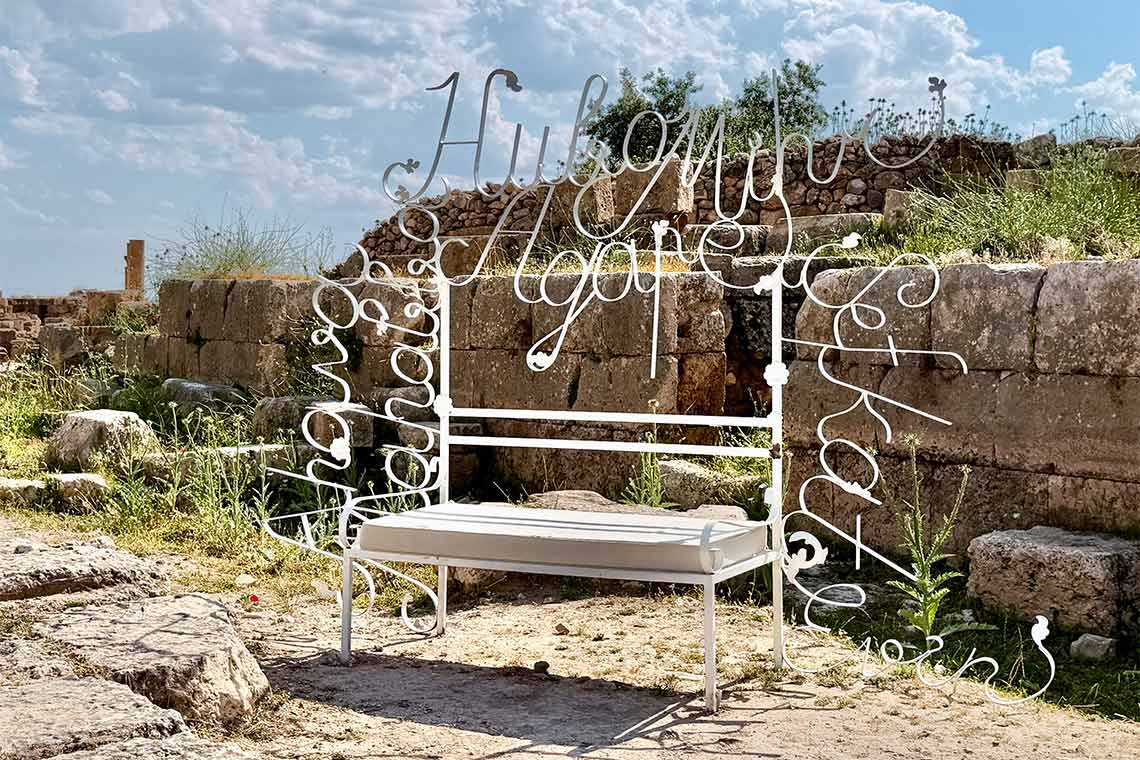
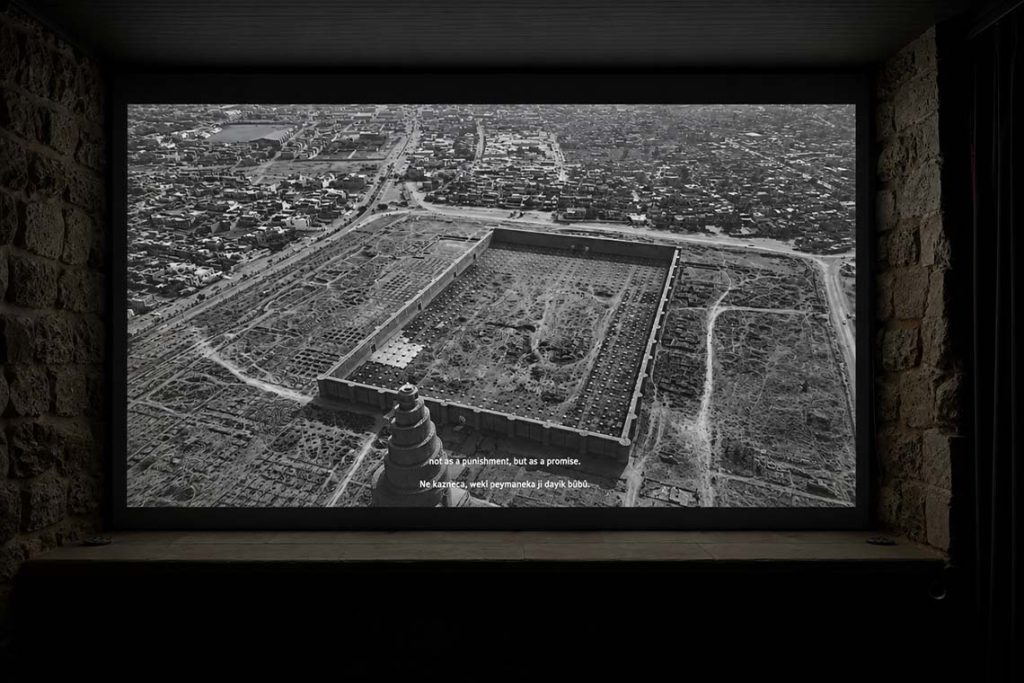
Under Bafra, who is artistic director at the Istanbul Museum of Modern Art, the biennial has drawn a strong international roster that includes Iraqi-Kurdish artist Hiwa K, showing his 2025 video You Won’t Feel a Thing on systems of control and violence; Šejla Kamerić, the Bosnian artist who leaves her forged metal Agape Bench (2026) as a gift to Mardin; and Chile’s Alfredo Jaar, whose lightbox What Need Is There to Weep Over Parts of Life? The Whole of It Calls for Tears (2018) is part of a presentation of the transnational Gaza Biennale. In all, 42 artists from Türkiye, the Middle East and beyond explore memory, displacement, heritage and belonging in the show.
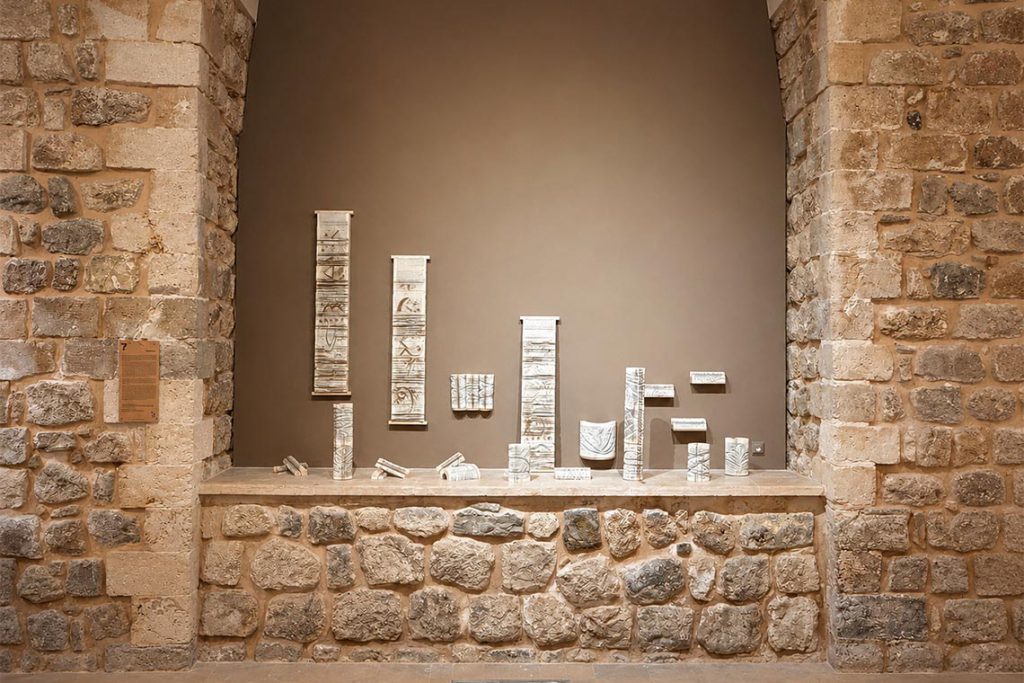
A relief from the Assyrian palace of Nimrud, destroyed by the Islamic State in Iraq in 2015, reappears in Mardin as part of Iraqi-American artist Michael Rakowitz’s The invisible enemy should not exist (2007-) series. Fashioned from Arab newspapers and packaging, the papier-mâché work from 2021 renders in black missing sections that were extracted over the centuries by Western museums. “The absence of the fragments that Mesopotamian communities have been forced to look through for almost 200 years [is] to make commitments for repair and return,” Rakowitz said in a performance at the opening.
Istanbul-based İrem Tok also gives form to absence in the newly commissioned What Remains (2026). Columns sculpted from the pages of encyclopaedias reference the fourth-century School of Nisibis, one of the world’s oldest centres of learning that once stood nearby but survives only in the historical record.
Filmed at a vast landfill site outside the region’s largest city of Diyarbakir, Mardin-born Erkan Özgen’s Broken Rhythm (2025) spotlights another kind of endangered heritage. The video pairs the percussion of women sorting through waste with dengbêjs, Kurdish storytellers who transmit collective memory through song, a folk tradition once suppressed by Turkish restrictions on the Kurdish language.
Birdsong accompanies the textile installation The Bird, the Thread and the Open Sea (2025), a reimagining of the twelfth-century Sufi poet Farid ud-Din Attar’s The Conference of Birds by Greek artist Esmeralda Kosmatopoulos, who works between Cairo and Paris. Diyarbakir-based Rozelin Akgün’s adjacent Seven Valleys (2026) alludes to the same allegory with biomaterial membranes tracing the spiritual journey.
The Birds Choose the Cards unfolds like a dreamlike poem about our age of cascading crises. Taking its title from a Taipei fortune teller whose caged birds select querents’ prophesies, Egyptian-born Basim Magdy’s 2024 film probes the interplay between fate and control amid “the realisation that we are extremely vulnerable and helpless in the face of wars, a pandemic and things that are so much bigger than us”, he said.
Yet the exhibition does not surrender to pessimism. “Art can be deeply critical while still preserving hope,” Bafra affirmed. “It can propose new possibilities and make us wonder what things might look like, if viewed from another angle.” Istanbul-born Erinç Seymen’s Wanderlust (2026), commissioned for the Mardin Biennial, injects dark humour into the iconography of the child ruler, using oversized postage stamps to expose the absurdity of the ruling class. Policemen in riot gear dance the tango in Spanish artist Carlos Aires’s response to state power in the 2016 video Sweet Dreams Are Made of This.
Guarding the gate of the fifth-century Deyrulzafaran Monastery are two snow leopards crafted from the timber of demolished Uzbek buildings for last year’s Bukhara Biennial by New York-based Vahap Avşar. Swarm Works (2025) contains a colony of honeybees so that one “endangered species houses another species that is also becoming extinct,” Avşar explained.
At the ruins of the Roman fortress city of Dara, Turkish collective Bi Acayip Hane recreated the constellation-like sculpture A Vision of Standing Cloud (2023) by the artist KITE, a member of the Oglála Lakȟóta nation. Time, memory and cultures also intersect in Turkish artist Alper Aydın’s System Failed (2026) in Dara’s cavernous cistern, where Armenians were held during a death march to the Syrian desert in the First World War. The monumental sculpture of a serpent swallowing an angel captures the moment of moral rupture.
The road from Dara winds past the Syrian border and military checkpoints to Kızıltepe, a dusty farming town of low-rise apartment blocks marked by four decades of fighting between the Turkish state and Kurdish militants. Avoided by tourists, it is fertile ground for politically engaged artists, including Mardin Biennial participants Hüseyin Aksoy and Mehmet Ali Boran.
Boran’s Diaspora (2026) emerges from interviews with Armenians, Kurds and Syriacs scattered across the world as ceramic plates arranged in the shape of the migratory crane. The work is housed in a disused hammam from the 1960s, reopened for the biennial. “In Kızıltepe, you don’t see the exotic, beautiful image of Mardin. You encounter the everyday realities of southeast Turkey,” Bafra said. “The biennial is a way of moving between them.”
Those everyday realities can still determine how art circulates in the region. Mardin artist Enver Basravi said he was informed that his Hypercustom Table (2010-26) – a photograph depicting men arranged in the shape of a table – was taken down from billboards and a building’s facade by “administrative order”. The work, which is not part of the official programme, conveys how inequality becomes normalised. A reason for its removal was not given, Basravi commented.
The 7th Mardin Biennial runs until 21 June
