

Two parallel exhibitions at Fondation H in Antananarivo spotlight Moroccan-Malagasy commonalities.
With two exhibitions by Moroccan talents on show this season, Madagascar’s Fondation H (FH) is delving into new readings of local culture through opposing yet complementary lenses. A solo show by Moroccan artist M’barek Bouhchichi sits in dialogue with a group show selected from FH’s collection, interpreted by Moroccan curator Abdellah Karroum. Bouhchichi’s work unpacks untold stories and craft legacies reinvented for the modern world, while Karroum’s show offers a regional snapshot of the political and social issues of today, explored through artworks from around the world.
“It’s very complementary. One is very much to talk about where we are as a foundation. the dialogue we want to build between artists and the public, and M’barek’s work is really about reowning our history and culture that colonial times erased,” FH founder Hassanein Hiridjee says. “Fondation H wants to build new experimentation, but particularly for me, we want to create shows that speak to the public.”
Curated by Hobisoa Raininoro, Bouhchichi’s Les Mains des Poètes stems from a six-week residency with Fondation H in 2025, which explored Malagasy artisanship and historic connections to the Arabic language. Leaning into Madagascar’s oral storytelling and poetry traditions, the exhibition expands on sorabe, an Arabic-Malagasy script developed in the fifteenth century by the Antemoro, a community from the south-east of the island. Brought to the island by Arab tradesmen, the Arabic script was adapted to the Malagasy language and used for a few centuries – also introducing paper, ink and documentation to an oral culture – until it was replaced by the Latin-based alphabet in 1823 by European colonists and missionaries.
To revive the script, Bouhchichi collaborated with Malagasy designer Domi Sanji to create Matsaraba, a contemporary typeface, which features on the new artworks in various ways. “When I discovered sorabe, I felt that this was one of the invisible parts of the culture,” Bouhchichi explained to Canvas. “Many times people draw the map of Africa and forget to include Madagascar. My artistic practice and research is all about communities and hidden heritage, but also about how things have changed and adapted, so this felt like a natural topic to look in to.”
A further goal was to think about the many hands involved historically, alongside the nuances and fragilities that emerge when constructing a language. “I worked with many craftsmen on the project,” he adds, “focusing on the materiality and function, because craft has always been practical and purposeful. If you remove this, you remove the soul of the object.”
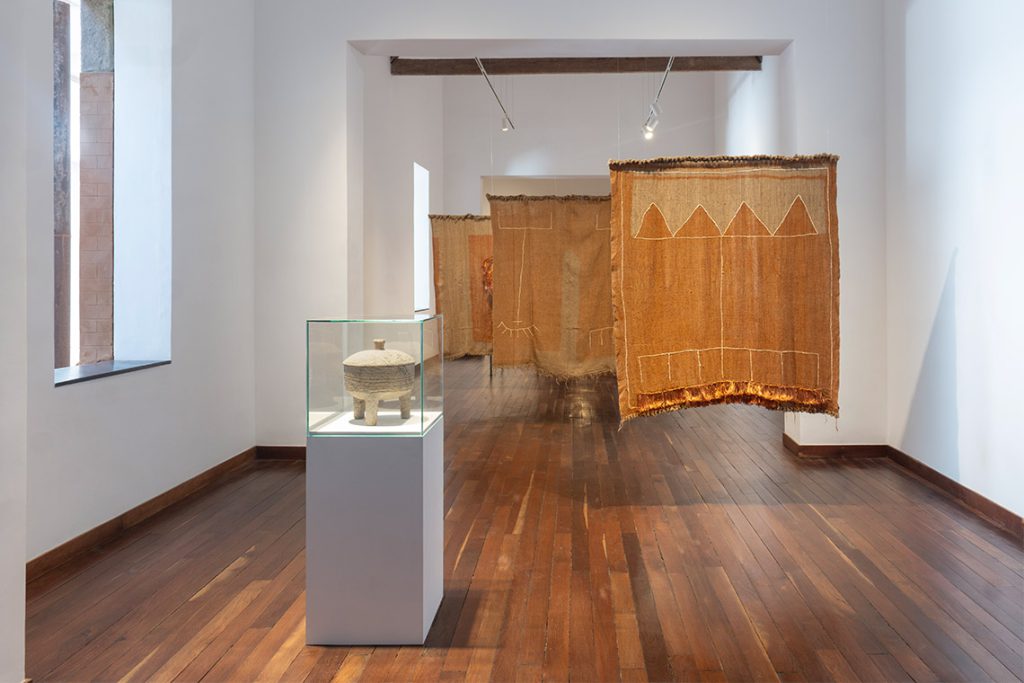
One the first works encountered by visitors to the show is Evidence Piece #1, Angraecum sesquipedale (2026), a replica of a traditional Malagasy cooking pot held in the collections of the Musée du quai Branly – Jacques Chirac in Paris. Rather than comment on repatriation, Bouhchichi rejects the idolising of such domestic artefacts removed from their original purpose, and instead argues that the craft knowledge used to make these ancient pots is still alive, ready to make new objects.
“We have the ability to make more of these, with our own hand,” he says. “In our cultures, we don’t have the concept of museums – they’re a very Western invention originally made to house ‘exotic’ objects, from the ‘savage or wild nations’ – a spectacle of our everyday culture.” He goes on to explain how labels were created to say “what is primitive, or artisanal craft, or sophisticated”, pointing out how “to our cultures, these are just everyday items which cease all meaning if they’re not used.” An installation next to the stone replica pot shows the same form crafted in various materials – clay, aluminium and ceramic – representing the local capacity to reproduce it endlessly and to reinterpret it for their own time.
Further in, a series of silk banners dyed in henna and embroidered with Malagasy symbols pays tribute to Queen Soazara, a little-known sovereign of Sakalava and who was the only monarch to retain her rule under French occupation. Bouhchichi purposely uses lamba – traditional Malagasy textiles woven in so‑called ‘wild’ silk – embroidered with traditional Malagasy tattoo motifs evoking the queen’s history, by Moroccan craftswoman Saadia Elouaziz. He combines both Malagasy and Moroccan craft techniques to create the striking textiles.
“I discovered that in the 1931 International Colonial Exhibition in Paris many of the texts labelled objects and crafts as sauvage. The insects producing this silk live freely, are not cultivated, so they call it sauvage or wild. To me, it’s only when they can’t master something that they call it sauvage,” Bouhchichi says. “This silk material is very symbolic in Madagascar, because it is used to wrap new-born babies, and also to wrap the dead when buried. It’s a material associated with care and with cyclic nature of life and death.”
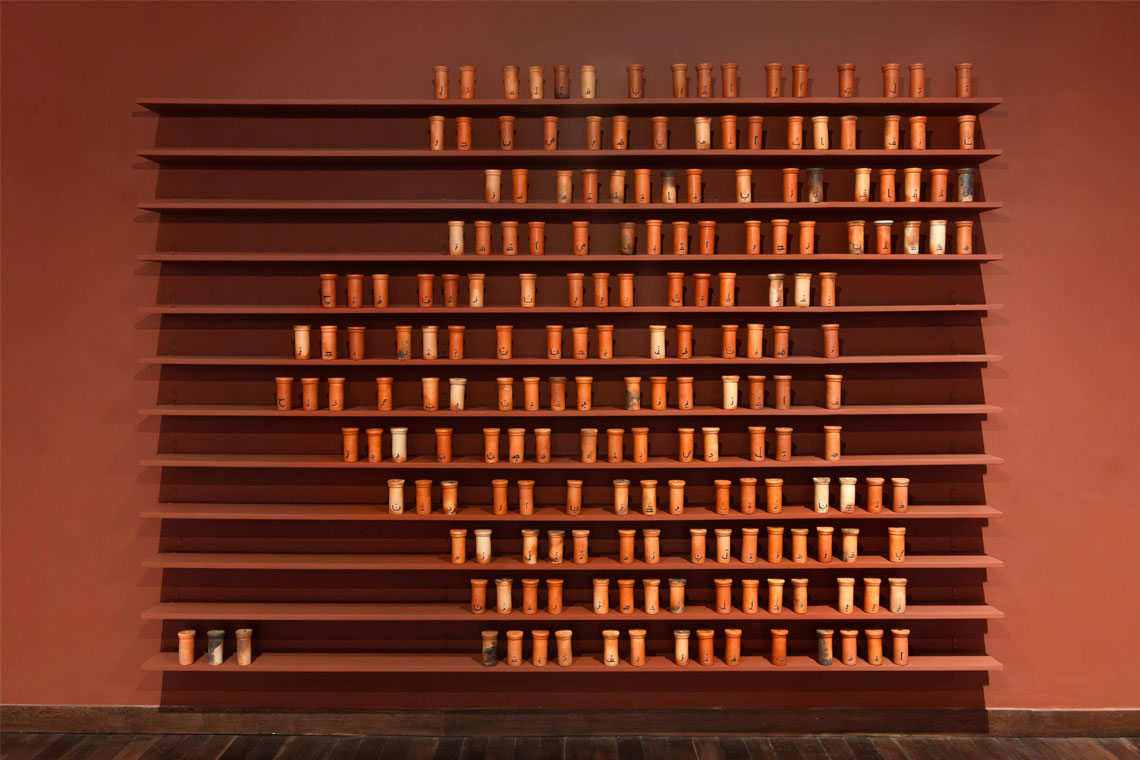
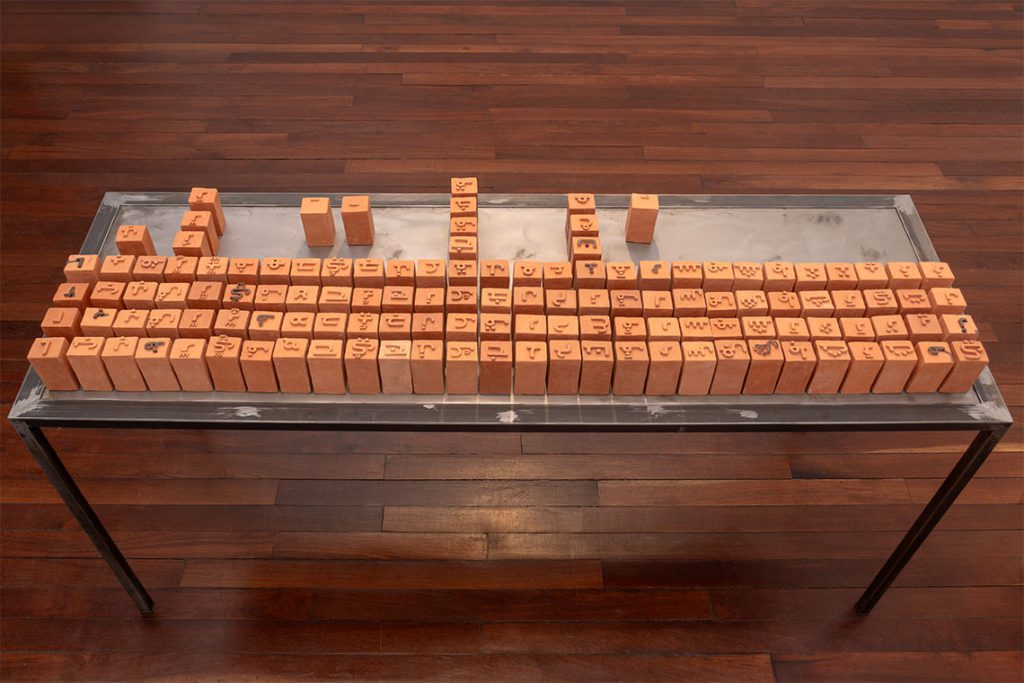
The final section in the exhibition includes The Earth Within Us (2026), a 127-clay brick alphabet using the custom Matsaraba typeface. These same bricks have been used like stamps to create I have another language, made from Antemoro paper and mangrove ink and noting fragments from Madagascar’s oral heritage – proverbs, words of wisdom and expressions of transmission – to physically document the knowledge that Madagascans have passed down through the generations. Bookcase #3 (2026) is made from 220 clay inkwells, each with a Matsaraba letter, spelling out a poem by Malagasy writer Randja Zanamihoatra, in which the clay itself becomes the vessel for language, rather than the ink.
Bouhchichi’s new work is full of symbolism and multi-layered meaning, truly delving deep into Malagasy culture and history to bring untold narratives to the forefront. His solo show acts as a natural follow up from Kabarin-javakanto: a reading of Collection Fondation H, which showcases over 50 artworks by 41 artists. Inspired by kabary, the ancestral Malagasy art of oration, the exhibition is conceived as an invitation to reflect on the role of art in contemporary societies. Artists such as Ahmed Mater, Ghada Amer, Mustapha Akrim and Manal AlDowayan showcase alongside Joël Andrianomearisoa, Troy Makaza and Otobong Nkanga.
“Kabary is the art of discourse, and is used as an introduction to many important events and celebrations, to present a topic or give information,” explains Karroum. “It’s very codified, has a specific structure and is usually presented by someone not related to the subject – a respected person in the community, or distant family member. I saw this reading of the collection as an introduction to the foundation and to the themes these artists are exploring, so the exhibition is structured in three parts, like a kabary.”
Nkanga presents two monumental 18-metre textile banners from the Cadence series (2025), whose designs depict diverse worlds, from the depths of the ocean all the way to outer space. The works touch on the importance of the bonds between humankind and the environment, in the face of global warming and the exploitation of Earth’s natural resources.
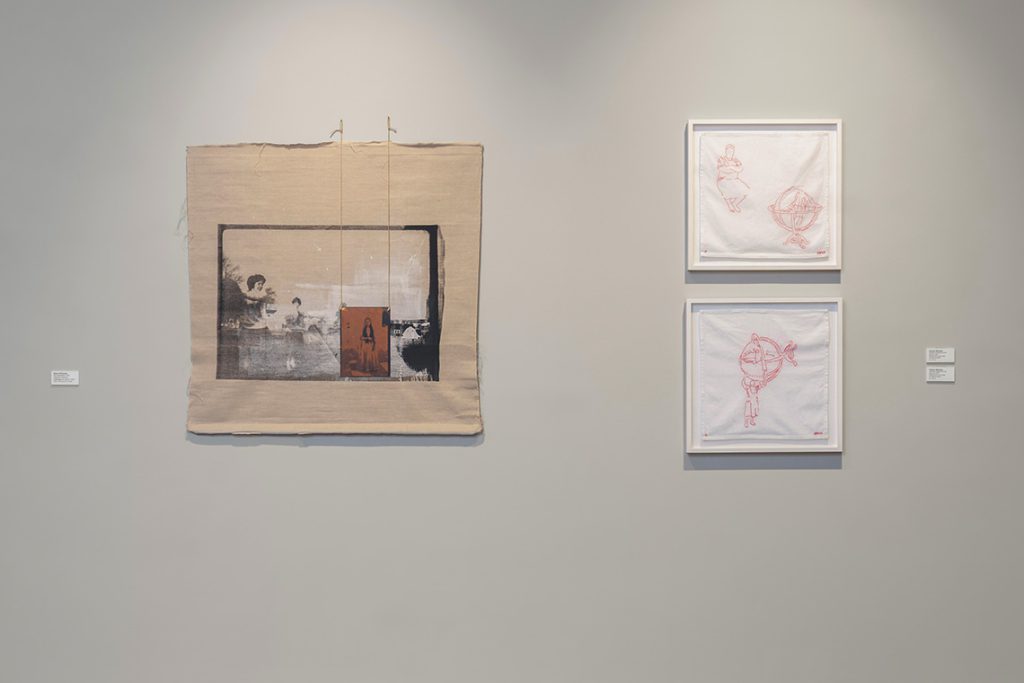
These colourful works sit in contrast to AlDowayan’s more monochrome pieces. The Cheerleaders (2015) shows a black-and-white image of young American women in cheerleading costumes – taken by the artist’s father whilst in the USA in the 1960s and 70s – overlaid with a sepia image of a female relative wearing a long dress, taken in Saudi Arabia at around the same time. The work juxtaposes two drastically different female experiences, both seen through the eyes of the artist’s father.
Regardless of which way round the two shows are experienced, both act as a form of cross-cultural exchange that engages the viewer’s curiosity. At their core, the exhibitions showcase the region as a vibrant crossroads where the past is continuously reshaped by the hands of the present, whether reclaiming sidelined heritage or redefining identity through artistic discourse.
Les Mains des Poètes and Kabarin-javakanto: a reading of Collection Fondation H run until 17 October
