

The artist representing the National Pavilion of Saudi Arabia at the Biennale speaks about preserving cultural heritage amid destruction through work that speaks to collective rather than individual histories.
For Dana Awartani, representing Saudi Arabia at the Biennale in Venice is a culmination of all that she has worked on in her artistic career thus far. She explains how the project is “a continuation of much of the research that I already do in my practice, looking at cultural destruction and preservation due to conflict and war, but on a much bigger, more ambitious scale.” Awartani has taken the opportunity to foreground not just her home country of Saudi Arabia but also the wider region, speaking to its abundance of cultural heritage that defies current geographical borders.
The path that led Awartani to communicate this cultural wealth through a craft-based artistic practice was not a straightforward one. The artist, raised in Jeddah but of mixed Palestinian and Syrian heritage, attended an international high school where a Western-centred art education prevailed, exemplified in the infamous still lifes of bowls of fruit that art students are typically made to paint. Awartani recalls feeling acutely disconnected from the aesthetics of her lived environment at this time, asking herself why her art classes did not also look to the culture and history of the region for reference.
Despite such reservations, art education would ultimately be where she would go to “understand her identity”. Following her mother’s determined prompting (Awartani jokingly refers to her as her “little dictator”), she found herself at Central Saint Martins in London, enrolled in an undergraduate degree in art and, later, a master’s course, despite growing doubts about the content of contemporary art education. In a serendipitous twist of fate, a family friend suggested a summer course at the former Prince’s School of Traditional Arts (now The School of Traditional Arts under The King’s Foundation) before her master’s course was due to begin. Discovering craft was a humbling experience, yet one that sharpened Awartani’s understanding of her nascent practice: “It made me feel that I’m not necessarily talking about myself, but about our region, which crafts are integral to.”
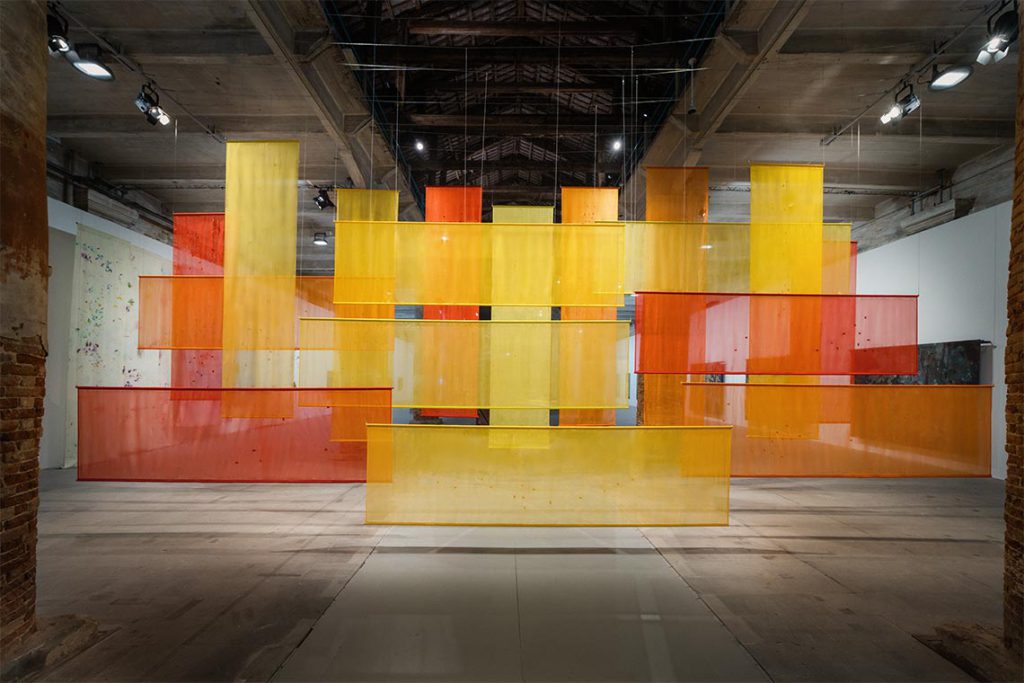
When asked how she feels representing Saudi Arabia at one of the world’s oldest global art events, Awartani explains that she views her participation as an opportunity to reflect on the rich cultural history of the wider region, particularly at a moment in time when cultural heritage has never been in such peril. She notes with sadness that when, two years ago, her large-scale fabric work Come, let me heal your wounds. Let me mend your broken bones (2024) was exhibited in the main exhibition of the 60th Venice Biennale, “it was a similar topic I was talking about. I was talking about Gaza then and I’m still talking about it now.”
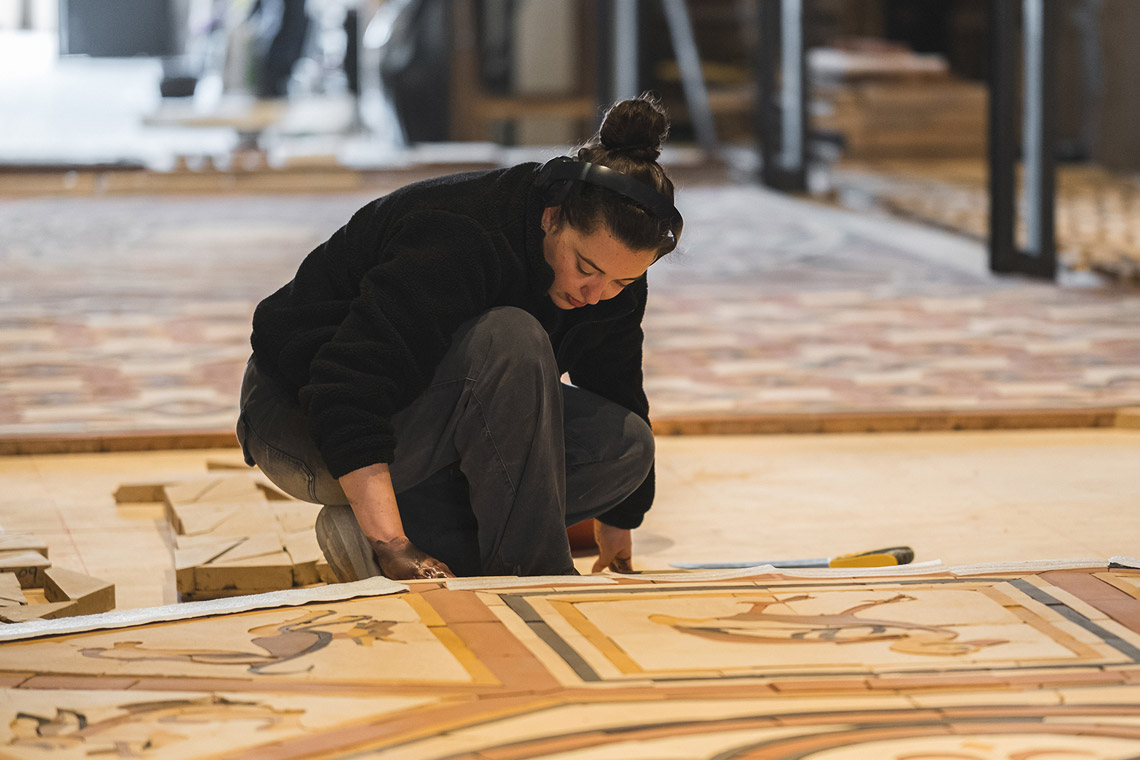
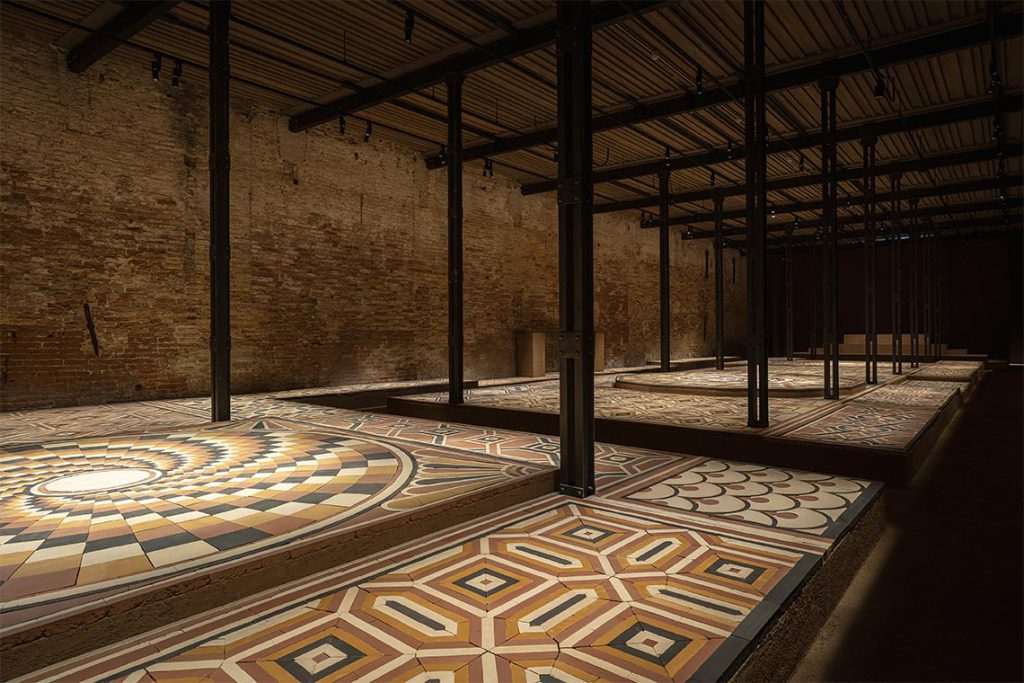
The immersive installation that Awartani is presenting at Venice this year is entitled May your tears never dry, you who weep over stones (2026). This monumental work is made up of a sprawling “patchwork” of floor-based mosaic tiles, as she terms it, which fill the entire pavilion of Saudi Arabia in Venice’s Arsenale. The designs hail from mosaics found in UNESCO heritage sites in various parts of the Arab world, with the patterns having been tweaked slightly to make the overall design feel cohesive. She sees the work as a form of decolonisation, arguing that, in many ways, this mélange of patterns is true to the historical spirit of the region. “Before we were colonised, there were no political borders as such, there was no Syria, Palestine, Saudi Arabia,” she says. “We were a region that shared with each other culturally.”
While working with curator Antonia Carver and assistant curator Hafsa Alkhudairi, Awartani was initially drawn to mosaic for this particular project through examining the links between Venice and the Middle East – the latter a designation that is itself a colonial inheritance and the usage of which Awartani acknowledges she is trying to extricate herself from. “The earliest mosaics have been identified at sites in Türkiye and Mesopotamia, with the Greeks and Romans later elevating mosaic work as an art form, Awartani explains. “During the Byzantine Empire, these mosaics were brought to the Middle East, specifically to Bilad al-Sham, present-day Syria, Jordan, Palestine and Lebanon, which had the most Byzantine influences.”
Despite this intersecting history, Awartani notes with frustration what she sees as indifference in the West to the destruction of cultural heritage in the Arab world. She highlights the 2019 fire at Notre-Dame in Paris, which drew widespread global sympathy and donations to help rebuild the damaged cathedral. Yet when similar or worse instances of destruction occur in countries such as Syria, Lebanon or Palestine, she feels there is “a sort of detachment” evident among the general public. She points out that many of the buildings recently destroyed in Iran and Lebanon, among other places, are inextricably part of a common global history. “Of the sites that the mosaics featured in the pavilion come from, there’s only one mosque involved,” she emphasises. “The rest are from churches, synagogues, citadels, castles and residences. The destruction in the region is occurring across all religions and cultures, which makes me question why it seems so often to not be given equal weight to similar losses elsewhere in the world.”
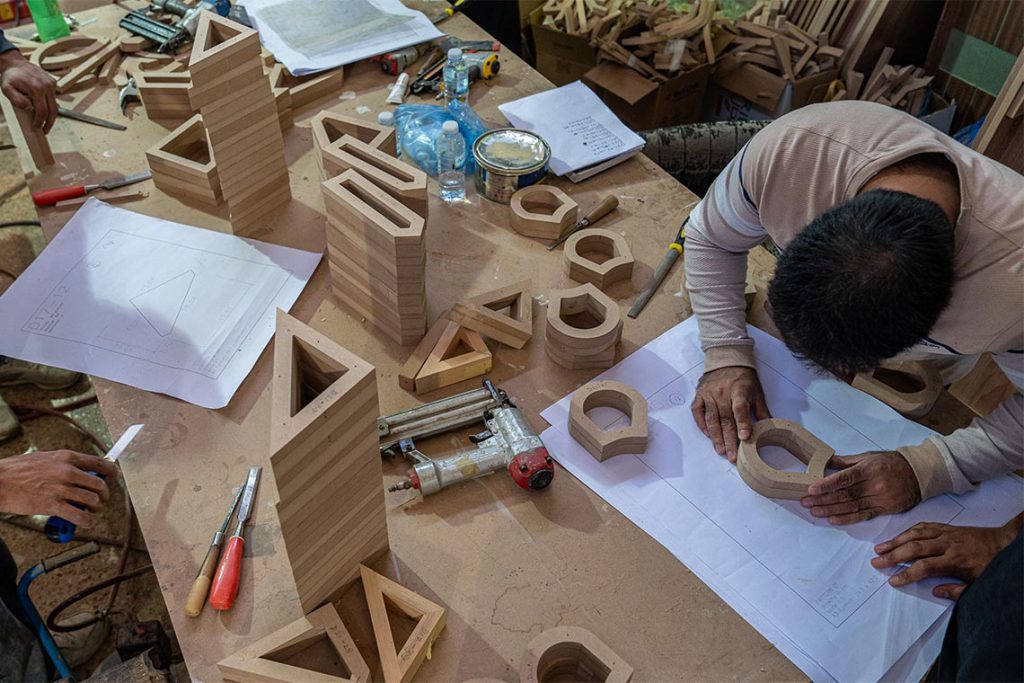
Transmitting traditional craft know-how down to future generations is one of the ways in which Awartani seeks to raise awareness of this rich cultural legacy. In the face of the ever-waning popularity of these ancient forms of art in favour of more ‘modern’ professions, Awartani sees her practice as a means through which to celebrate this knowledge while also keeping it alive. Ever cognisant craftspeople on projects requiring specific expertise. For Come, let me heal your wounds. Let me mend your broken bones, she travelled to a remote part of South India to work with a community who use entirely natural, biodegradable dyes. Just as the leading cause of water pollution in India is due to chemicals from the textile industry, a slower, sustainable “traditional mode of making can solve the very problem the industry creates,” she explains.
Awartani maintains that craft is also, crucially, a form of resistance. She cites Gaza, where the Strip’s inhabitants have been periodically cut off from electricity and gas supplies. “People started building shelters out of mud, ovens out of clay,” she says. “They defied the conditions imposed upon them, using their knowledge of the earth to survive.” For May your tears never dry, you who weep over stones, the artist worked with clay to build the mosaics, favouring the earthy material for its ability to hold memory, trauma and history. As is customary for the artist, rather than approaching a production house to assist with the potentially daunting task of recreating thousands of mosaic pieces, she went directly to those with age-old knowledge of working with clay. In the desert in Saudi Arabia, she brought together a group of more than 20 craftsmen to create the clay bricks, alongside expert woodworkers to create moulds for the tiles that would eventually be installed in the pavilion in Venice. Awartani shares that all of the workers happened to be living in diaspora in the country, hailing originally from countries including India, Syria, Lebanon and Pakistan, collectively constituting a vast mosaic of knowledge.
Craft, Awartani believes, “is about the human being”. The craftspeople who are the keepers of this dying history and knowledge are at the forefront of her practice, which she views as a means both of archiving this disappearing expertise and of calling attention to the urgency of the current situation in the region. “I’m really grateful that I’m able to talk about Gaza, Syria and Lebanon, as the situation is still ongoing,” she says. “People tend to reflect on things much later on. For me, this project is a call to act now, before it is too late.”
The National Pavilion of Saudi Arabia is located in the Arsenale
This profile first appeared in Canvas 123: Venice Special Issue
