

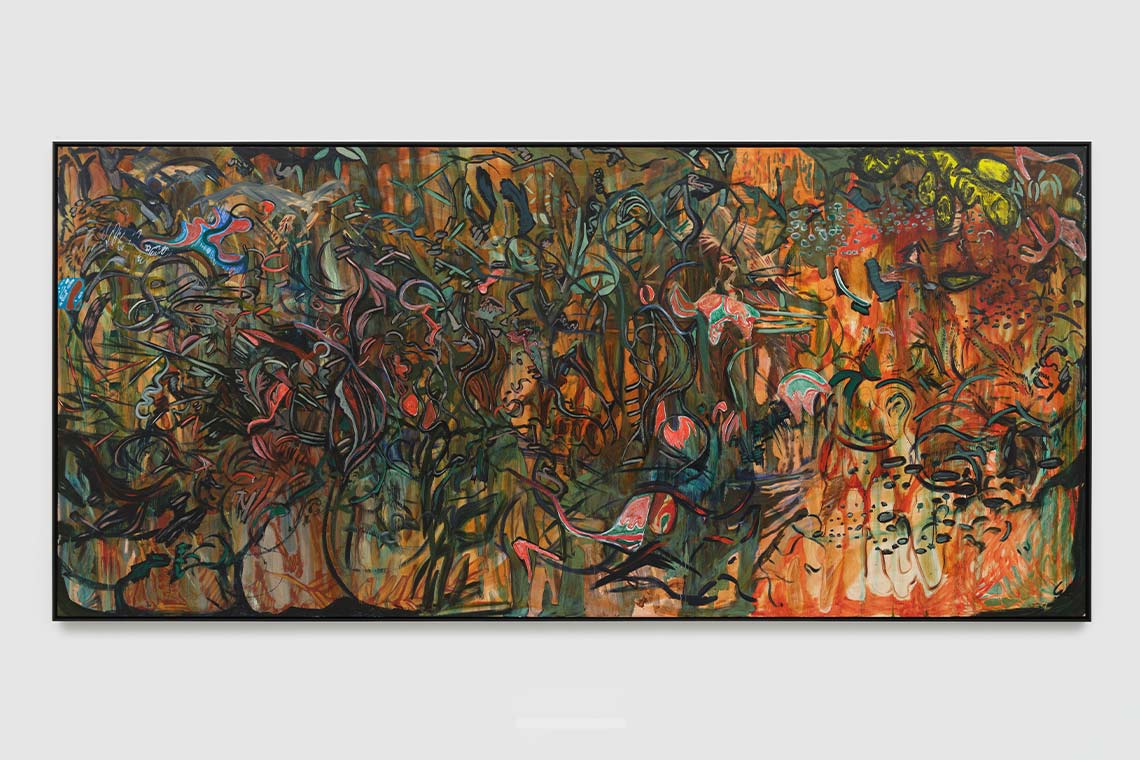
The Saudi artist’s first solo exhibition in Asia opens new doors to cross-cultural synchronicities and mark-making as an expression of self and place.
Alia Ahmad’s stunning debut solo exhibition at White Cube in Hong Kong is all about first impressions – and lasting ones. This becomes apparent when strolling through the galleries to see twenty-one colourful new small-to-large-scale works of ink on paper and oil paintings (all 2026), spanning several rooms and a corridor across two floors. Completed in her studio over the past year, the works presented in In Time, A Bloom / مع الوقت، تزهر make an immediate, physiological impact as the artist directs our attention to her interpretation of the place she calls home: Riyadh.
Ahmad visualises Saudi Arabia’s capital city, set on a desert plateau in the centre of the country, by painting how this landscape regularly transforms itself, a process which likewise reflects on how she continues experiencing living and working there as an artist. Ahmad’s path to painting has also been forged through her training as a researcher and in digital culture, suggesting a deep knowledge of layering and rendering, both as medium and as message, especially now as so much art is being experienced through flat, digital surfaces.
The exhibition serves as a prompt for IRL viewing of art in general, and in understanding how Ahmad explores her homeland as a field of emotional, cultural and historical enquiry. By consistently applying a range of brushwork, from thick oil to ink drips, her paintings channel the desert plane as loaded experience, both evocative and elegiac. Whether this stems from Ahmad’s process, in our viewing, or in her painting bearing witness to countless others’ experience across time, such dense surface treatment plays a potentially greater, graver role: as a reminder of our capacity to enter new worlds or reflect on our own through art as a vehicle for creative output and critical reflection. Certainly, careful consideration has been paid to the layered mix of various illustrative and calligraphic strokes and washes under Ahmad’s care and in an approach that ranges from paper to paint, and from framed, mid-size works to canvases large enough to feel like you can enter them at will.
Photography by Kitmin Lee © White Cube © Alia Ahmad
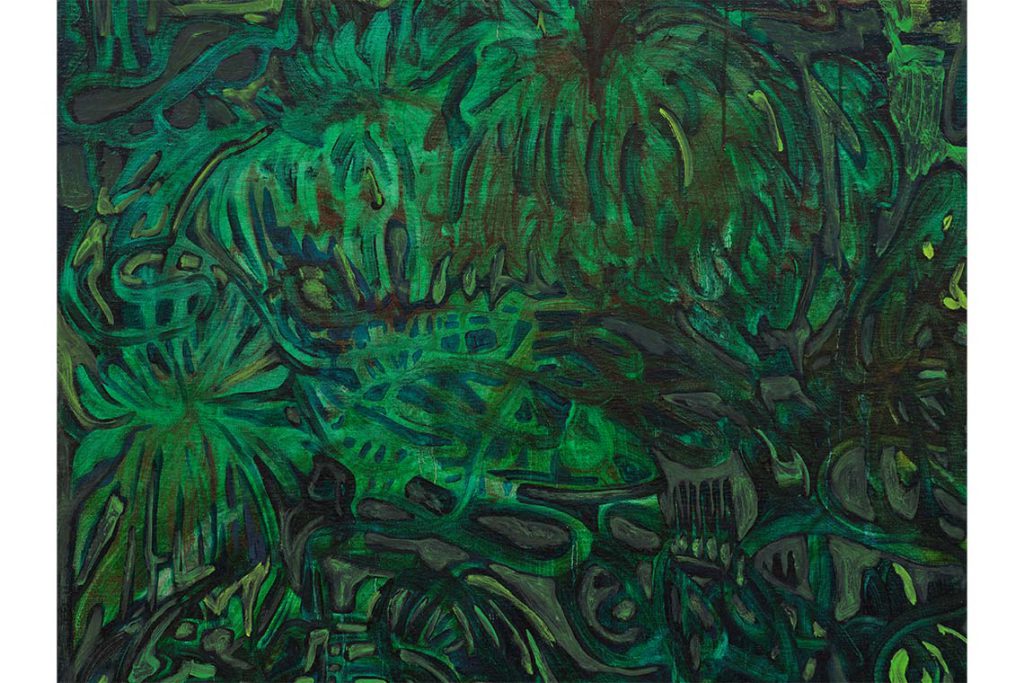
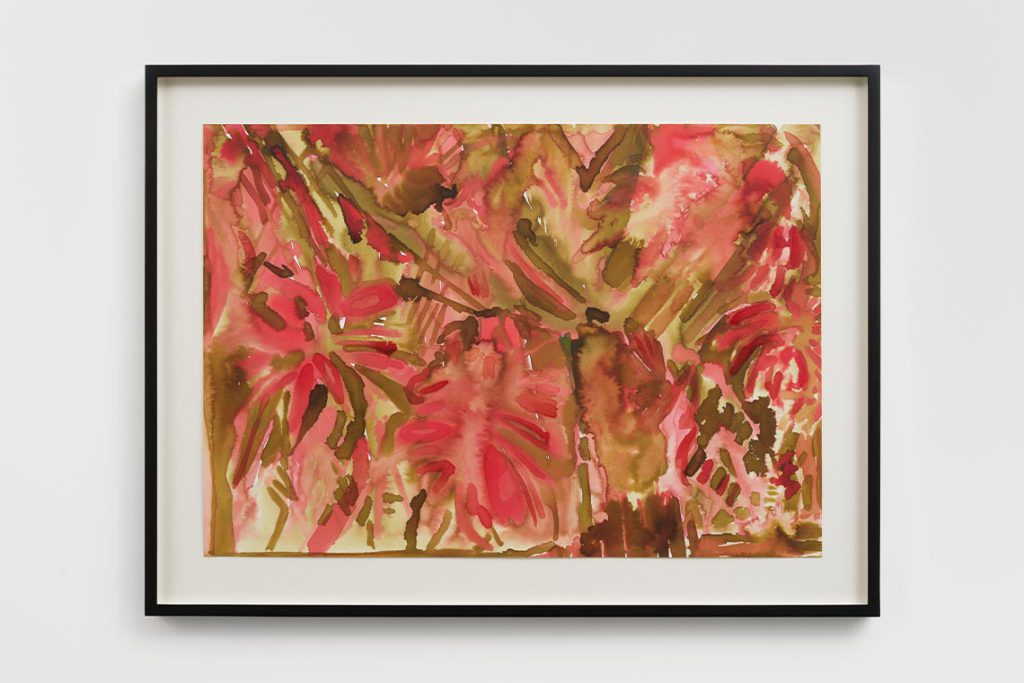
Throughout, there is a consistency of form that caters to Ahmad articulating a unique artistic style. This includes dominant colour schemes, such as in her frequent references to foliage, literally in Greens and Greenery / مشجر, or when rendered in shades, from dark blue in Night Walks /مرسى ١ to bright yellows, fuchsias and more in her Flowers In Bloom / ورود مزهرة series. Various drops, drips and washes, perhaps illustrating desert heat (or Hong Kong humidity) can be observed in canvases such as Solace / ﺳﻠوان, while her mark making, used as outline or demonstrating a graphic sensibility akin to printmaking or collage, underscoresVachellia Seyal Var / السيال.
Whether awash or overlaid with patterned brushwork, Ahmad’s approach evidences many historical lineages, among which is that of female painters for whom any exposure of themselves can be observed through their capacity as artists, often self-presenting as painters. However, as no figures are portrayed here, Ahmad inserts a sense of self by using ‘place’ as subject. As for the history of female landscape painting, particular legacies – like those of the late Georgia O’Keefe and Agnes Martin – continue to loom large, as do their visual iconography characterised by abstract flora and fauna, plus lines and grids, respectively. Through this lens, Ahmad can be seen as balancing both trajectories, as Mirene Arsanios writes in her accompanying essay ‘A Total Flower’, citing Ahmad’s “series of large-scale paintings inspired by desert flowers, [and] vegetation that not only grows despite arid and hostile conditions, but precisely because of them.”
More importantly, what particularly continues to grow and survive within Saudi Arabia as a territory? The answer extends to local artists like Ahmad, who find themselves among a forest of regional “signs and symbols”, as Arsanios continues: Ahmad’s work, “while evocative of the tight weave of Al Sadu textile traditions or the exaltation of Arabic calligraphy, departs entirely from replicable or fixed patterns. Her brushstroke is unpredictable, holding within itself another kind of sentience. While evoking indigenous traditions and histories of craft, Ahmad’s practice has evolved from the modernist lineage of Saudi painters, […] extending the purview of abstraction into ecological concerns that speak directly to our contemporary condition.”
As a millennial artist – being born in 1996 – Ahmad can nonetheless claim a direct link to modern pioneers of Saudi art such as Safeya Binzagr, the first female artist to exhibit publicly in the Kingdom, and Mohammed Al Saleem, whose distinct ‘Horizonism’ style, like that of Ahmad, embeds calligraphic impulses within abstract, two-dimensional fields. Added to this being Ahmad’s first show in Asia only expands the range of mark-making traditions, opening the door for comparative study in ‘translating’ the intertextual and intercultural connections between Arabic and Chinese ink art, as well as the relationship to artists’ publishing histories. Symbolic connections abound, too. In Hong Kong, large floral arrangements placed on the street indicate time-honoured rituals, some celebrating the opening of new businesses while others honour the recently passed. If the namesake work of Alia Ahmad’s exhibition is any indication, In Time, A Bloom / مع الوقت، تزهر offers a chance to reflect on and empathise with others’ experience of self and place, despite the increasingly unprecedented motivations undermining the possibility to do so.
In Time, A Bloom / مع الوقت، تزهر runs until 27 June
