

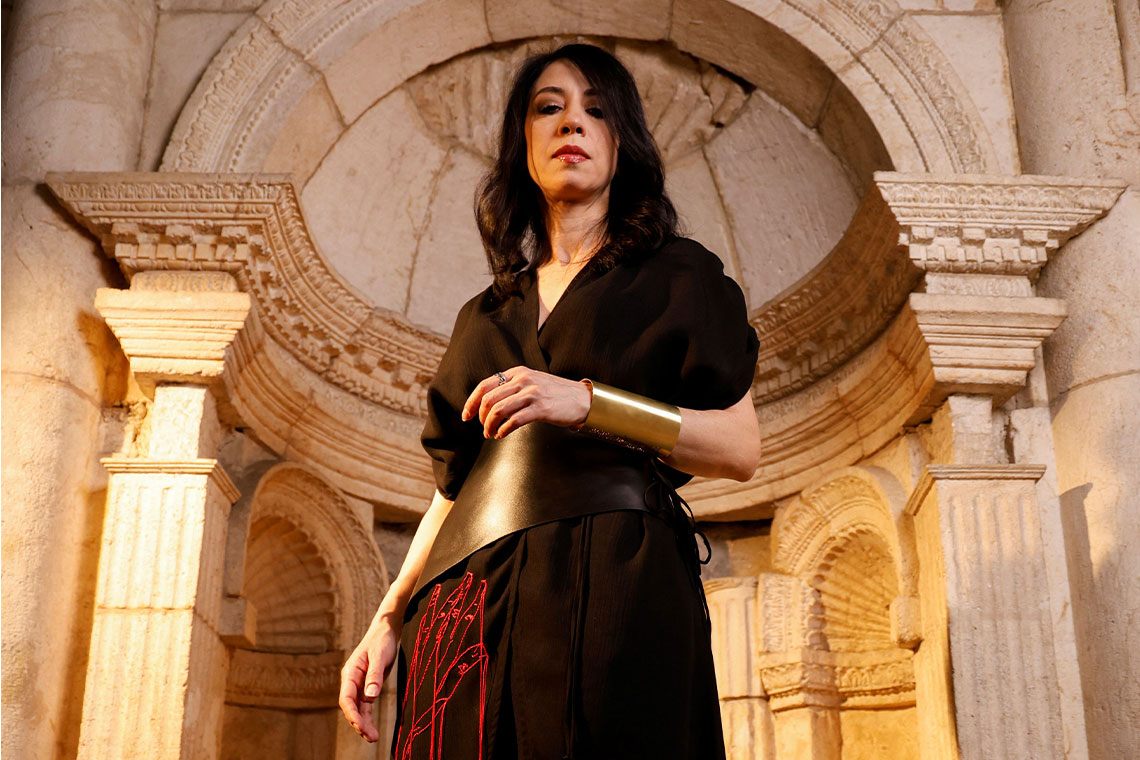
The artist fills the National Pavilion of Syria with a monumental installation that speaks to the strength and diversity of the country’s history.
“I let my subconscious mind lead my hands. It’s almost like they’re moving by themselves,” says Sara Shamma, speaking from her studio in Damascus. Guided by instinct and a desire to look deeper for the barely visible, the Syrian artist has crafted a deeply psychological figurative approach that holds onto the rawness and intensity of lived experience while pushing it into almost surreal dimensions. While highly trained, having spent years studying the techniques of art history’s old masters, such as Rembrandt and Dalí, her practice has since evolved into a more visceral and uninhibited expression that is distinctly her own.
Shamma’s canvases are populated almost exclusively by piercing faces, built slowly through layers of oil. During our conversation, she draws a distinction between portraiture as a way of rendering specific identities and her own practice of constructing human beings from the material of their absorbed experiences. “A person holds everything inside them,” she says, speaking of her main inspiration and muse. “Since I was very young, I have tried to dig inside every individual whom I have met, to try and recognise what they have been through, looking for even the smallest of changes. Right down to the veins in their eyes.”
Guided by intuitive methods of thinking, seeing and making, she continues to return to stories that delve into the complexities of what sits beneath the human condition. With vulnerable yet universal subjects such as death, displacement and motherhood consistently recurring across her works, Shamma explains that she is simply drawn to paint whatever is present in her life at that moment when she picks up the paintbrush: “The themes thatI usually work on come from everything inside me or around me. Or everything that I am.”
In what would lead to one of her most arresting and acclaimed series, she recalls hearing reports in 2012 of Yazidi women being abducted and sold at ISIS slave markets along the Syria-Iraq border, something that stayed with her for many years. It became the catalyst for the series Modern Slavery, which she completed as a result of a research residency at King’s College London in 2019. Prompted to confront the hidden mechanisms of such cruelty in modern societies and its impact on women’s bodies and identities, her process began with interviewing survivors of trafficking and forced prostitution before translating her emotional reactions onto the canvas. Her approach is notably sensitive in terms of how she tackles such complex struggles without catastrophising them – not so much illustrating testimonies, but the feeling that those conditions inflict inside the body and mind.
Shamma’s approach in Modern Slavery comes through powerfully in 4 ages of women, which depicts three liberated figures intertwined with shadows of a past that they escaped, while a fourth (seemingly the youngest) crouches with no shadow at all, suggesting that she has no future. The fall depicts the face of Shamma herself and the feelings of grief and resistance through a body that appears suspended while falling, trying to survive, but perhaps forced to surrender to her fate. Meanwhile, in Double motherhood we see women across three generations of a family as Shamma confronts the tension between protection and the failure to protect daughters. In the painting In & out naked figures are knelt over or exposed in various layers, caught helplessly in a state of distress.
Despite the heaviness and often confrontational nature of the subjects with which she engages, and the level of emotional investment that they demand, the artist tells me that she actually feels a “huge joy” the moment she begins painting and fully enters the world of the work, “feeling everything until I can step back out to look at it from above”. The process, she says, is “very freeing, and a kind of meditation in itself”, describing a state of total absorption in which she is at once disconnected from, and deeply connected to, everything around her.
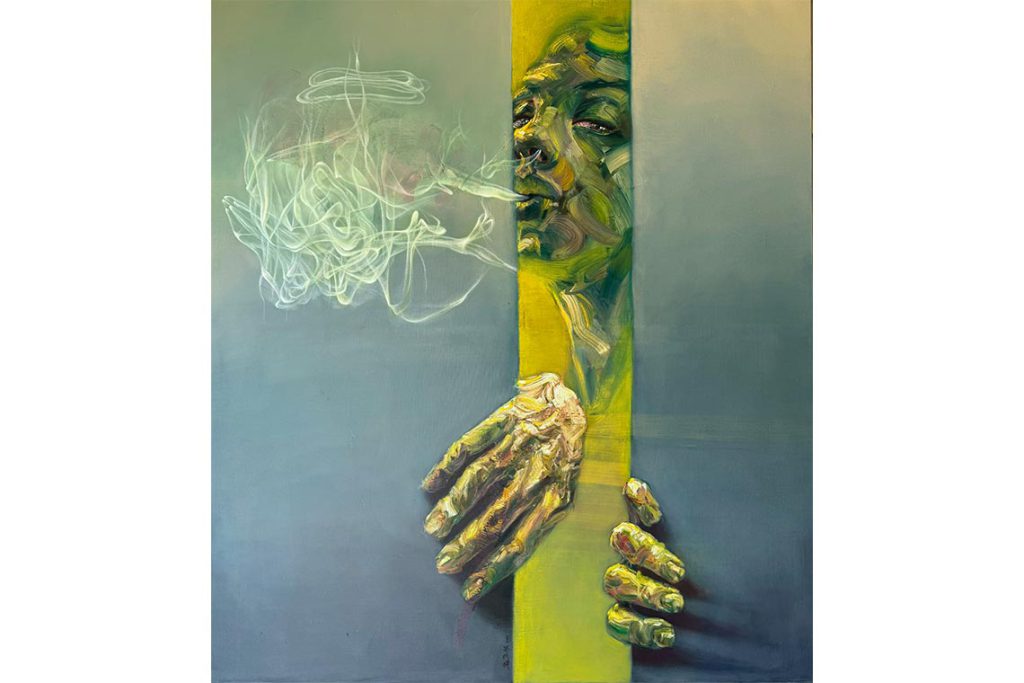
Her practice is deeply sensory, and she also describes experiencing painting in a way that stretches well beyond the visual. She suspects that she has synaesthesia, as she sees each colour as almost carrying its own personality: “When I look at a painting, I can taste it, I can smell it, I can hear it”, she shares, delighted. Green, she has said in the past, means both regeneration and fragility to her, a duality she found resonant with her broader reflections on nature and existence. Last year, it became the protagonist of her exhibition Interference Green, appearing across 20 compositions in which layered transparencies gave way to thick, almost sculptural brushstrokes that seem to float forward from the surface and shift in their hue and intensity.
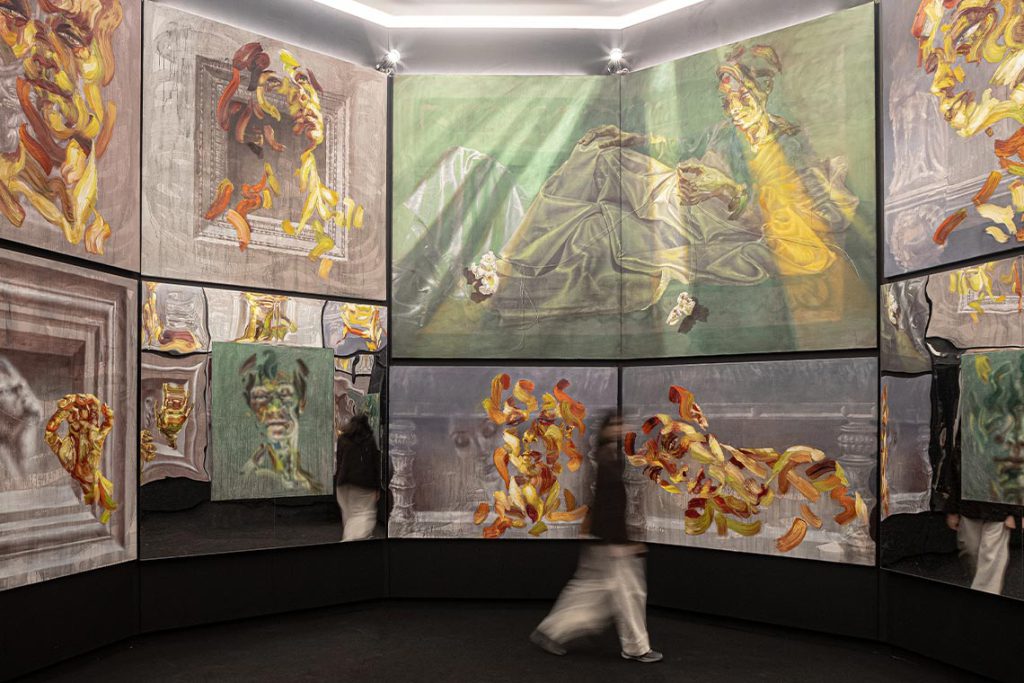
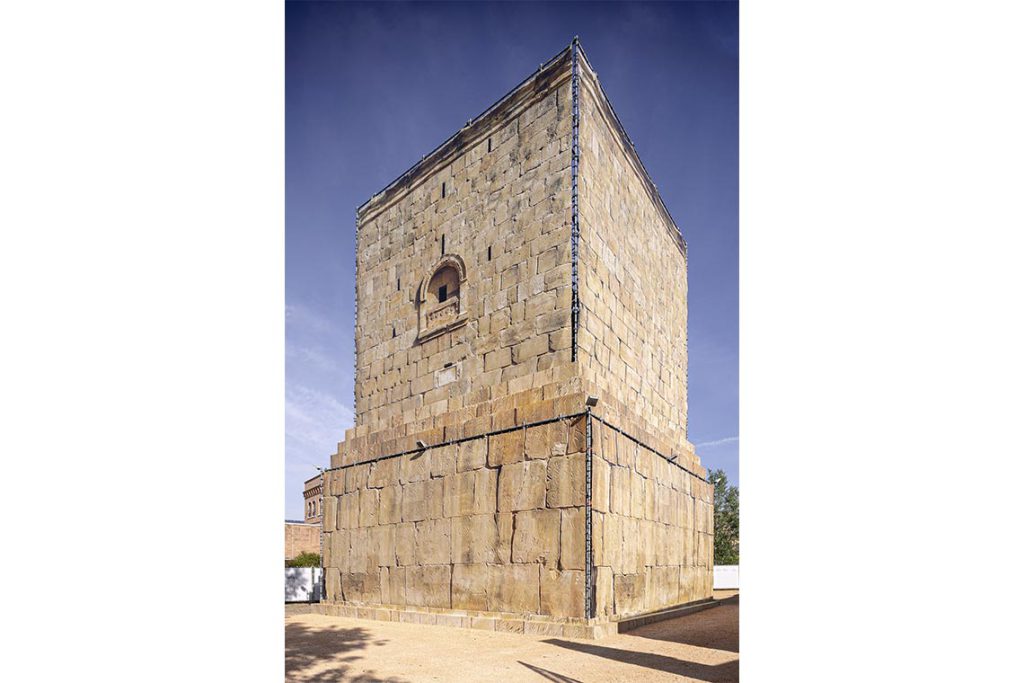
In a milestone for both her country and her own career, Shamma has extended her practice into a more immersive and spatial form as she represents Syria at this year’s Biennale. With a full-scale reconstruction of the ancient funerary towers of Palmyra, once an important crossroads of different civilisations, her solo exhibition at the pavilion focuses on the loss of cultural heritage alongside the human stories bound up within such destruction. Much of the city was ruined during the civil war, with almost all of the tower tombs demolished by ISIS between 2015 and 2017, and hundreds of funerary portraits looted and sold abroad. “This whole war has caused huge destruction, not only for heritage but also for humanity,” Shamma says.
However, the register she brings to all of this is not one of grief. Syria, she says, is now “reborn” following the fall of the Assad regime and the advent of a broader shift in the country’s political and social landscape. “Any person is capable of creating a real difference in the rebuilding of this country, and we Syrians carry so many layers of history within us,” she shares with pride and hope. Particularly, she sees this as the artist’s hour. In the absence of stable cultural institutions, it is creatives, she suggests, who know “all the beautiful hidden secrets of their country” and who carry the obligation to make Syria visible to itself and to the world in this moment of renewal.
The tower she has created, entitled The Tower Tomb of Palmyra and measuring 15 metres in height, places the viewer inside a tomb drawn from one of the most significant chapters in Syria’s history. It asks what it means to encounter that past from within and to confront its loss at the hands of human cruelty. The space is filled with sound inspired by the desert and scent drawn from indigenous herbs, alongside a series of new paintings bearing faces – Shamma’s painted faces, which have always been acts of testimony to the irreducible specificity of being alive in a body, in a country, in a moment.
The National Pavilion of Syria is located at IUAV University of Venice – Cotonificio
This profile first appeared in Canvas 123: Venice Special Issue
