

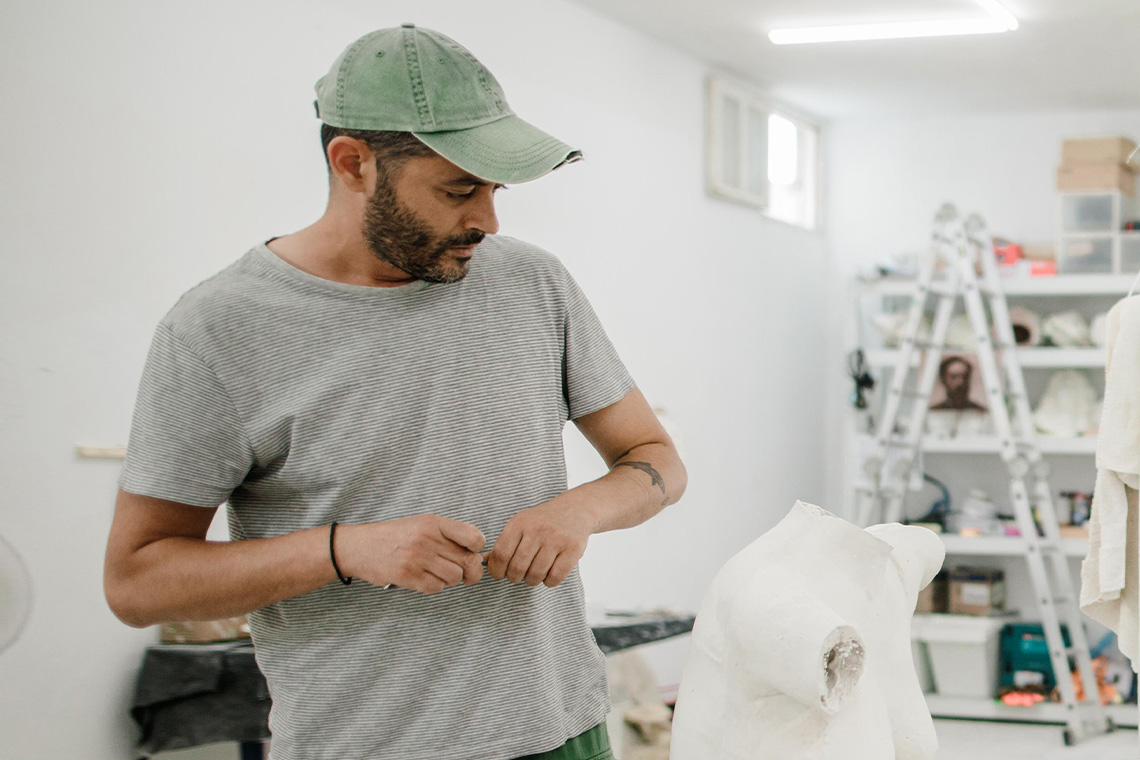
Across the more than 30 artistic projects on which he has worked during his career, Nidhal Chamekh has done it all; from large-scale public installations to bright neon pieces and multi-object assemblages. Yet it is the humble act of drawing that remains his favoured medium of expression. “I don’t know if I always fully understood what being an artist truly meant or what it entailed,” he tells Canvas. “But one thing is certain. Drawing has always been a central part of my life – perhaps the most important part. Everything has revolved around it.”
Drawing has been his companion since childhood and he hasn’t ever stopped. “Scribbling, tracing a line, I think it’s one of the most ancient gestures,” he says. “Behind every work, every thought, project or anything else, there is always a preparatory sketch. Drawing is what comes before any action. It is the immediate extension of thought.” The artist, who was born in the Tunisian town of Dahmani in 1985, describes drawing as “the art of beginnings”. Yet, his own beginnings were quite atypical in terms of his trajectory as an artist.
A son of working-class teachers, Chamekh gained a baccalaureate degree in mathematics in Tunis, where he later attended the Institut Supérieur des Beaux-Arts. “It was my only choice and my greatest aspiration,” he says. “Coming from a mathematics background, my choice was unusual – fine arts programmes are generally pursued by students with a literary background. But I have no regrets. In fact, mathematics, particularly geometry, plays a crucial role in my artistic practice today.”
Studying at the institute, which was founded under French rule in the 1920s, proved to be an eye-opening experience for him. Although he recalls the pedagogy (modelled on Western teaching) as being “outdated”, Chamekh nevertheless engaged with a dynamic ecosystem of professors, students and artists, all of whom left an impact on him. “This intellectual and artistic exchange was incredibly enriching and inevitably shaped the way I think, see and create,” he notes.
Next came Paris, where he continued his studies at the Sorbonne University. It was another indelible experience, where he immersed himself in the city’s cultural life, but in the long run it made him realise certain aspects of his homeland. “This academic experience broadened my perspective on art, expanding my aesthetic framework and prompting me to critically reassess the education I had received in Tunis,” he explains. “Over time, I became more aware of how our curriculum had been entirely modelled on a Western canon, with a glaring absence of African, Arab and even local art histories.”
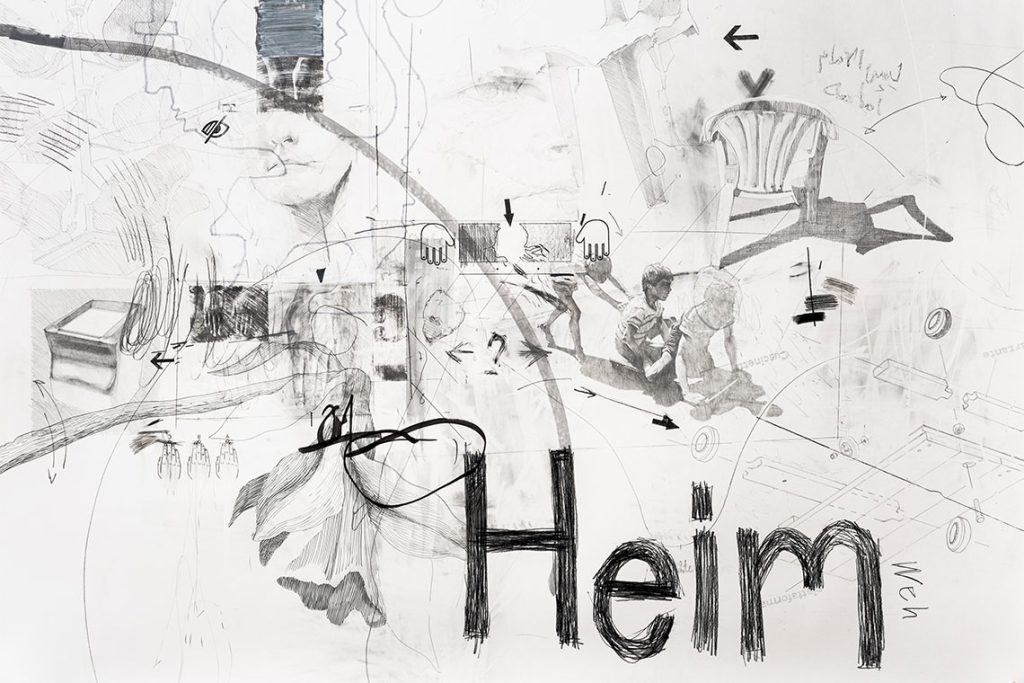
Conflict in all its forms – be it social, political or historical – is a central theme in Chamekh’s body of work, ranging from drawing to sculpture, from video to installation. His artist statement describes how his practice “reflects on the times we inhabit”. So, how does he view the world we live in today? Akin to his map-like, black-and-white drawings, which are mostly large in size and meaning, the state of the world is loud and full of contradictions, which can sometimes feel indescribable.
“There is a general sense that we have reached a threshold,” he says. “Unbridled capitalism ravaging the planet and all living things, societies torn between freedoms that have become mere illusions and a reality marked by subjugation, totalitarian regimes born from so-called democracies. At the same time, history feels eerily repetitive – its ghosts returning in the genocides unfolding in Palestine and Congo, in modern-day slavery on distribution platforms, in the uberisation of entire sectors of labour.”
Despite these challenges, Chamekh believes that there is an opportunity for populations to rise up and speak out against injustices. He admits that his work is at its core political, as in “shaped by the political in its original sense – the articulation of polis (the city) and polítês (the citizen) – rooted in reality and the collective,” he explains. One of his earliest career milestones was being a member of the artistic Tunisian collective, Politiques, which was active during 2012–13 following the Tunisian revolution of 2011. Chamekh points out that it was not a formal unit, but rather a productive experiment that generated collaborations and encounters amongst its members. These included artists Ymene Chetouane and Fakhri El Ghazel, among others.
Chamekh is mostly known for drawings that are rooted in personal and collective matters. In nos visages (our faces) (2019–22), for instance, he reassesses the violence of colonial history by meshing two faces together, forming a distorted yet powerful facial composite. They are based on real-life images of soldiers recruited, often forcibly, from France’s colonies. Through these drawings, the artist pays tribute to the lives of these men, whose names have been undocumented and forgotten over time. In Exil (Exile) (2019), he has created collage-like compositions of intriguing details, describing the work as a way “to unfold fragments of memories, childhood images, and analogies. In these drawings, I attempted to create a mental map of what exile is for me – an experience and a condition that are personally close to me.” In one corner of an image, there is an unfinished portrait of the iconic Palestinian poet Mahmoud Darwish, who famously wrote about exile and estrangement and inspired this project.
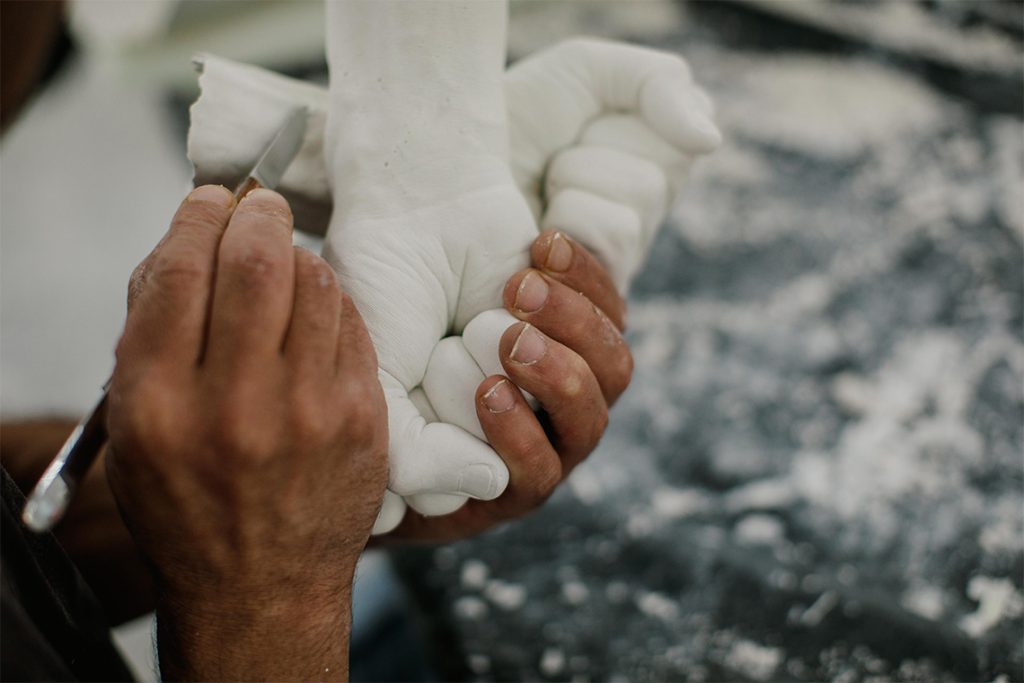
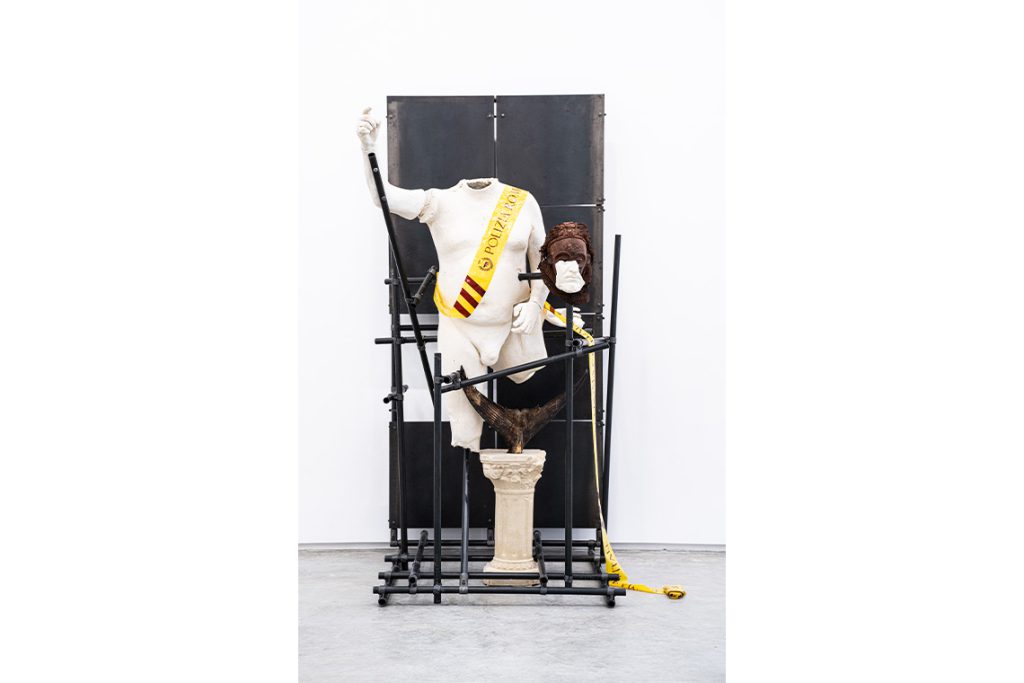
Over the years, Chamekh has also experimented with sculptural assemblages, based on historical figures such as Hannibal, welded through a bold and ironic combination of heterogeneous objects. “Chamekh seeks to translate the dissonances, discontinuities and hybridisations that they contain,” explains a text on the artist’s website. The king and the mask (2024), which comprises a decapitated statue of the Roman emperor Augustus merged with other elements including a ceremonial African mask and a superstitiously significant fish tail. This form of experimentation was fuelled during the artist’s years in Tunis, where he was inspired by his surroundings. “People in the popular neighbourhoods are used to repairing, reusing and changing the function of objects. Ready-mades don’t need to be ‘discovered,’” he says.
Today, Chamekh is based between Tunis and Paris. Although he spends most of his time in the French capital, he still keeps an eye on his country of origin. He views the domestic art scene as lively and active, despite the unstable political and social conditions the country continues to live through. But there is hope, he says, which can be sensed in the younger tier of Tunisia’s artists, who are creating a new path for themselves, divorced from the past. “More and more artists are self-taught, bypassing art schools and escaping the formatting of these [Western] institutions that have not been able to renew themselves,” he explains, underlining also the importance of the shift away from classical media like painting, which were imposed by colonisation and reigned supreme for many years. “This change has allowed the new generation of artists to explore new, more affordable materials that are more rooted in the local reality and also allows them to try new approaches to exhibiting, sharing and distributing their work.”
This profile first appeared in Canvas 117: The Maghreb Issue
