

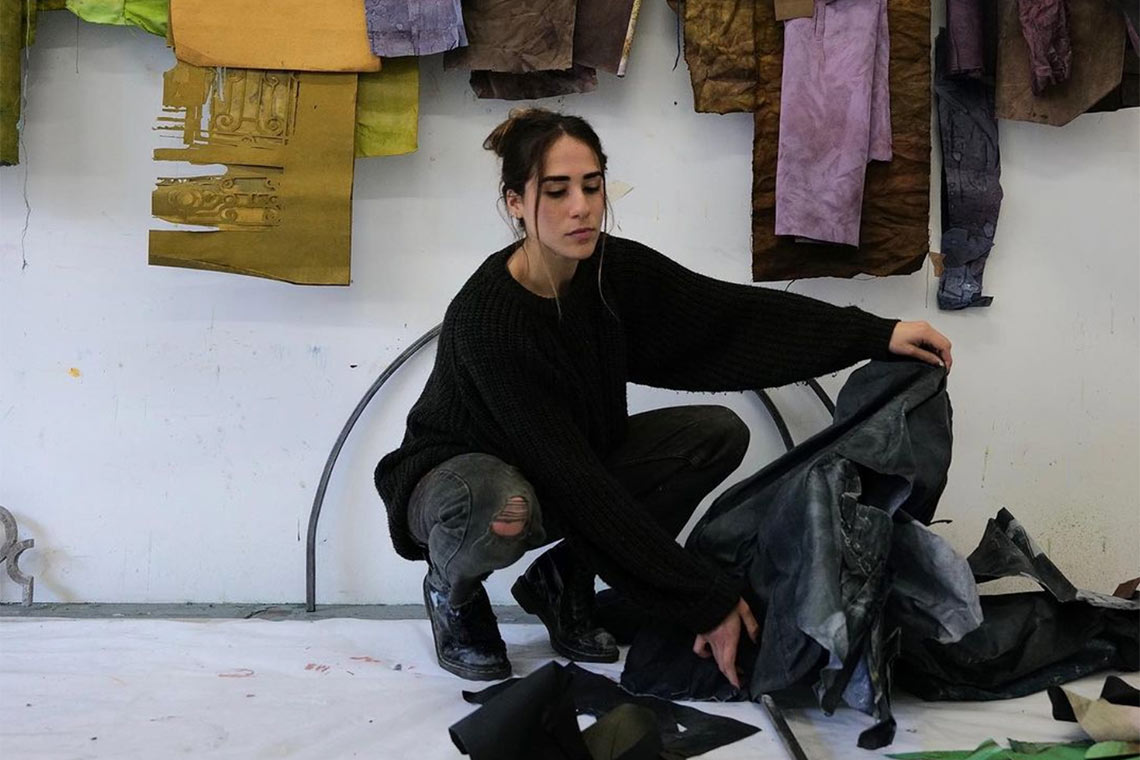
The Libyan artist weaves an intricate and insightful path through the medium of textile with startling results.
Foreigners Everywhere, curator Adriano Pedrosa’s main exhibition at last year’s 60th Venice Biennale, explicitly centred the legacies of historically overlooked artists from the Global South. The majority of those featured were no longer living but, amid this celebration of unsung contributions to modernism, the bold contemporary work of emerging textile artist Nour Jaouda caught critics’ eyes.
Born in Libya in 1997, Jaouda was one of the youngest names on show, but this did not limit the ambition of her tapestries. The three pieces explored memory, resilience, belonging and longing, all timeless themes that had also haunted the work of the late Palestinian poet Mahmoud Darwish, whose poem The Second Olive Tree had inspired Jaouda. Its message of “mourning and resistance against the violent uprooting of ancient olive trees in Palestine” made her think about the act of memorialising, or “establishing meaning and emotion through what is absent, rather than what is present”.
Meanwhile, Jaouda had recently visited her grandmother in Benghazi for the first time since the 2011 revolution. It was the place where she had spent her formative years, “surrounded by the nature of my grandpa’s farm, the generations of old fig, olive and lemon trees and grapevines, as well as the Mediterranean hues of the coastal city,” she recalled. This scenery became the starting point for a new series of drawings of deconstructed botanical forms that would work their way into the tapestries later shown in Venice. “The pieces explore how plants embody memory,” Jaouda explains, “and how they symbolise the ancestral connection we have to land.”
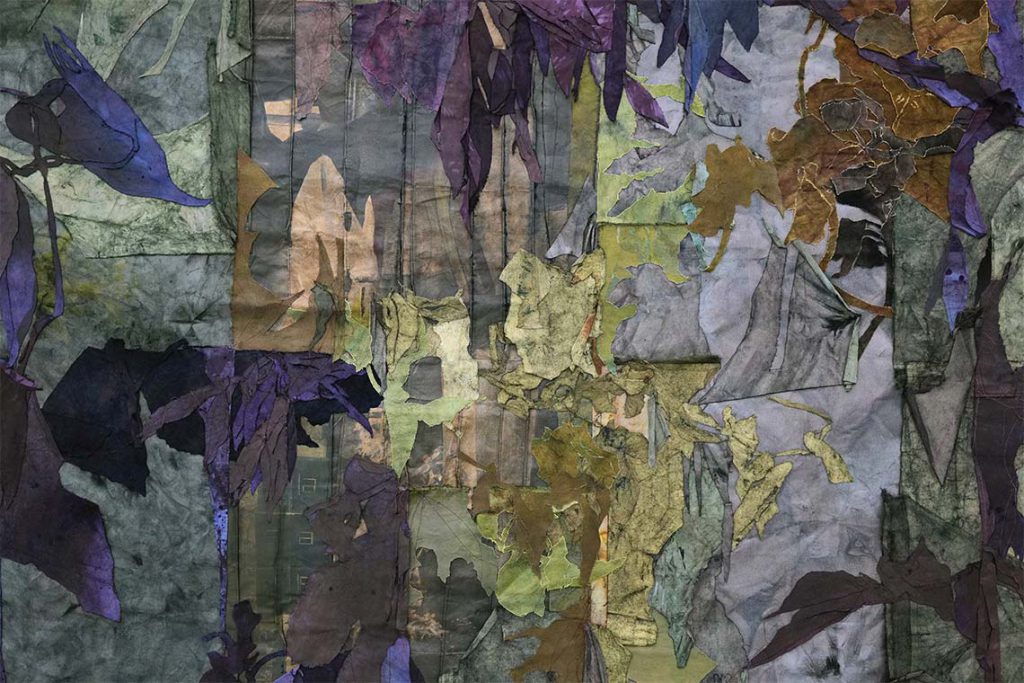
Although the Libyan landscape has reappeared throughout Jaouda’s practice, she was raised predominantly in Cairo. The Egyptian capital also had a part to play in feeding her “compelling urgency to make”, from its mix of contemporary and historical architecture to “the rich histories of craftsmanship that flood its chaotic streets. You cannot escape it!” Indeed, Cairo continued to exert a strong influence on Jaouda after she moved to England in 2015, at the age of 18, to attend the Ruskin School of Art in Oxford, followed by an MA at the Royal College of Art in London in 2019. Although she had enrolled to study painting, she soon began deconstructing traditional approaches by testing out new techniques, like diluting the paint before washing it onto unstretched canvas and found fabrics. The results blurred simple distinctions between painting, textile art and installation and, in turn, Jaouda found the pieces took on excitingly complex social and political dimensions. The decolonial theories of academics and philosophers like Stuart Hall, Edward Said, Homi K Bhaba and Frantz Fanon were instrumental to this process of “subverting and questioning histories of colonial power through traditional craftsmanship”.
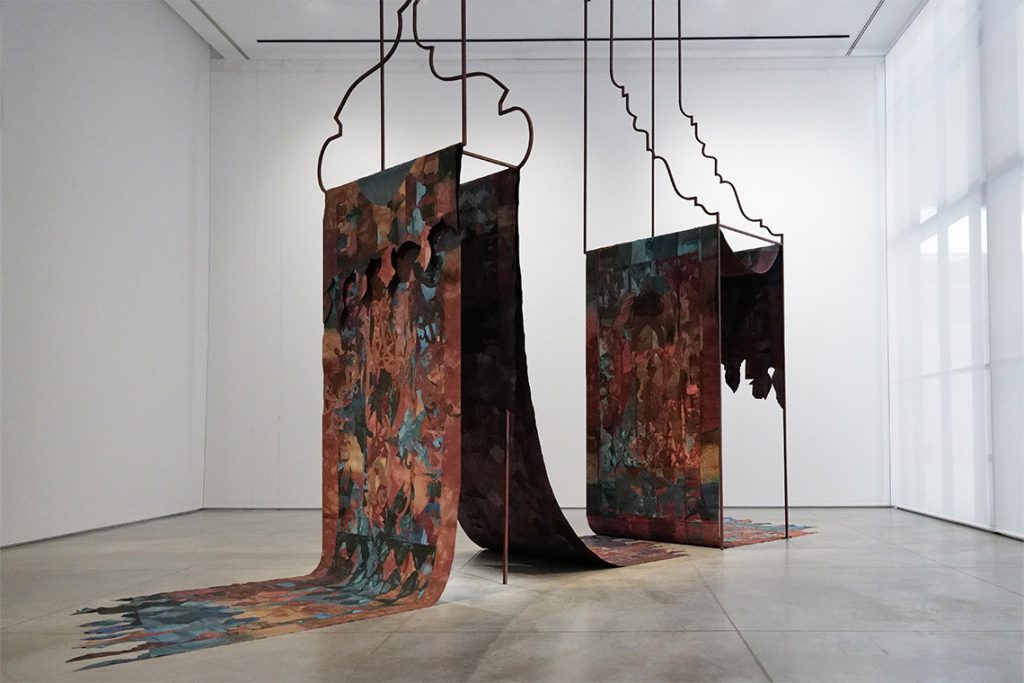
On a more formal level, Jaouda also found it endlessly intriguing to create compositions that were no longer straightforwardly pictorial but which operate very differently to painting. “A tapestry imposes itself as an object that occupies real space and real time, the way a sculpture does,” she explains. “It’s a painterly dilemma between the internal space of the image and the physical, tactile materiality of the fabric.” Her scholarly guiding star in this case was Karen Barred, the American physicist whose theory of “new materialism” argues for the agency of matter. Jaouda also found plenty of inspiration in the work of her fellow artists. It is unsurprising that some of her favourites include sculptors who centre materiality in their work, including Kader Attia, Mona Hatoum, Saloua Raouda Choucair, Louise Bourgeois and Magdalena Abakanowicz. She is also a fan of Mark Rothko’s ability to channel “the spiritual and emotional power of colour” in service of “sublime, psychological and silent revelations”.
Looking at the expansive wall hangings and metal-framed installation structures that Jaouda began to make, it comes as little surprise to learn that her practice is very labour-intensive. “What really interests me in working with textiles is the slowness, malleability and temporality of the material,” she says, describing the importance of repetitive gestures. In this way, time becomes an active agent in the process. For example, for how long does Jaouda let pigment stain the fabrics when she hand-dyes them? Decisions like these determine how “the colour animates the material agency”.
In a process that Jaouda calls “décollage”, she tears up larger dyed textiles into fragments that she lays out over the studio floor and reassembles. In this way, she seeks to create new meanings by taking things apart in what she describes as “a continuous process of making and unmaking”. The approach raises intriguing questions about whether a material is complete or coming undone. “Understood literally, décollage means to take off or unglue something that was joined together,” Jaouda explains. Although it is a violent method involving direct negation of the material, she considers this philosophy being “as much construction as it is destructive”. Equally crucial, is the anti-hierarchical nature of these flat compositions, resulting in a “chaotic unity, where everything is connected, there is no beginning and no end”.
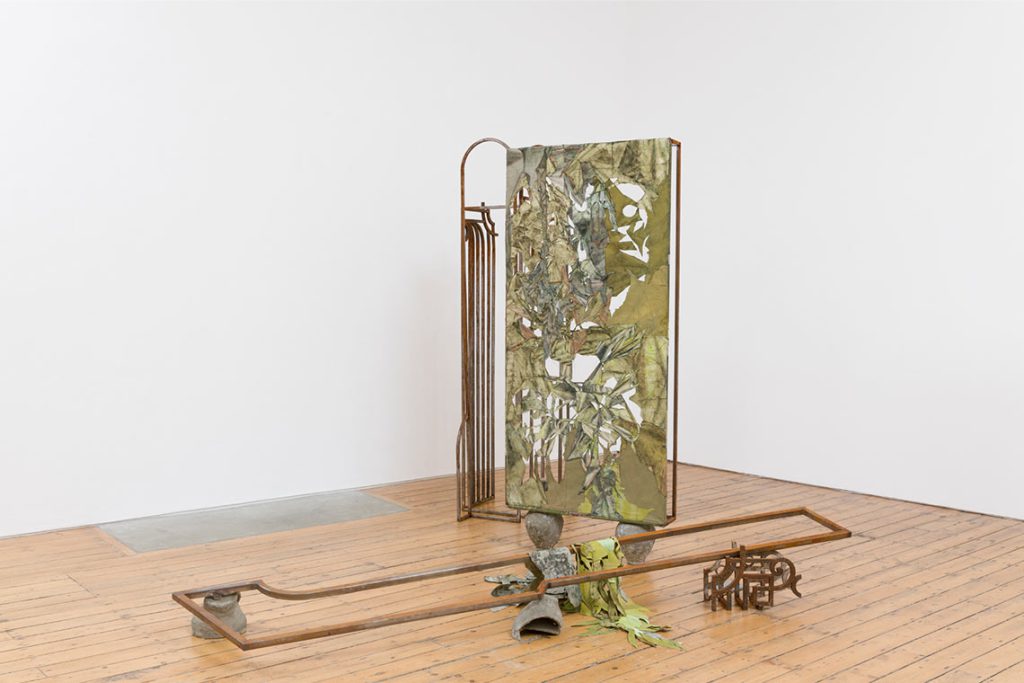
By being selective about the type of textiles and locally sourced dyes with which she works, Jaouda intends to “embody an ecology of migration”. She has embraced what she terms “a migratory practice”, split between Cairo and London, explaining that it did not make sense to choose only one base. She believes that our identities, like plants, develop new roots while growing, allowing them to transcend borders. Yet, the constant movement and provisionality have also invited Jaouda to strongly consider the importance of site-specificity, leading to a practice that is highly responsive to its surroundings. “As I move, the colours, textures and forms shift,” she says. Even in a globalised world, many parts of our urban and natural environment – from architecture to flora and fauna – become symbols of a specific region or culture. “Our relationship to our landscape is central to our spiritual and ancestral connection to the land,” she insists.
Having previously shown predominantly with small non-profits or commercial galleries, Jaouda’s 2025 is already off to a very busy start after she was suddenly thrust into the public eye in Venice last year. In January, she installed the monumental installation Before the Last Sky at the second Islamic Arts Biennale in Jeddah (see page 146). The triptych of tapestries is draped from a metal fixture suspended from the ceiling, gently echoing the different postures in Islamic prayer: sujud, ruqu’, and julus. As such, the work’s densely montaged and unpredictable patterns, in shades of yellow, burnt ochre and aquamarine, are experienced by the viewer as a series of rising crests. The piece was inspired by the humble prayer mat, but prompts us to consider lofty questions like “How do we create sacred space?” Or, “How do we connect our internal and external world, our material and our spiritual world?” The mat, by transforming a floor from mundane to sacred, transports the user, allowing them to transcend time and place through ritual and devotion.
This autumn, Jaouda will round out the year with her first institutional solo exhibition at Spike Island in Bristol, England. Although nothing has yet been revealed about the show, the artist’s star turns in Venice and Jeddah suggest that, once again, her work will open our eyes to the often-overlooked capacity of textiles to summon endless meditative and introspective possibilities.
This profile first appeared in Canvas 117: The Maghreb Issue
