

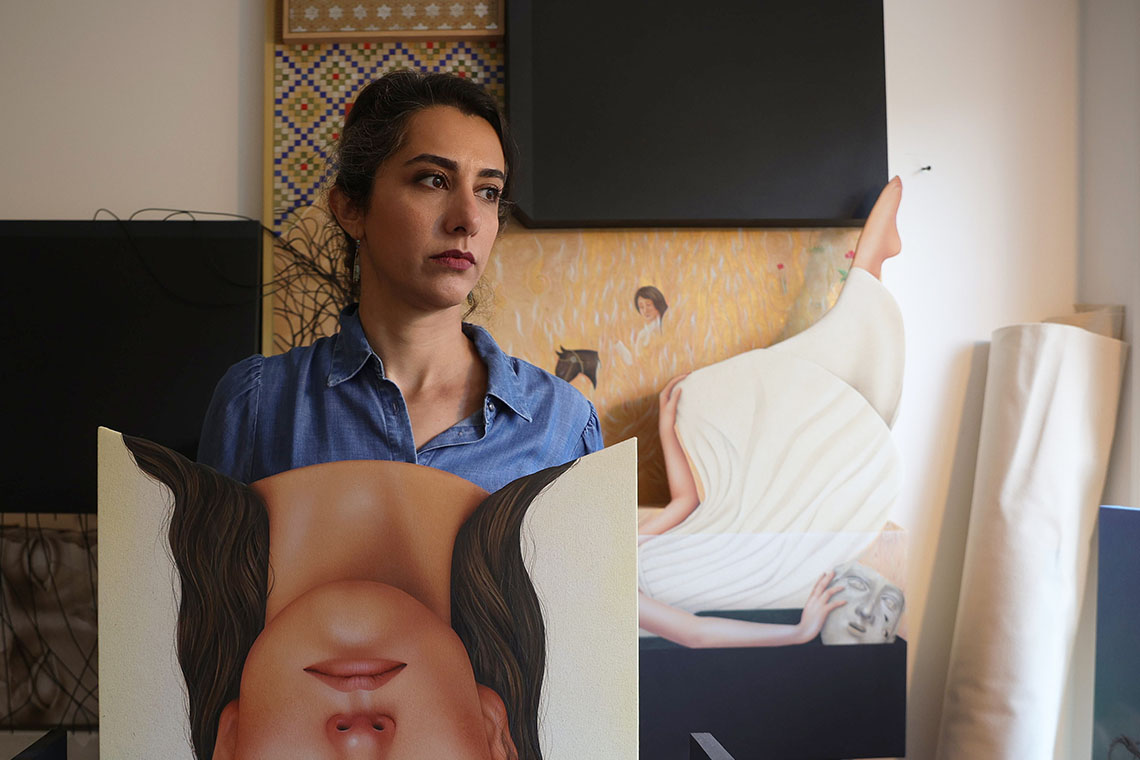
The artist’s triptychs frame lucid dreams and punchy realities into windows and onto homes and minds.
Home has always been a complex subject for artists of the diaspora. There or here, a determined place of belonging feels fleeting and even beyond reach. For Arghavan Khosravi, home is more of an inner place undetermined by physical presence or residence. A constant afterthought, however, the ultimate harbour is an exercise on her transforming relationship with her own identity. After leaving Iran a decade ago, the Connecticut-based multimedia artist delves into the everyday experience of an unanswered response to where home might be.
Khosravi’s newest series of sculptural triptychs carve dreamlike instances in which architectural interiors operate like portals to the subconsciousness. “They are emotional or psychological residues of memories of private and public spaces in Iran,” she tells Canvas. The artist stresses that the vignettes are not autobiographical but rather borrowed from her dreams, which find themselves organically in her altar-like constructions. “They can be snapshots from a dream that I cannot even remember,” she muses, explaining that letting her imagination take the lead ushers her to each juxtaposition.
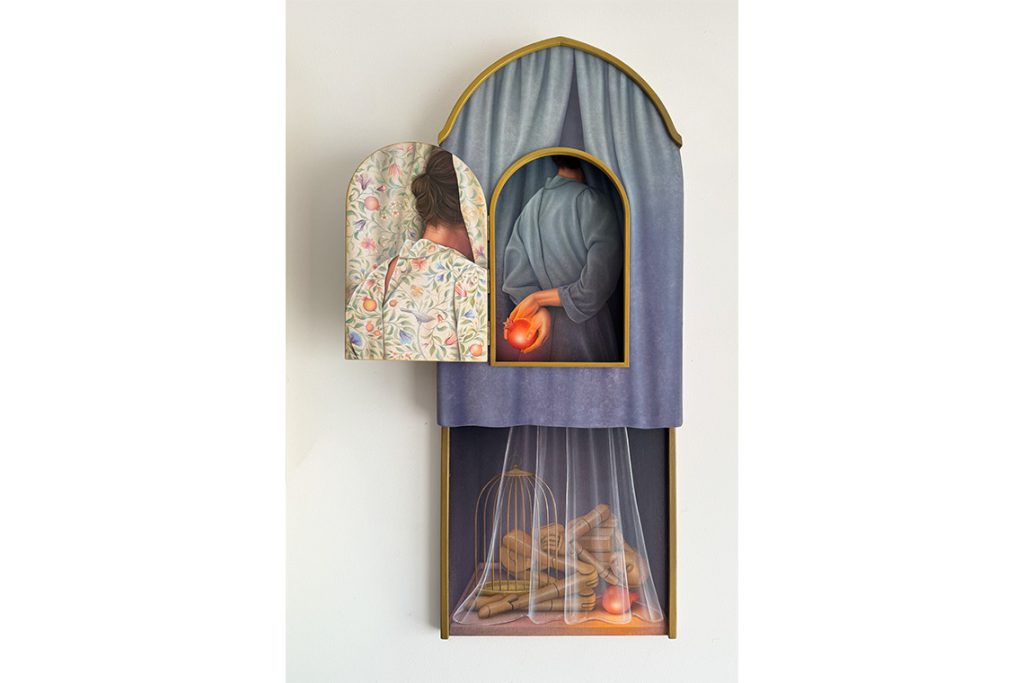
A female protagonist anchors each mise-en-scéne, emerging from different corners alluding to architectural frameworks, such as windows, doors or mirrors. These arched borders materialise the duality which establishes Khosravi’s visual vocabulary. Inside or in, home or away, a fluid determination of the self pokes, hides or reveals herself. The figure’s decidedly contemporary appearance is a deliberate choice. “I like to have visual hints such as clothing that suggest this scene is happening right now,” she says, emphasising that the woman is neither herself nor another real-life person.
With a cinematic expression and theatrical posture, the figure challenges the work’s flatness. By lifting a curtain or looking at herself in the mirror, she assumes self-awareness, even daring to acknowledge the viewer’s presence through occasional direct gazes. Khosravi illustrates her universe in bold poppy colours that support her attempt to render the scenography of the very moment. The palette also defies signals of taste and relatability. The Rhode Island School of Design graduate artist admits to using neon colours to build an immediate bond with the viewer, starting with a visual bridge to plunge them into an enigmatic discovery in each triptych. She recognises the melancholy and even violence that she occasionally finds herself depicting. A discarded wooden puppet, for example, lies crumpled at the bottom of a vignette, with an empty bird cage next to the skeleton-like body. She uses a pomegranate as a pillow while lying on the floor, which feels somewhat chilling. A similar pomegranate appears in the hand of a woman whose face is hidden from the viewer. Draped, her upper body remains an unknown, just like another woman whose likeness appears in the open window, where a floral drapery also shrouds her visage. The cropped presence of the figures ignites a sense of yearning, contributing to the artist’s experimental handling of the body. The corporal limitedness, however, also refers to acts of censorship which we impose on ourselves or feel dictated by other powers. Eyes deprived from the onlooker or bodies cropped by architecture carve room for symbolism to flourish and hand the viewer autonomy in imagining their own inner world.
In another work, a broken wine glass appears next to a woman, whose solemn expression is contrasted by her earring, protruding from the flat surface and connecting with her other ear, which appears on the right panel in the form of the woman’s own reflection in the mirror. This trompe-l’œil effect repeats across the series – for example, as wires connecting two opposite windows from where the subject rises with a contemplative expression. In other cases, stereo-foam or wood panels add the third dimension to the artist’s mysterious conduction of scenography. Bulky chains and vein-like strings occasionally materialise in Khosravi’s visual palette to accentuate comfort with tension. What can be considered both ornamentation and constraint infuse a tactility that is emancipating as much as limiting on her subjects. Woven similar to threads, these three-dimensional components suggest depth and beautification, but the artist also asks the viewer to consider them as restraints. “I think about restrictions imposed on us by controlling systems,” she says. The woven accents, according to Khosravi, operate as line drawings in space as well as art historical references to gold halos depicted above holy figures in Christian iconography.
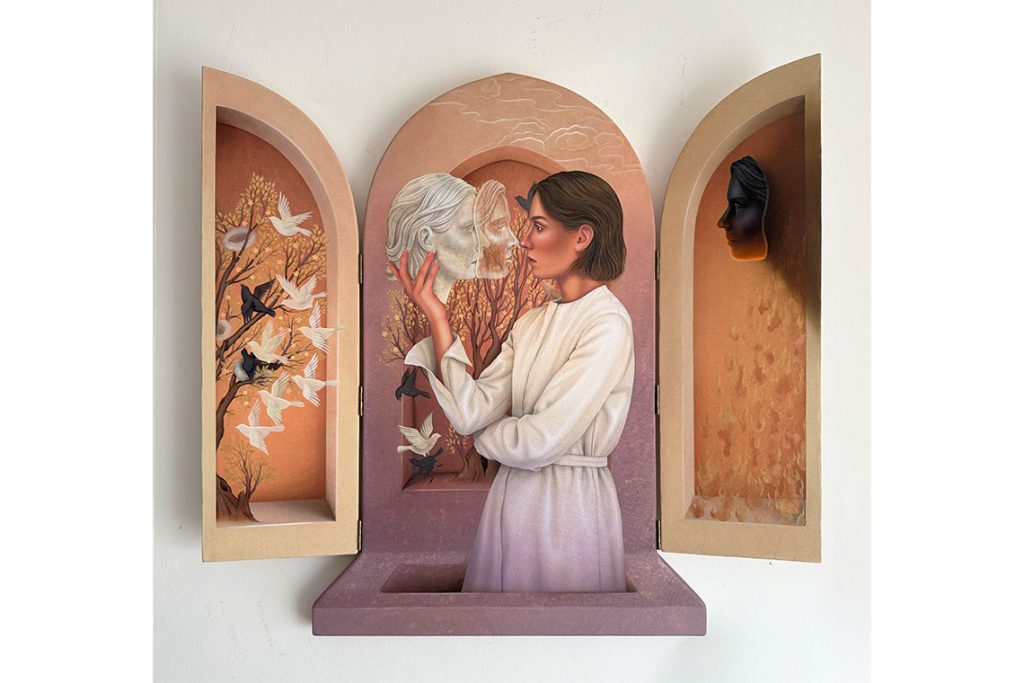
Sculptural touches also contribute to Khosravi’s search of interiority from an architectural point of view. She layers her cerebral constructions with immediate reminders of the very physicality of her fascination for the self. Palpable and direct, each picture echoes as an invitation to look and even step into. As much as a summoning, the artist’s universe feels like a secret, placing the viewer into voyeur position, gazing through the keyhole. A tweaked sense of scale contributes to this sense of dream reality in which bodies and fruits can easily be the same size, or a tear dropping from an eye can equal the roof of a building in dimension.
“If I need to distill all my practice to one word, it is contradiction,” Khosravi explains. Beyond bright colours and an idealised beauty, the polarities such as warmth and eeriness or gazing and being subjugated keep the artist’s lexicon kinetic and porous. She cites traditional Persian miniatures as the foremost guidance for her approach to interiors. “I flatten the space and eliminate the vanishing point,” she explains. The stacked perspective which subverts the realistic sense of depth and scale similarly frees her from a perceivable reason, rather granting her with multiple ways – surreal or familiar – to inhabit a place. Online archives of institutions such as The Metropolitan Museum of Art and Harvard Art Museums give her access to different examples of Persian miniature, connecting her with an interest she took up while studying at the University of Tehran.
Iran still casts its influence. Her years as a children’s book illustrator after getting a degree in graphic design wink at the viewer in the boldly editorialised illustration of a young woman or with the poppy colouration of a dress or a window. “I’m not trying to hide this aspect of my career,” the artist says. “If I didn’t have that experience, my work today would have looked different”. Logo design, on the other hand, was fundamental in grasping the relationship between form, composition and colour: “I learned how to communicate different subject matters with limited room to manoeuvre.” She admits, however, to finding graphic design too demanding for the conflict between her creative instincts and those of a client. In her art today, she dabbles with what are perhaps harder questions to answer, such as where the home is or what interiors feel more familiar. However, Khosravi’s responses continue to vary and burgeon, like the rooms of a mysterious house which, for someone, might mean a home.
This profile first appeared in Canvas 121: If Walls Could Talk
