

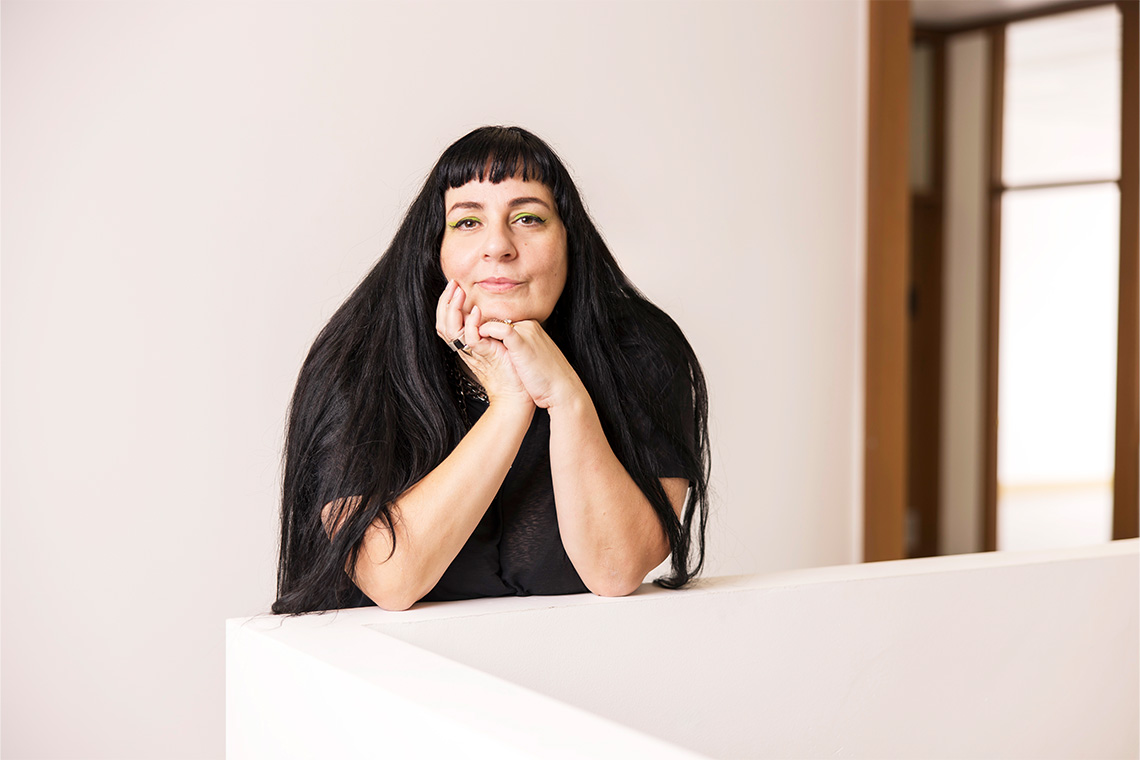
The artist makes art from the intricate choreography of family life – the unspoken rules, the inherited gestures, the weight of home.
A lounge is not a neutral space. For Marian Abboud, it is where warmth and surveillance operate simultaneously, where hospitality becomes performance, and where daughters learn to read their mother’s eyes in real time. “As a kid you learn those rules fast, often through a parent’s eyes,” she tells Canvas. In Abboud’s work, domestic interiors function as both sanctuary and instruction manual – sites of refuge that simultaneously encode behaviour and transmit cultural knowledge across generations.
Based in Western Sydney on Dharug Country, the ancestral home of the First Nations Dharug people, Abboud creates installations that bring the private life of Lebanese-Australian families into public view. Working across video projection, performance, installation and sound, she collaborates with her sisters, aunts and nieces, treating family not as subject matter but as co-creators holding embodied knowledge. Her materials are deliberately ephemeral – light, shadow, translucent fabrics – allowing images to hover and shift, much like memory itself.
At the heart of her practice sits a Lebanese Arabic word, wejbet. Abboud translates it as “the social contract of family”, those duties performed out of obligation, the formalities that shape family gatherings, the gestures of respect that must be performed just so. In a video published ahead of this year’s Biennale of Sydney, in which Abboud will take part, the artist explains her personal journey with wejbet: “I hated it, because I really wanted to exist in this assimilated Australia,” she admits. “Yet now… I’m really reaching back to all this cultural knowledge that I struggled with…Why did it take me 20 years to now embrace what is so important and so relevant in my life?”
This evolution – from resistance to recognition – is threaded through her work. My Cousins Home (2022), a two-channel video projection on blue chiffon, captures the restriction she once felt. The work documents an elaborate social dance: turning up to your cousin’s house unannounced but immaculately dressed, accepting tea even when you do not want it, kissing cheeks in the correct order, and “hospitality and hierarchy that run together”. Female family members stand on walls and porches – thresholds – holding long strings of bright blue beads that visually evoke those associated with prayer. The beads are held aloft in hands, hang downwards, or are stuffed in mouths, calling to mind both a flow of water and freedom and simultaneous stifling. The work embodies what Abboud describes as the dual nature of these spaces: “The ‘home’ reads as a soft place, and also a place where you learn discipline,” she reflects – capturing both the comfort and constraint of cultural transmission.
Growing up in a female-led household fundamentally shaped how she sees power. “It taught me how power operates without announcement,” she reflects. “Through care. Through timing. Through who serves, who holds the mood, who absorbs tension, who keeps the family moving.” She explains how she learned early on that women often “run the emotional infrastructure of a household while also carrying the weight of being judged inside it.” This understanding permeates her installations, where she returns repeatedly to women’s rituals as practical infrastructure rather than romanticised tradition.
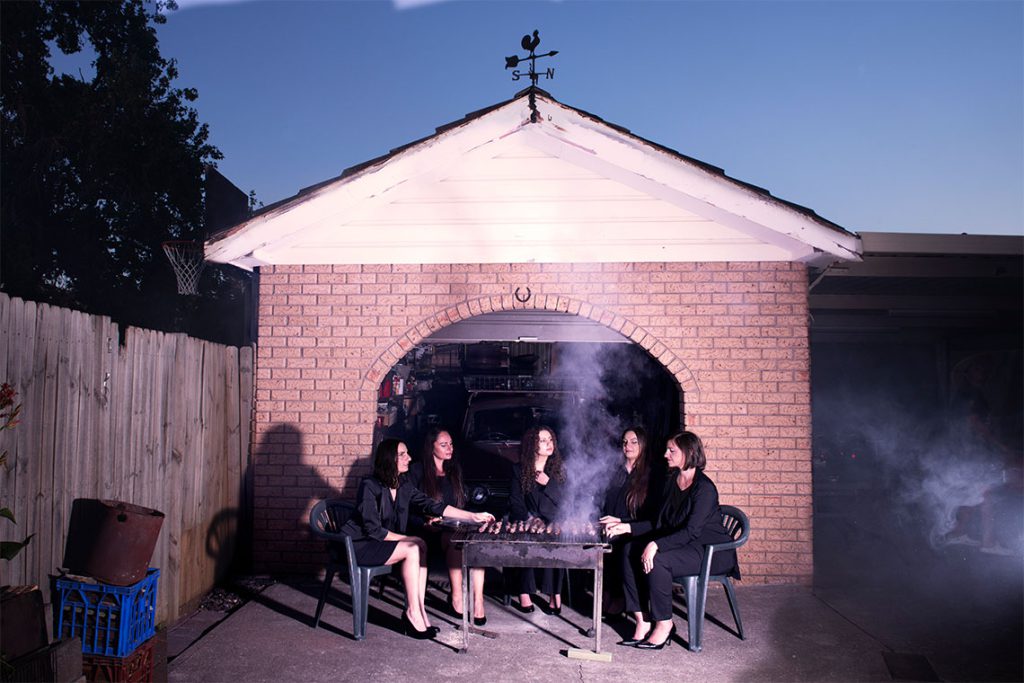
The Secret Handshake (2016), part of the Bloodline Series, examines mourning in particular as a gendered performance. With one particularly striking photograph depicting family members in black mourning dress sat outside a house – five women sit on a line of chairs on one side of a path and one man sits on the other side, creating a visual imbalance – the wider installation uses suspended sugar rocks, silk and organza, video projection and CRT televisions to ask what families demand of daughters and sisters during grief. “Grief brings people together, and it also sharpens roles, especially for women,” Abboud observes.
The artist’s commitment to collaboration extends her feminist analysis into practice. Her sisters are co-authors, not performers. “Family never felt like subject matter,” she insists. “It’s not mine to extract and present back. They hold the knowledge inside their body, the gestures, posture, the look between sisters, the timing of interactions, the way memory and grief moves through a body.” Working with her nieces brings a different energy: seriousness mixed with play.
Her attraction to projection and light-based work stems from their relationship to recollection. “Projection allows an image to behave like a memory,” she explains. “It lets an image feel like it’s visiting the room, rather than being fixed to it.” Light also brings a kind of tenderness to tough subjects, she notes, because the “scene never fully locks into place”. Shadow play also adds new dimensions – simple objects cast new characters, bringing an element of improvisation and discovery. This lack of fixedness also echoes Abboud’s conception of diasporic life, with its constant translation – between languages, generations, and public and private versions of yourself. “You can be one person at home and another person outside it, and both are real,” she notes. Home becomes the container for this complexity; a suburban interior might look unextraordinary, but Abboud believes it holds an archive: “what people brought, what they left behind, what they rebuilt.”
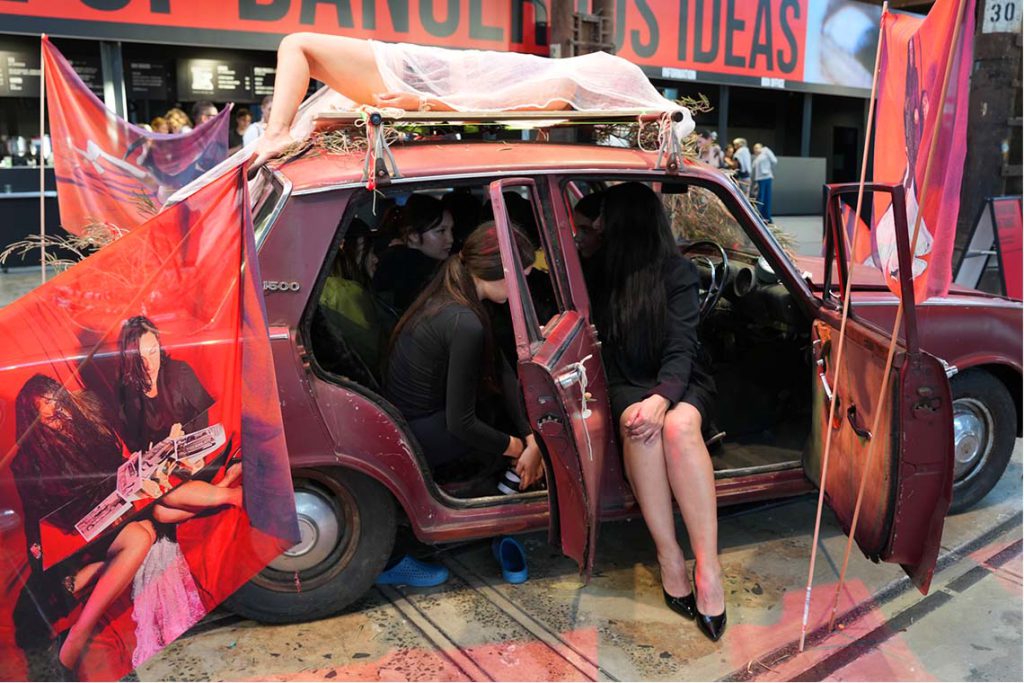
For the 25th Biennale of Sydney in 2026, Abboud will present the third iteration of her ongoing Bloodline Series, Sister +++++ Familial Formations III, centring her late father’s 1964 Isuzu Bellett – his first purchase after migrating to Australia. “It carried us through school drop-offs, weddings, funerals and Sundays across Western Sydney,” she says. After he died, the car sat untouched for a decade. Now her family are restoring it, turning repair into cultural memory work. The installation transforms the Bellett into a multi-sensory environment. Translucent fabrics printed with family photographs create semi-transparent partitions throughout the space. Audio from cassette recordings exchanged between Australia and Lebanon plays on loop, the audio quality degraded over the decades. Mounted on the car’s roof, a stack of old television sets displays a multi-channel video installation, presenting memory as fragments rather than linear narrative.
Visitors alternate between observing and participating directly, a movement that Abboud says mirrors what wejbet feels like to her now – “you step in, you resist, you return”. Through workshops, participants make amulets from turquoise, sugar and spices, contributing their own protective rituals to the installation. Authorship becomes distributed, transforming private family history into shared knowledge, building on what the artist describes as “a bank for collective memory, wisdom and knowledge to pass on to the next bloodline”.
The biennale context amplifies the work’s significance. “I’m making a case that family histories belong in public at this moment,” she insists, “especially when migrant and refugee communities are still spoken about through policy language rather than cultural presence.” By securing space within a major international exhibition, Abboud demands that these intimate domestic records be treated with institutional seriousness.
What emerges throughout Abboud’s practice is a portrait of home as something far more complex than simply comfort. It is the place where identity forms through small instructions and private codes, where obligations gradually transform into inheritance. In Abboud’s work, the domestic represents both pressure and preservation – the site where culture survives because someone, usually a woman, decided it mattered enough to carry forward.
This profile first appeared in Canvas 121: If Walls Could Talk
