

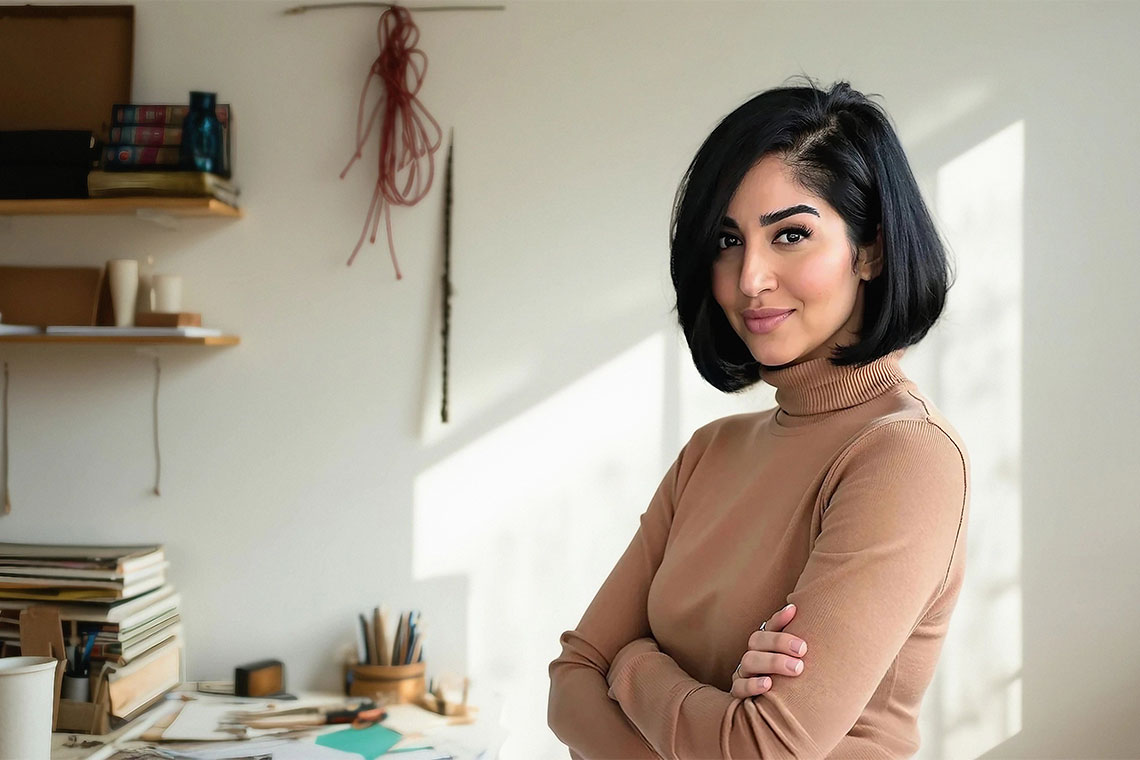
The artist’s experimental, technology-driven practice redefines and tests the limits of the human body.
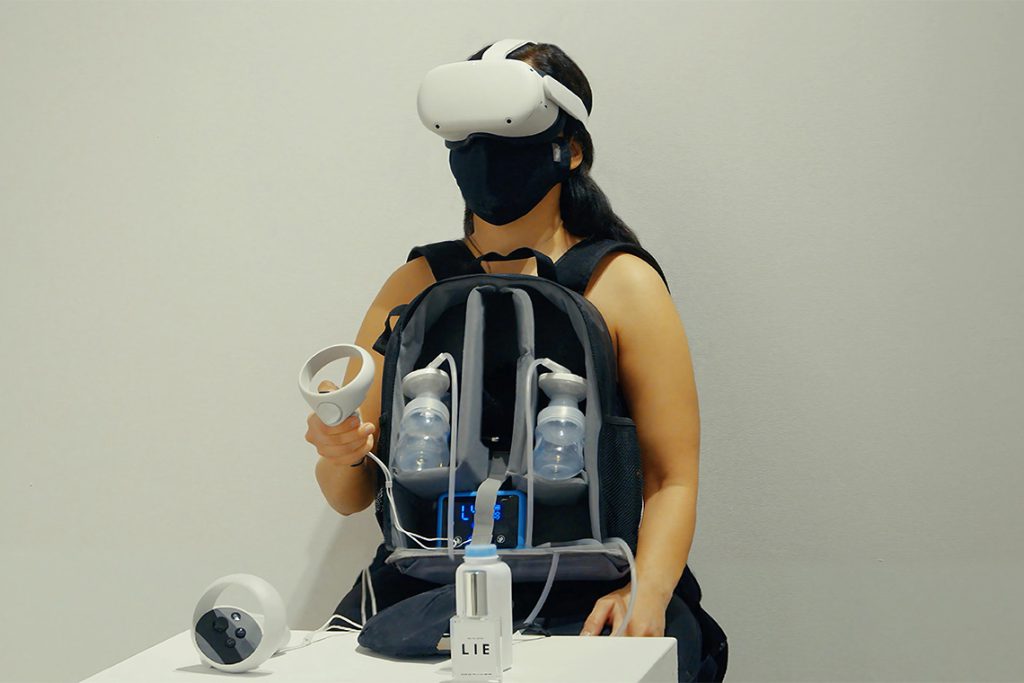
Lactation is one of many complex bodily processes that appear to work like magic. After having a baby, a woman produces the milk needed to sustain new life. These days, however, scientists are able to manipulate nature and our bodies to achieve otherwise impossible outcomes. The Iranian artist Sara Niroobakhsh is fascinated by this, our ever more intimate relationship with technology, whether it is an extension of us or, increasingly, assumes authority over us. In 2021, she launched the experimental biohacking performance LIE: Lactation Induction Engine to trick her body into producing milk, or “reprogramme it to believe that care is still possible even when the conditions are wrong”. Niroobakhsh relied primarily on a pumping machine to stimulate her breast ducts. It became a companion, a prosthetic.
Eventually, she added sensory stimuli, like the sound of newborns crying and the smell of their skin, “not to master her body, but to make it feel”. Amazingly, by the 21st week, the first colostrum began to flow. “Technology in my work is never something shiny and smooth,” she says. “It might be failing. It might be fragile. I’m drawn to technologies that ask questions.”
Born in Iran in 1981, Niroobakhsh was not provided with a formal art education at school. “I grew up in a time when creative expression had to find indirect channels, especially for girls,” she recalls. From a young age she was highly observant with a particular sensitivity to gesture. “I was always drawn to hidden languages, things that are unsaid but that I felt deeply,” she says. “The body not as an object but as a site of tactful negotiation, of storing memory, of navigating friction in the family and in culture.”
Her father’s job as a supervisor at an oil refinery gave Niroobakhsh access to a library and she became an avid reader of science fiction. In hindsight, she understands this as an act of resistance. “It offered the radical permission to imagine other systems, other sciences, other anatomies, other futures,” she explains. “It was a blueprint of survival that helped me understand my own alien position within my small community. I always try to examine larger systems of power and erasure.”
It was not until Niroobakhsh went to university, however, that she was able to develop these ideas further. She first completed her BFA in Graphic Design at Shariaty Technical and Vocational College in 2004 before moving on to an MFA in Illustration at Tehran University of Art. Thanks to lively class debates about critical theory, Niroobakhsh began contemplating society’s many contradictions, “like beauty and censorship, intimacy and surveillance, tenderness and control”. These thoughts inspired a series of minimalistic durational performances, principally composed of silence, repetition and sequences. “I had a deep need to test what the body could say when words felt insufficient and censored,” she says of these spare and serious works.
Shortly after graduating, however, the opportunity to take part in a residency organised by the director of the Tehran Museum of Contemporary Art pushed Niroobakhsh to explore her nascent interest in oil painting. Combining performance with new conceptual experiments, Niroobakhsh took more than 500 photographs of herself and other models flinging themselves off a high ladder and onto a mattress below. These became the source material for a series of paintings, Self-Portraits, initiated around 2011. Embellished with broken glass or an endless expanse of sky, the works heighten the dramatic tension and danger of Niroobakhsh’s freefall.
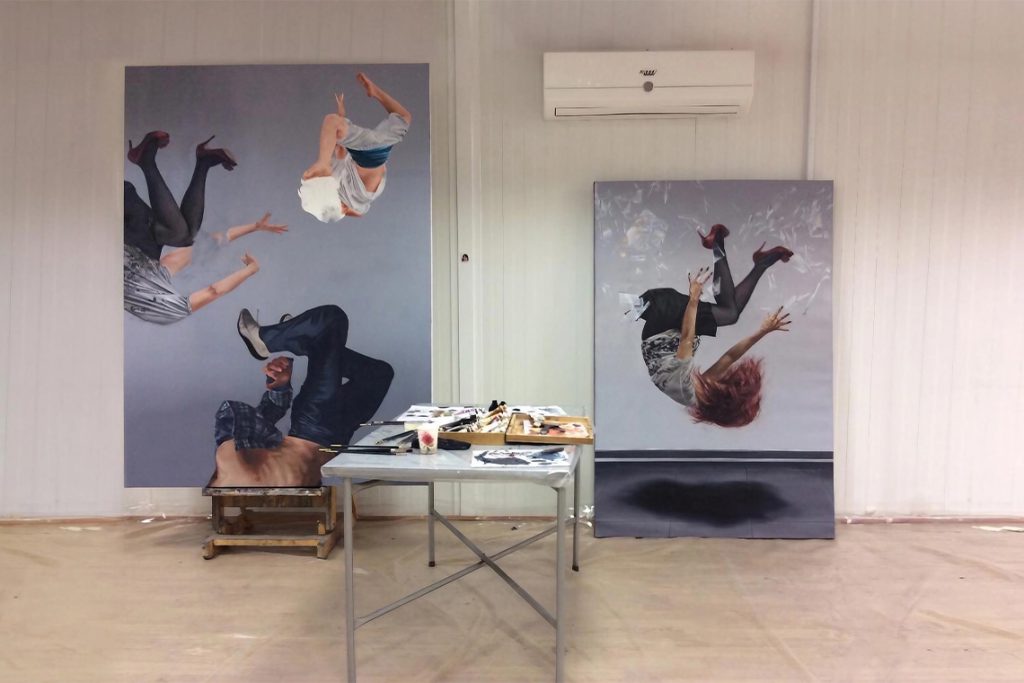
The surprising works partially reflected the artist’s trepidation about her imminent emigration to Canada, a daunting journey into the unknown. “It felt like dying for me,” she said. “I wanted to capture the momentum that I didn’t know how to measure.” The works were a major turning point in her “understanding that my body could speak. It was the first time I looked at myself not as a finished object but as resistant, political, as a system of information.”
In 2020, Niroobakhsh began an MFA in Art and Technology Studies at the School of the Art Institute of Chicago (SAIC). Although the course introduced her to technologies she had never even heard of before, she soon realised that she had been “designing these systems all along” via embodied processes that she would now be able to expand with new tools. In that sense, the most important thing she gained was not technological know-how but “learning to trust my intuition and begin articulating a practice that was already hybrid at its core”.
After the death of her mother, following a nearly decade-long battle with cancer, Niroobakhsh found solace in using homemade saffron-infused saline solutions to crystallise some of her mother’s most treasured belongings, including her shoes, mirror and chess board. The word ‘crystallise’ can mean ‘purify’ in Niroobakhsh’s native Farsi, and the colour and scent of the saffron carried memories of the classic Persian dishes that her mother used to cook. As Niroobakhsh experimented with different solutions, noting which formed faster or were more fragile, she found a parallel with the growth of cancer cells within the flesh or bone. It begged the question of how her own body might respond to the crystallising process.
At one of the performance venues at SAIC, Niroobakhsh staged Tabalvour (2020), for which she made a clay vessel inspired by ancient burial rites from her region. Curled up inside, she immersed herself in hot saturated sodium borate liquid and saffron for an arduous two hours. At first she felt dizzy and numb and, by the time crystals began to form, she had to remain completely still. Eventually, the salty liquid put Niroobakhsh into a state of extreme dehydration, causing her skin to burn and her head to ache. Through submitting to the transformative experience, which Niroobakhsh described as “healing”, she realised art’s capacity to shift perspectives. “I was able to view death as something that transferred [my mother’s] suffering body to a more valuable thing,” she explains.
Niroobakhsh’s practice is undoubtedly unique, although she admires other artists who are also “unafraid to treat failure as a method in their art” and “ask questions about the world, humanity, intimacy”. Her partner, the celebrated Iraqi-born American performance artist Wafaa Bilal, is a frequent collaborator. At the moment, they are expanding a project first conceived for COP 28 in Dubai in 2023. It will centre around the planting of date palms along the Iran-Iraq border as a gesture of trans-generational grief, reconciliation and ecological regeneration.
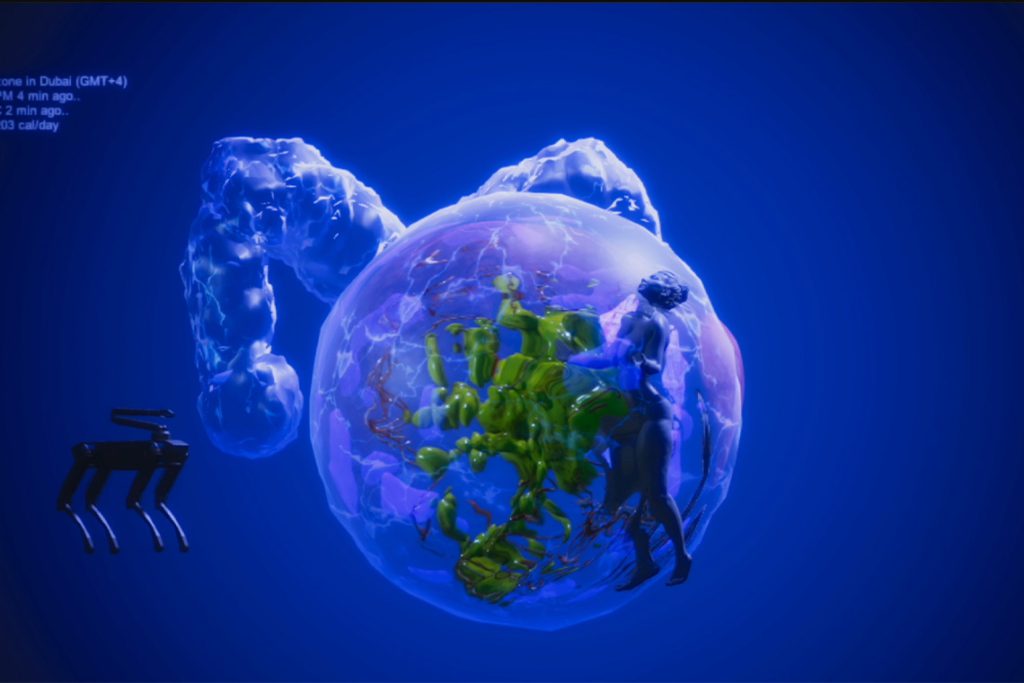
Niroobakhsh is also developing a new speculative performance that explores the increasingly commonplace collision of biology and technology, especially in the realm of reproduction. For IB: Impossible Baby (2023–), she plans to implant an artificial embryo into her uterus for nine months. Covered in sensors and powered by AI, it will be able to record data and communicate with the outside world via the internet. The boldly intrepid work will explore the possibility of embodied AI, not as a tool but as a collaborator. It is a relationship that we must navigate with increasing urgency, she suggests, claiming that “what current AI is lacking is an understanding of divine humanity. It’s still learning from us.” Yet how can we hope to connect with this entity? Although she does not have any answers yet, Niroobakhsh plans to keep using tech, the body and performance in her search “for ways to resolve questions that feel too fragile or scary, or too layered and complex, to express through only one language.”
