

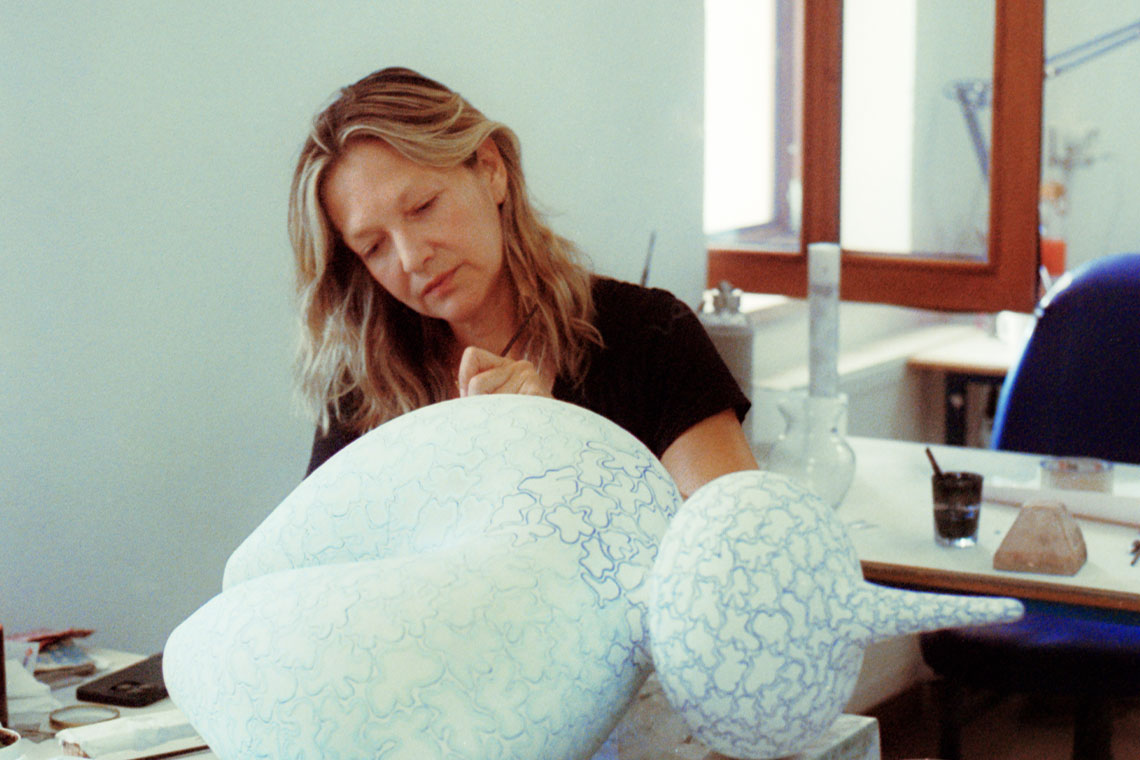
The New York-based Turkish artist forms clay on both sides of the Atlantic to expand the potentials of myths and everyday realities.
Between two continents and dual methods of pottery, Elif Uras has honed a ceramic practice that teeters between tradition and experimentation. The Ankara-born sculptor, who lives and works between New York, Istanbul and İznik, forges intimate silhouettes in ceramic, most of which allude to corporal forms embodied in clay’s time-defying permanence. She decorates the vessels with images of female labour and resilience, often presenting them in collective action within ornate vignettes. The material’s innate fragility, on the other hand, veils her sculptures with a gentle commentary on time and its non-linear paths. This harmony of resistance – both bodily and materialistically – and alchemic susceptibility yield sculptures that brim with lush surfaces, bulbous forms and mythic narratives.
Uras’s decision to infuse female bodies onto her vessels resulted from the traditional lack of the subject matter in pottery. “I immediately wanted to place women figures onto my ceramics, because the common forms in pottery have always been abstract,” she tells Canvas. “The icons of prehistoric goddesses seemed to be so naturalistic and inspiring.” The millennia-old clay tradition across Anatolia provides what she calls a “wealth of information” during her research. The same geography’s myriad pre-Islamic myths, in which goddesses such as Kybele and Artemis claim matriarchal clout, continue to provide ceaseless visual and fictive cues.
The artist weaves a bi-continental practice between her home studio in Manhattan, located a ten-minute walk from the Greenwich House Pottery where she often fires, and the ceramics studio where she has been forming clay for the last 15 years in İznik. The pottery tradition in the north-western Turkish town dates back to the fifteenth-century Ottoman Empire, when artisans crafted the early examples of the region’s signature intricate patterns in cobalt blue. She enjoys the contrast between her two methods in two geographies that she considers home. “I start with a lump of clay on the wheel and wait for the revelatory moment of how the work turns out,” she says. Slip casting, however, requires a sketch for a precise finale and help from other artists to lift the large-scale stoneware.
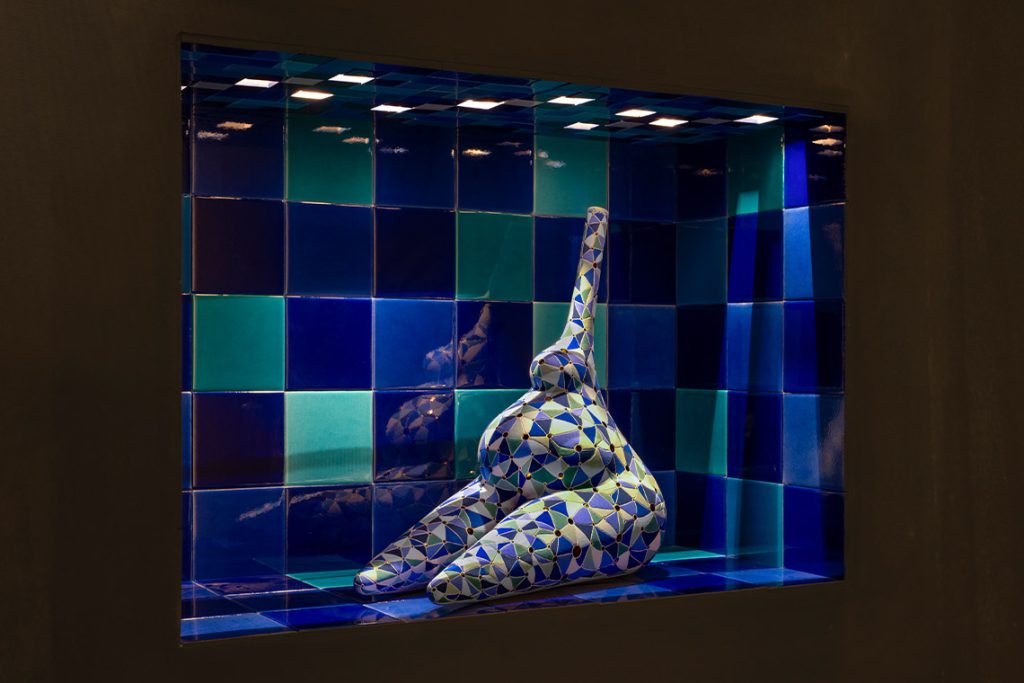
Uras’s current solo exhibition, Earth on their Hands, at Istanbul gallery Galerist, alchemises rooted artisanal techniques with a narrative-forward lens trained on overlooked female micro-histories. A 70-cm sculpture, titled Craft Palace (2025), pairs a cube-shaped base with a globular body that morphs into a cone head; a thin waist secures the balance between the hexahedron foundation and the orb. Overall, Uras has adorned the surface with miniature images of women performing tasks that range from domestic to artistic. They cook and clean, but we also see them forming clay at a pottery studio. Their nudeness shrouds the figures with a sense of eternity. Amazonian and decisive, they operate as a community yet focus on each task with sharp devotion. The cone-shaped crown is painted as a map, where the gnarly earth-toned land creeps into the azure hue that in fact dresses the entire vessel. A commanding body herself, the sculpture encapsulates multitudes of lands, tales and labours.
No! (2025), is a tablet covered with a rich motif of nude women protestors whose arms are all ceremoniously raised in the air. They are held within a large banner clutched vehemently by another taller, also nude, female figure. From the sea of determined limbs rises another banner that simply reads “no” in a cursive font. “I look at the body as a site of labour, production and resistance,” says Uras. The same gentle typeface borders the entire horizontal frame with the same expression of refusal. “No” echoes out of the tablet as an emblem of female resistance against violence and social restraints. Turkey’s growing femicide rate renders the juxtaposition alarmingly contemporary, in contrast to the artist’s evergreen miniature approach to figuration. “Border patterns give a link to the lineage of ornamentation,” adds Uras, whose tender handling of patterns amplifies the iconography’s punchy message. The tablet format bridges the ancient with the very moment in which an urgent call for action is embodied through the ineffable reality of the human form.
Despite the immediacy of her intricately illustrated messages, Uras’s oeuvre challenges limitations of place and time – instead, methods of production and storytelling span different geographies. Two distinct ways of pottery on dual sides of the ocean keep her practice porous. Wheel-throwing is reserved for New York, where she moved in the late 1990s for a law degree at Columbia University. After receiving her MFA in painting in 2003, she found herself in plates hail from this side of the Atlantic, where high-fire kilns are more commonly utilised compared to İznik ceramics, which are traditionally low fired. “The clay is softer and more fragile in the United States,” the artist explains, “which makes the material more forgiving.”
A wall-spanning spiral display of around 200 coins have also travelled from overseas. The meticulously adorned clay rounds each contain minuscule illustrations of common or divine endeavours, performed by deities or everyday people. Kybele, who carries a city over her head, is not far from Sabiha Tansuğ, the Turkish ethnographer and artefact collector for whom Türkiye issued a coin depicting her face in the 1970s. On others, women farm their lands or defend their olive trees against demolishers. The installation flattens the hierarchy between mythic victories and those fought by everyday women, suggesting a re-reading of feminine defiance and productivity beyond motherhood. “They are proposals for the future that take cues from the past,” says Uras.
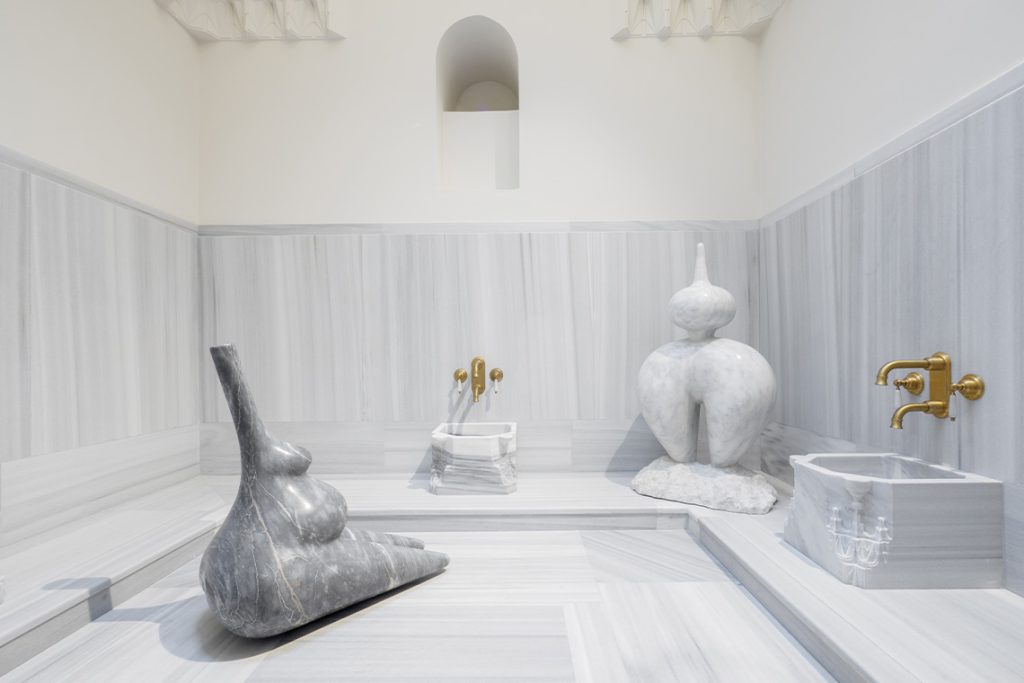
Image courtesy of the artist and Galerist
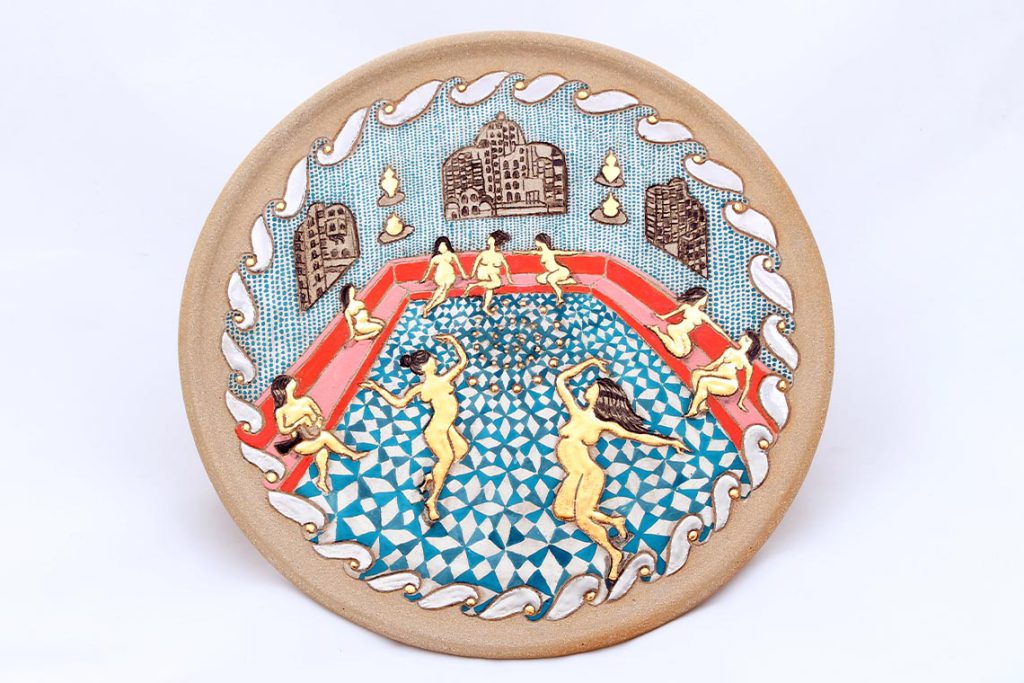
The gold lustre details on plates, coins and vessels push suggestions of ornamentation towards a commentary on value. Gold’s long-standing status as a matriarchal token and feminine ornamentation is challenged in the artist’s hands as a symbol of micro-finance. In the Turkish domestic tradition of altın günü (roughly translated as “gold or golden day”), housewives host one another weekly for a late lunch and occasionally dancing, with each guest bringing a gold coin for the hostess. Camaraderie and hosting garner an alternative income for women who remain outside of the workforce. “It is a unique homosocial tradition and a form of female bond and support,” explains Uras. Golden Day (2025) is a plate form on which the ritual of the titular gathering is performed in the artist’s fashion. The fish-eye view shows a group of nude women dancing and socialising, their lush hair adding voluminous individual character to otherwise identical-looking figures. The domestic setting is as ornate as the artist’s elegant abstract motifs that circle the vignette. Production Line (2023), on which a group of women carve onto clay sculptures, is bordered by a circular series of hands that pass gold coins to one another. Ornamentation functions as a signal of life cycle and the self-sufficiency of women through work. Uras – who no longer paints on canvas – favours the plates as ideal surfaces: “I see my work between painting and sculpture, and an object like a plate has its own innate power.”
The show’s larger vessels, such as Pink Taurus and Great Mother (Büyük Ana) (both 2025), come from the İznik studio where slip casting allows for vertical breasted figures with hollow insides. Their larger forms often require help from fellow potters. A few stoneware pieces stand on legs, while others sit or are positioned on all fours as half-human and half-animal beings. Their intricate carvings result from long hours of application by Uras in the studio. “I am inspired by past heritage and how matriarchal support has shaped value,” she adds. Her own labour, whether alone or with others, invariably seeps into the clay with each carving, bearing its own myths for today and future.
