

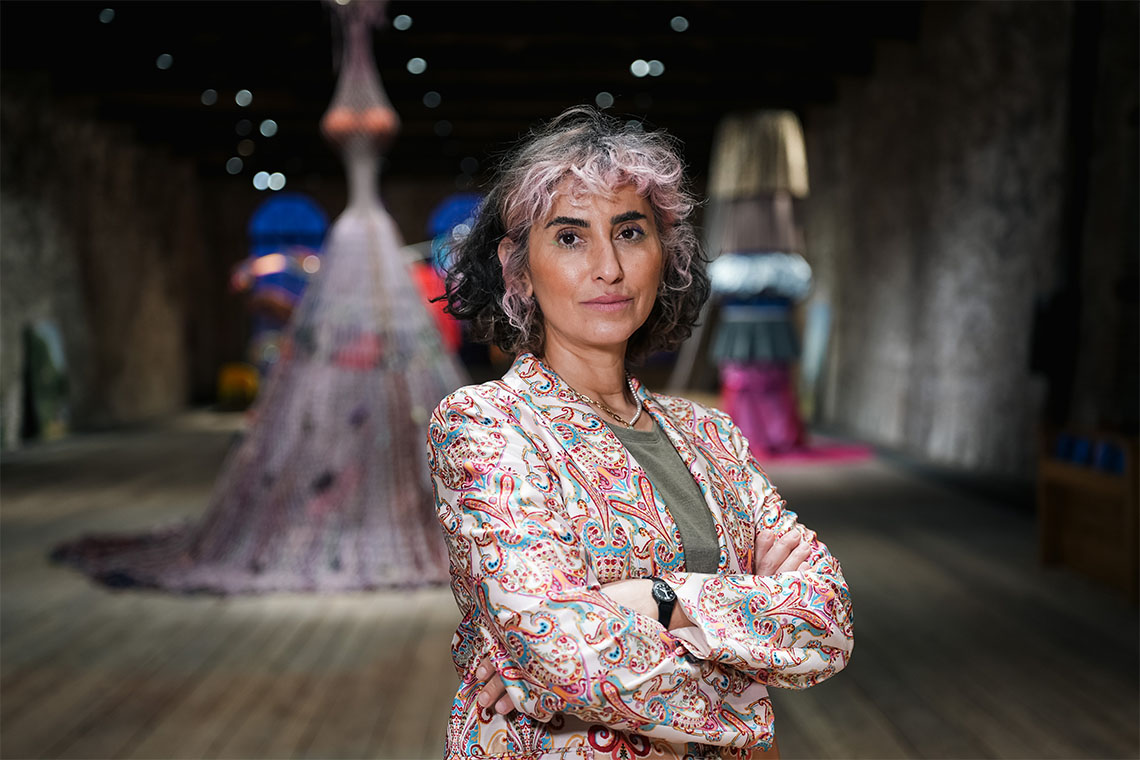
The artist’s installation at the Türkiye Pavilion asks firm questions about migration, determination and fluidity, all with her rich palette of materials.
Nilbar Güreş is fascinated by the nooks and crannies of language. She is even more captivated by how translation occasionally dilutes an expression’s beating heart or the ways in which a word remains defiant to literal counterparts across geographies and cultures. The true intrigue, the multidisciplinary artist tells Canvas, is found in the “gestures and meanings that don’t need to be translated”.
This realm of interest was instrumental in the research carried out by Güreş for the project she presents at the Biennale. She eventually landed on the title A Kiss on the Eyes, inspired by a Turkish term of endearment historically utilised at the end of penned letters to deliver a heartfelt closure. Often sent to younger family members from their elders, a peck on the eye suggests sincerity and compassion with an acknowledgement of lineal hierarchy and the tenderness of familial bonds. Güreş took the bold path of “being incomprehensible through language” at some point in her process and settled on an expression that refuses a word-to-word translation into English or Italian. “I realised once again how much the need for intelligibility creates stress for us creative people,” she ruminates. “This time, I let the audience wonder and ask themselves what it means to kiss someone’s eyes.”
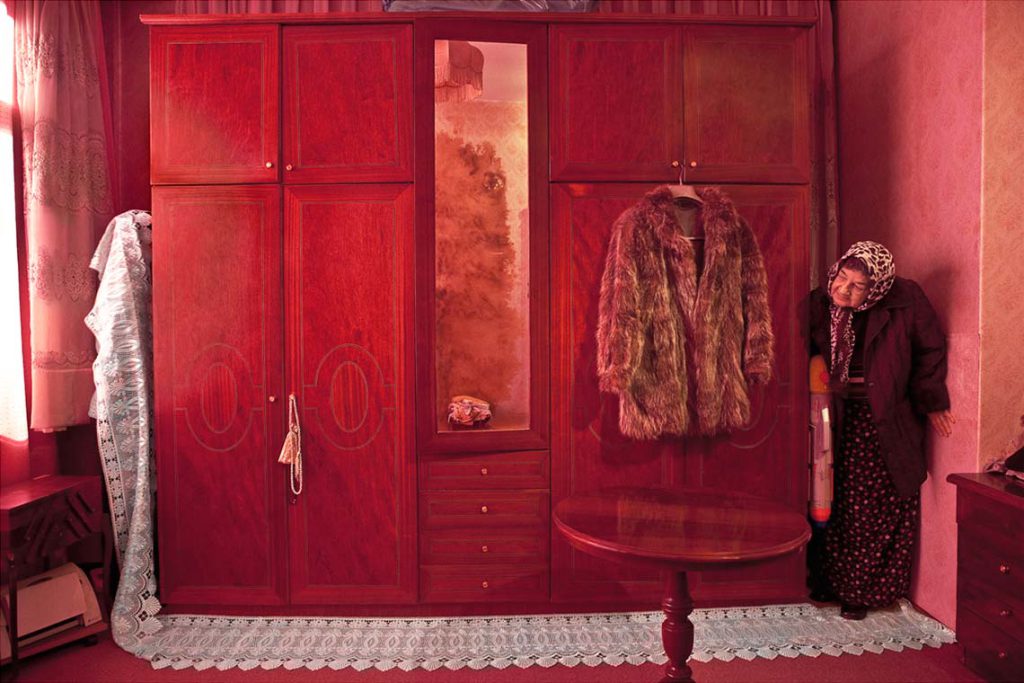
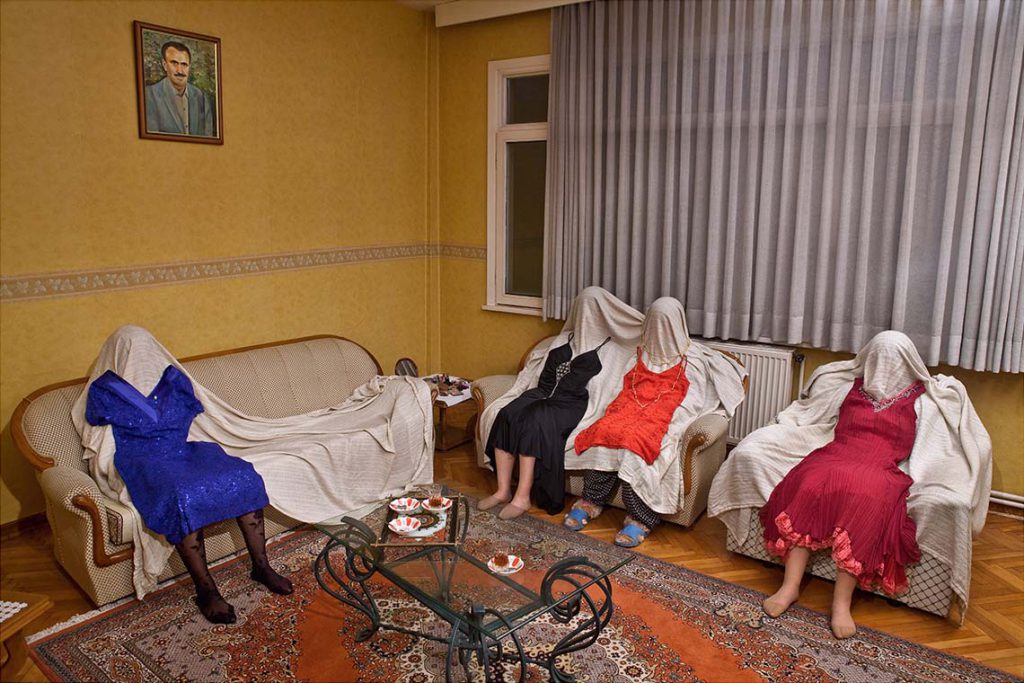
A singular question, if not multiples of it, is repeatedly begged for in Güreş’s multimedia works, which rarely conceal their socially driven and visually vocal statements. Tactile fabrics, lace-covered paintings and lipstick marks left on paper are among the Vienna-, Naples- and Istanbul-based artist’s gestures to converse with her viewers on immigration, tumultuous social dynamics and oppression of the body. Brutally intimate and immediately absorbing, her often soaring and occasionally modest-scale outings unite in their textural wealth and layered narrative. For Güreş, each material is a well waiting to be looked down into. “I don’t see lipstick as just lipstick, or metal as just metal,” she says, instead inviting the make-up tool to be seen as a “rising skyscraper”. Or why not see metal as a “second skin warmed by human warmth”? Whether on paper or in three dimensions, tactility remains a breathing essence across her practice. For the 11th Istanbul Biennial in 2009, she presented an interpretation of her Unknown Sports series in which women carried banners made out of bedsheets at a gym. The politicisation of textiles was also central at the 31st São Paulo Biennial in 2014, for which the artist created fabric sculptures with texts pulled from protest banners being marched along the streets of Brazil.
Similar to the beauty inherent in the eyes of its beholder, the nature of Güreş’s materials, she thinks, echoes the “preferences and priorities of the kind and spirit that will use them”. Familiarity and purpose are feelings that she borrows from everyday life to wrap her viewers in en route to revelations on how we live and resist. The gendered allure of a lipstick or the comforting promise of a fuzzy fabric inhabit a sharp territory of alarm and familiarity. “Every form exists for its admirer,” she muses, pointing at her own thrills: “I, too, greatly enjoy working with forms reflecting the pursuits I admire”. The mundane – occasionally alarming, if not numbing – appears in ways that challenge our association with normalcy and its subjectivity. The 20th Biennale of Sydney in 2016 presented Güreş’s three-channel video installation, Open Phone Booth (2011), in which vignettes from daily life in a remote Eastern Anatolian town chronicled the struggles of local people with the ailing telecommunication infrastructure.
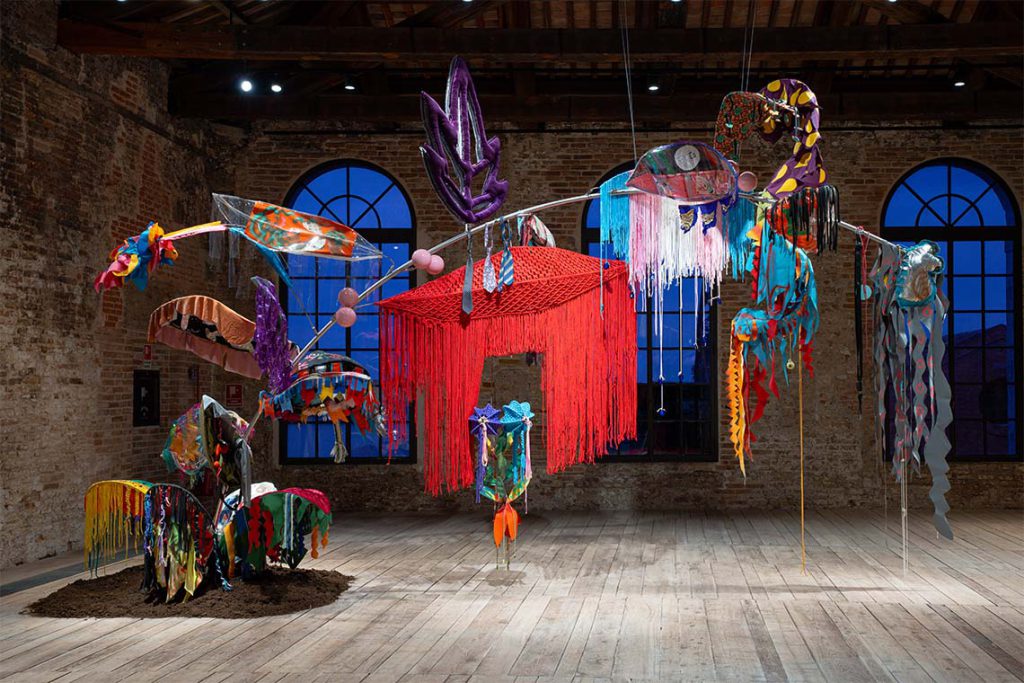
Textile occupies a substantial stake across the installation at the Arsenale pavilion, shaped in a narrow rectangular form. The artist considers fabrics as “rooted in the body, the first stop of domination”. If we approach history as a battle between the hard and the soft and as a metaphor for the binaries, Güreş underlines the fabric’s potential in defiance and self-expression. She trusts in protest banners and flags as much as gentle weavings laboured on in homes. There are bodies at her pavilion, but they are bodies “that don’t resemble bodies, or forms that aren’t perceived as such but acquire bodies.” These are, she thinks, figures that “highlight the empathy and life within everything.”
Across a four-month production period in Istanbul, Güreş collaborated with metalworkers, tailors and different artisans to push the dimensional and alchemic natures of her practice. Regardless of scale or material, she almost always starts each work with a drawing, and Venice was no exception. “I immediately opened my sketchbook,” she recalls of the day when she received the official invitation. A mythic potential still never abandons her output, bleeding a trust in the otherworldly into subjects such as gender injustice, natural collapse and xenophobia. “Facts and myths exist equally powerfully in our lives,” she says. “Legendary women and feminine characters still live among us.” This overlap of the divine and the very moment often bears work in which humour functions as political satire. In the 6th Berlin Biennale of 2010, she presented Çirçir (2010), a photography series for which she captured images of women from various backgrounds delivering vague chores at a soon-to-be demolished Istanbul house that once belonged to her family.
Güreş and the pavilion’s curator Başak Doğa Temür have distilled a generous palette of the artist’s almost three-decade practice into an adventurous spin on bodily agency and spiritual quests. This uncompromising weaving of the corporal and the fluid ushers a span of visual multitudes, fitting to the artist’s desire to avoid delivering exhibitions that “seem to belong to a single artist”. The plethora in creative and visual drives has in fact been central to most of Güreş’s recent and past exhibitions. Take, for example, her recent show at Istanbul’s Arter. The artist’s first institutional career survey in her native city was entitled Velvet Stare, once again alchemising the lushness of a touch with the fleeting mark of a gaze. Not unlike her Venice outing, she veiled her delivery with a nearly felt quality for the viewer, in this case with the fuzzy velvet, whereas it is the wet kiss that she seals her show with in La Serenissima.
In Istanbul, the artist’s engravings from the late 1990s initiated a survey that later unfolded with paper cutouts and photographic collages and ended with last year’s tree-like copper and fabric sculpture, Monstera (2025). For the artist, the overall exhibition was not so different from the workings of a language, or poetry even. “The works gathered together were perhaps like letters,” she suggests. She also points to the metaphorical use of lower-case letters in her practice. These are jabs that may seem modest in size and optics, not to mean however that one does not occasionally notice statements in capital letters, where larger than-life installations come near to absorbing their viewers. This tugging between grand and intimate echoes with the Biennale’s main exhibition In Minor Keys, in which the late curator Koyo Kouoh propels us to listen to the quiet tunes to hear deeper echoes. “I don’t want my exhibitions to speak with a single voice and constantly on the same note and level,” Güreş adds.
She conducts her materials with an acceptance of the qualities and forms that they eventually adopt along the way. She makes the works, but somehow sets them free – her strength comes from acknowledging their great potential to change a mind or flicker a desire. “Meaning isn’t a matter confined to a limited space,” she affirms. Although textures and collaborators play significant roles in the process, she underlines how “the materials and the people we work with don’t directly influence the final meaning of the artwork”. For the last impact, she suggests looking at “cultural diversity”, which is “what allows for different interpretations of artworks.”
The connection between memory and senses remains undeniable in Güreş’s practice. She works with the awareness that smells and sounds transport us to a place back in time, or that a texture can remind us of a certain day. A childhood memory still follows her to this day. After her grandparents had migrated to Switzerland as workers in the 1960s, they began bringing tablecloths back to Turkey during their summer visits to the family. The artist remembers a specific cloth with red roses on a turquoise background. At the age of eight, she felt “captivated at first sight” and asked her mother to keep the fabric for her. Years later, the very piece of textile was the main material in her graduation artwork, along with a bottle of water that came from Switzerland. “One was a background for a painting and the other, an assemblage material,” she says.
The Türkiye Pavilion is located in the Arsenale
This profile first appeared in Canvas 123: Venice Special Issue
