

Curated by Dr Amin Jaffer, the National Pavilion of India brings together five artists to reimagine how home and identities are shaped by land, craft and memory rather than geography.
There’s something about Venice that has the dreamily nostalgic air of a faded seaside resort town, where everyone agrees to overlook its archaic organisation along the nineteenth-century logic of stable nation states. Ditto the cracks that have now been revealed to be structural rot, with the mass resignation of the jury in protest of the inclusion of countries whose leaders currently have ICC arrest warrants out against them, namely Israel and Russia. This question of national participation feels especially fraught in India, a country so diverse and multifaceted that it more closely resembles a continent of nations and where citizenship is currently deeply contested, with the 2019 passing of the Citizenship Amendment Act and a proposed national rollout of the controversial – and pointedly Islamophobic – National Register of Citizens.
It is therefore perhaps unsurprising that over the Biennale’s 131-year history, India has only had two official pavilions before, in 2011 and in 2019. For this third participation, art historian and Al Thani Collection curator Dr Amin Jaffer brought together five artists from different regions of India under the rubric of Geographies of Distance: remembering home. Himself the product of several generations of Indian diaspora in East-Central Africa, Jaffer unspools the concept of home to consider how it both comes into focus and dissolves through architecture, memory and a material culture rooted in indigenous practices.
Organic materials abound: mud, clay, soil, hand-spun thread, bamboo, papier-mâché. Together, an image of home emerges that is rooted not in official documentation and delineated identities, but rather in the terroir of the land itself. This feeling is most overt in the large sculptural cracked-earth panels of Drift and Not Just for Us (all works 2026) by Alwar Balasubramaniam (Bala), which remarkably conjure up the too-tight feeling of parched skin. He reveals how “the material I used as source, and also as the cast of this work, is actual earth from the site in which my studio and home is located”, specifically near Tirunelveli in Tamil Nadu.
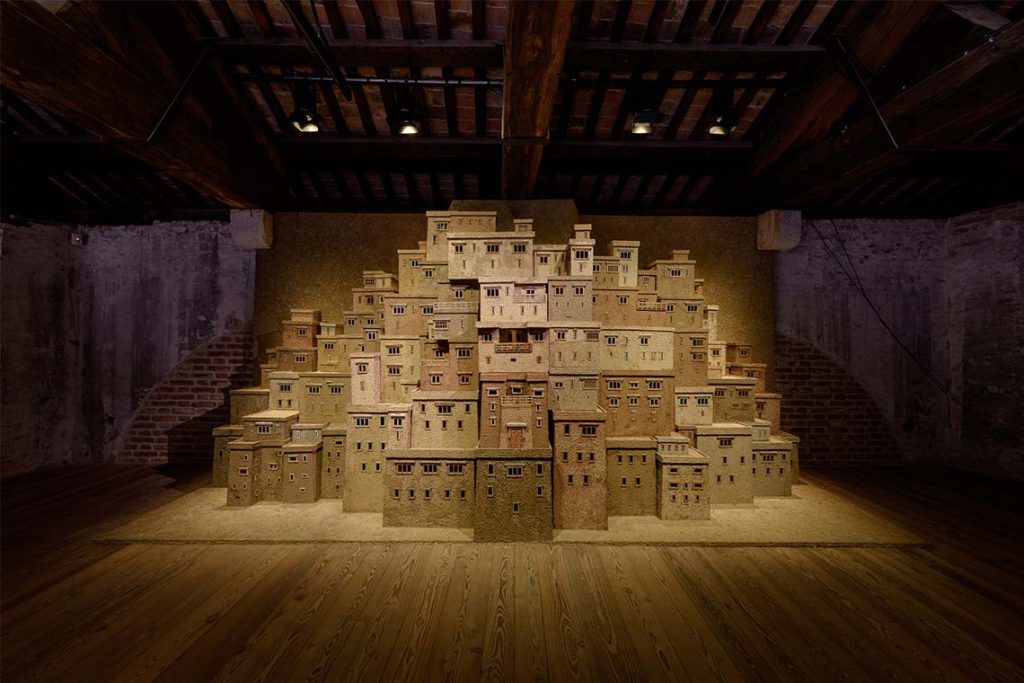
The works are the result of a slow, patient dialogue between soil and water, orchestrated over time by the artist, who induces environmental stresses as much as he witnesses and indexes them. Prints left by monkeys, peacocks and various reptiles crossing the site remind us that the concept of home must necessarily be a multispecies one. They find particular resonance in Skarma Sonam Tashi’s installation Echoes of Home, which documents the traditional Tibetan-influenced and climate-adaptive vernacular architecture of his native Ladakh.
“The materials of my work – recycled board, paper-mâché and clay – carry the textures and fragility of Ladakhi homes, connecting home to memory, sustainability and a deep relationship with the land,” he explains. Clustered together here as if set into a hillside, they seem especially fragile. In contrast, Asim Waqif’s paean to bamboo, which he explains was historically the material of choice for rural housing in northeast India, has a kind of jocular exuberance. The Hyderabad-born artist’s installation Chaal does not reference a specific rural region but rather the scaffolding that is a constant sight in cities and urban conglomerations aross the country that are in a perpetual process of becoming.
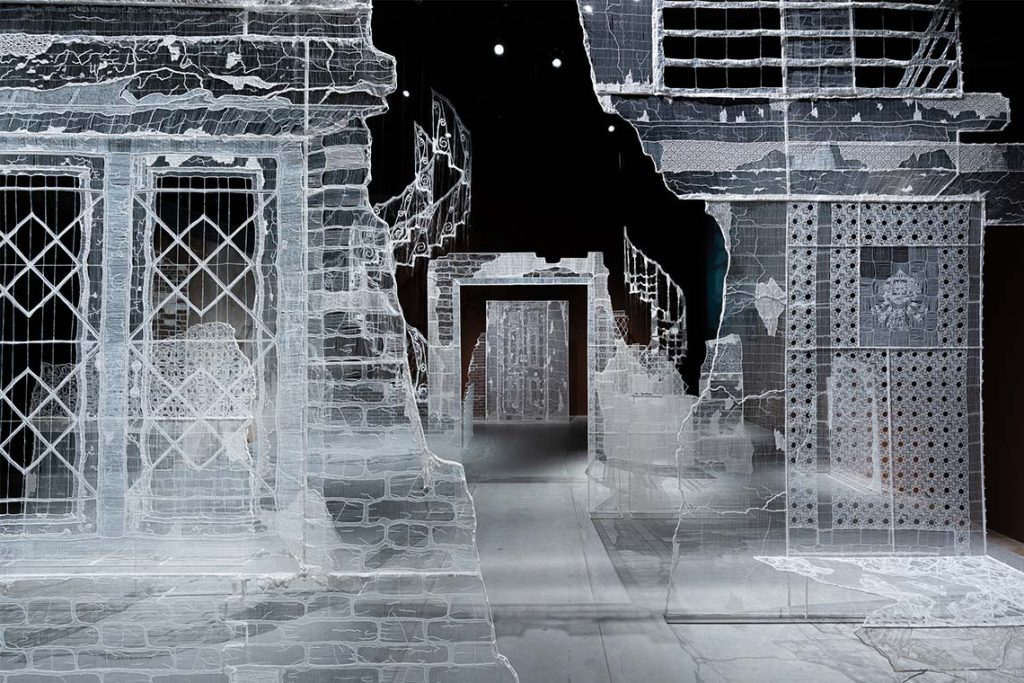
New Delhi-based Sumakshi Singh approaches the same phenomenon through the more personal experience of the nationwide construction boom – and attendant rising land prices – which saw her family home demolished. “I learned threadwork by embroidering and knitting with my grandmother and mother in this home, which I have recreated for the pavilion,” she says, adding that, given this familial history, thread felt like an appropriate material through which to work. Her particularly beautiful, if elegiac, site-specific installation Permanent Address recreates her former home as a ghostly aerial afterimage. “[Thread] also allows me to convert something solid, concrete and opaque like architecture into something porous, gossamer and ethereal, like a memory,” she adds.
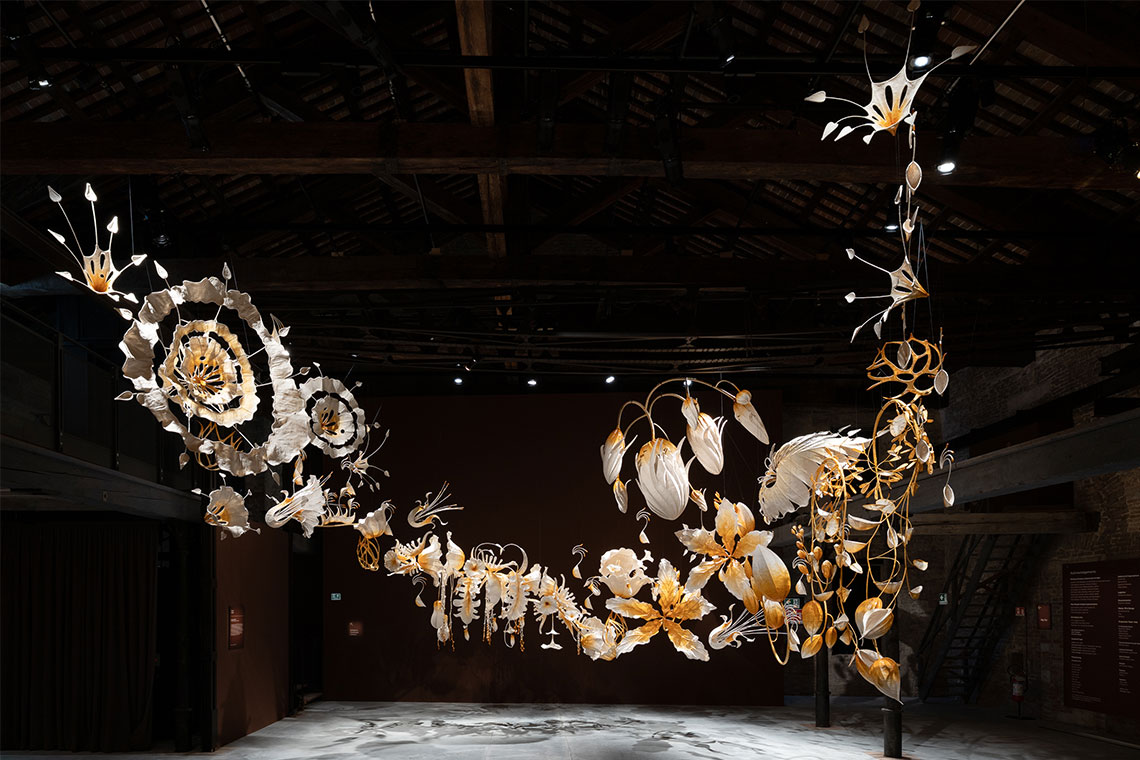
Meanwhile, Ranjani Shettar offers that “my primary material here is handwoven fabric and it is deeply rooted in India, my home’s tradition, culture, economy, history and independence.” Like Balasubramaniam, who left the city to return to his ancestral village, Shettar moved from Bangalore to the rural location near Sagara in Karnataka so as to be better able to slow down, observe and read the weave of the natural world around her. Her practice also tends to integrate traditional local crafts like lacquerware, as seen in her site-specific aerial graphic score of suspended botanical forms inspired by her encounters with the different flowers around her. This pavilion is one that is not grappling with the concept of home so much as the quiet, and far more pertinent, question of what it means to reverse the flow of urban migration and be or become rural.
The National Pavilion of India is located in the Arsenale
This feature first appeared in Canvas 123: Venice Special Issue
