

Sonsbeek returns for its thirteenth edition, celebrating 77 years of Europe’s oldest exhibition of public art.
Originating in the Dutch city of Arnhem in the aftermath of the Second World War, Sonsbeek was conceived as an opportunity for comfort and healing on shared public land in the wake of the devastation wrought by the 1944 Battle of Arnhem. Now, as the world stands in a state of crisis once again, exhibition curators Amira Gad and Christina Li have brought this heritage to the fore through Sonsbeek 2026’s theme, Memory as Living Action, putting forward memory as a complex and dynamic field that is shaped not only by our perception of the past but also by our present.
“We were really intrigued by Sonsbeek’s legacy of radical restart,” Gad explains to Canvas. “It reminds us that renewal is fragile and that our memories for that type of renewal are fragile too, but also resilient. However, it is clear to us that we are not in a time of renewal. We are presenting an exhibition in the midst of global conflicts, wars and environmental, sociological and political crises. It is not simply that history is repeating itself. It is also that we need to equip ourselves with tools to learn from history, so that it can take us forward in a just and collective way. This is an invitation for us all to participate in that action.”
As such, the 2026 exhibition – extending throughout both the iconic Park Sonsbeek and multiple other sites and institutions across the city and surrounding region – transforms Arnhem into a space for enquiry and exchange, blending human ingenuity with natural beauty. Featuring works by 18 artists and collectives, including 12 new commissions, Sonsbeek 2026 resonates with diverse narratives, histories and experiences.
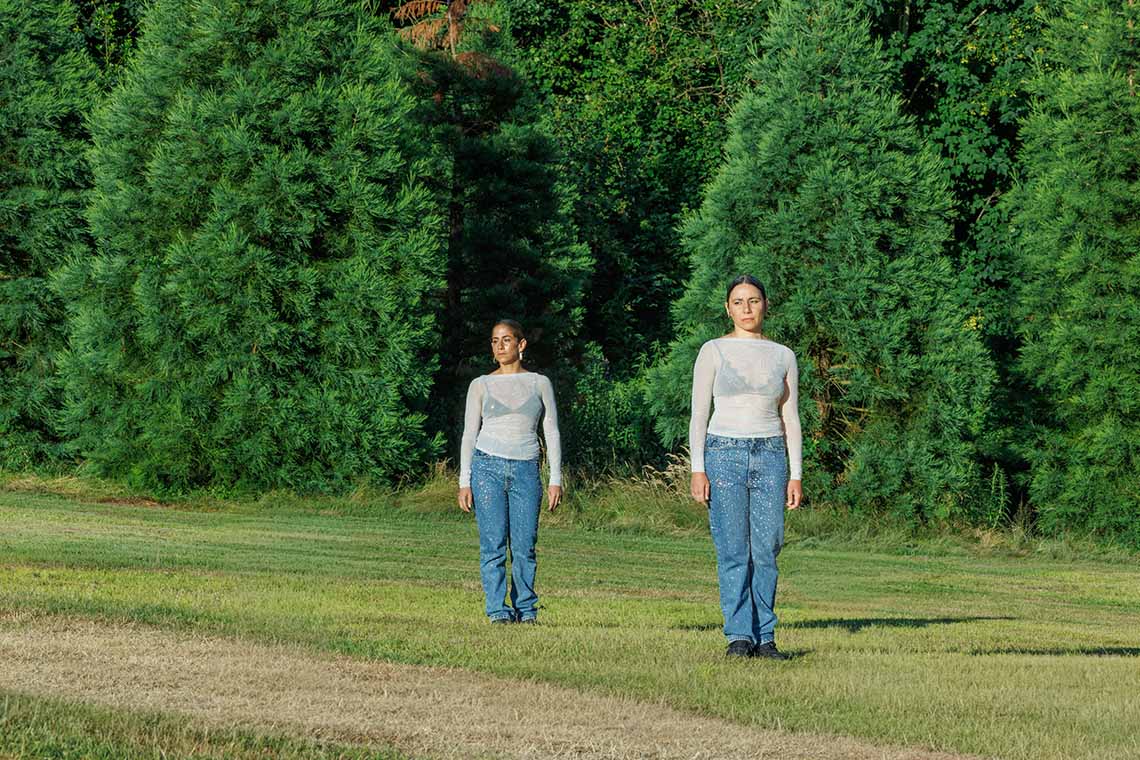
As part of the opening festivities, Egyptian dance collective nasa4nasa – co-founded by Noura Saif Hassanein and Salma AbdelSalam – delighted the first of the exhibition’s visitors with a sunset rendition of their performance piece Promises outside the Stadsvilla in Park Sonsbeek. First developed in 2024, the improvisational score sees the pair attempt to create a form of ‘sensitive proximity’ through deliberate and controlled spontaneous movements. Each iteration of the performance serves as a renewed attempt to fulfil a promise of synchronisation and unity, while simultaneously acknowledging the possibility of failure, causing the promise to be broken and evoking themes of longing, friendship, commitment and temporality.
“We work a lot with slowness, about being in the moment in a certain landscape together, and how that shifts the attention from just being performers or choreographers to also working with the space around us,” shares AbdelSalam. “It’s about tuning in and listening together to the environment around us, thinking about the space between us – that third body that’s created through the choreography.”
The closeness of the partnership brings a unique perspective and special value. “It’s about the 10 years of collaboration that we have, and the knowledge that we have acquired over that time,” adds Hassanein. “We know each other’s bodies and always anticipate each other, giving each other time to find these negotiations or connections. This constant tension creates a lot of possibilities that are full of surprises for us in terms of what fails and what works. It’s very familiar and intimate, how we find each other and how we move. There’s a lot of knowledge and many layers.”
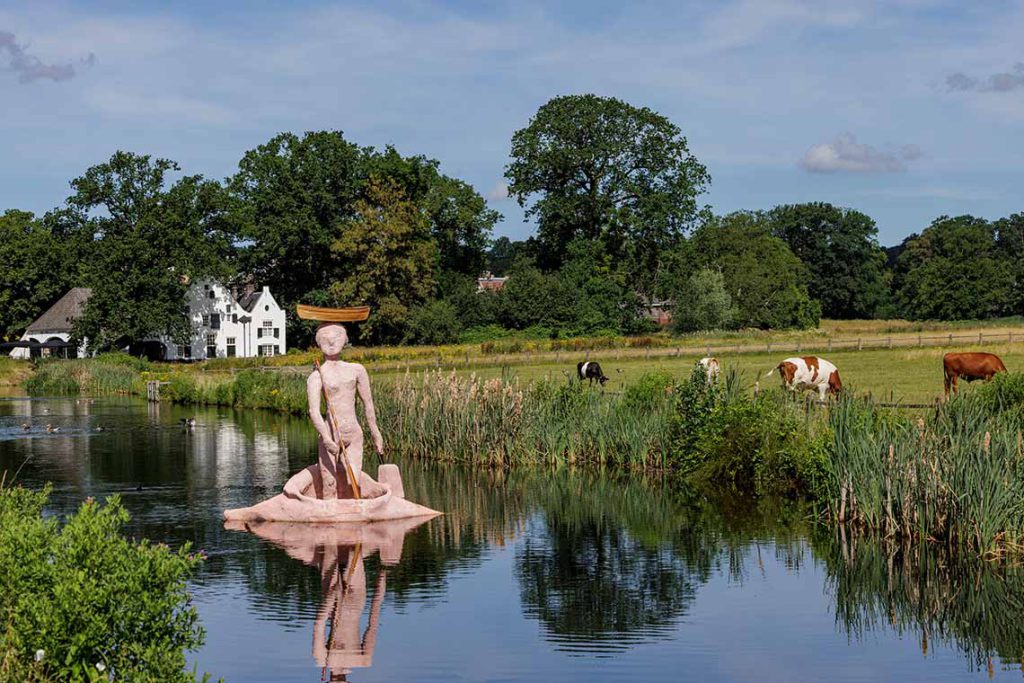
Lebanese artist Mounira Al Solh also explores the movement of bodies in her sculptural piece And Europa fled / En Europa sloeg op de vlucht / عندما رحلت أوروبا (2026), albeit from a radically different perspective. Displayed on the water of the Sint-Jansbeek stream that bisects Park Sonsbeek, the work shows a monumental sculpture of a female figure – the mythological Europa – standing in a murex shell, the source of the purple dye for which the ancient Phoenicians were named by the Greeks. She carries with her the modern trappings of a travelling refugee, bridging an ancient tale with a common modern reality.
“Europeans think that their ancient stories come from Greece,” Al Solh points out, “but what is ‘Greece’? According to the myth, Zeus kidnapped Europa from the Lebanese shore, and the Phoenician alphabet was brought to Greece by Cadmus – the brother of Europa – as he searched for her. Before that, there were hieroglyphics and cuneiform. It’s all a communication between many different civilisations.”
The metaphor Al Solh initially sought to convey gained a new and extreme specificity when her long-time collaborator, boatmaker George Barbour, was stranded in Jordan and unable to return home following the resumption of hostilities in Lebanon earlier this year between the IDF and Hezbollah. The miniature boat that adorns the statue’s head is the result of his efforts during this period of forced relocation, created in Arnhem using wooden offcuts gathered by Al Solh elsewhere in her practice. “I want to remind people that even Europa was forced to flee,” she says. “Today there are refugees coming, but the Europeans don’t want to receive them. They want to close their borders but, not so long ago, they also had to flee. What is happening today in Beirut was happening during the Second World War here in Arnhem. It can happen to anyone, at any time.”
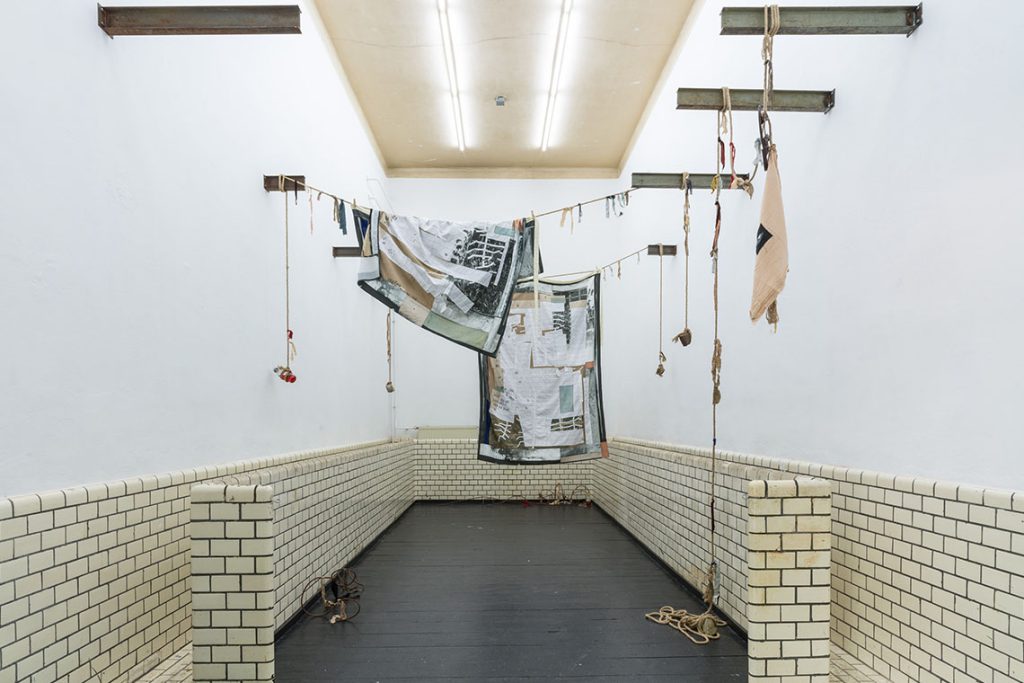
Elsewhere, Palestinian artist Jumana Manna is showing her ongoing installation project, Your Time Passes And Mine Has No Ends (2025), presented at satellite venue Omstand. Comprising a series of hand-crafted banners and embroidered scarves hanging from ropes set between steel balconies, the work combines messages to and from Palestinian political prisoners and photographic prints, while also evoking traditional Palestinian celebrations.
“I began developing this project in 2024,” explains Manna. “I was looking for ways to get beyond the creative paralysis that I and many around me fell into after the genocidal onslaught on Gaza began. One question that I found myself returning to was: What is the proper space and role for joy and celebration in this current moment? This is what drew me to the history of Mawasim, which is the celebration of the land and seasonal change through movement, prayer, song and dance.”
Manna sought ways of pulling together various threads of Palestinian consciousness, including by stitching quotes from political prisoners onto the hand-made banners “as a gesture of inscribing the experience of isolation onto the collective body and public, suturing two citations of Palestinian liveability against the silencing and fracturing aims of the [Israeli] occupation”. More broadly, her approach underlines the wider ethos and scope of Sonsbeek . “Art plays an important role of nourishment, opening up a space for reflection and imagination,” she affirms. “This includes the necessity to imagine liberatory futures, even in times where hope for justice feels hard to believe in.”
