

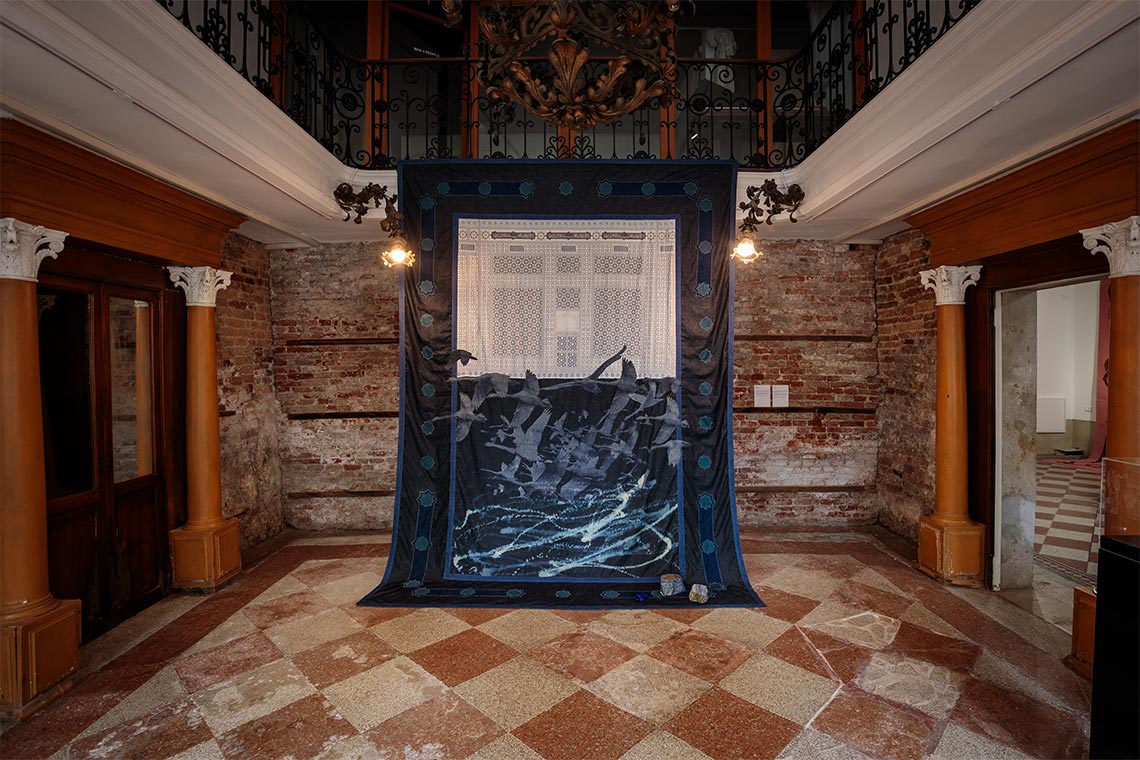
For the Pakistan Pavilion, artist Faiza Butt uses craft traditions, collaborative practices and textiles to explore the country’s layered histories.
“Western art history is not the history of art of the world. Our regions have been expressing in other ways. In non-industrial nations, art was never separated from functionality,” Faiza Butt declares when we connect to speak about her solo presentation at The Pakistan Pavilion. She gives the example of Mughal karghanas or artisanal training and production workshops where artists used to play radically different roles as image makers, noting that miniatures were supposed to be read like a map in a book, not hung on the wall as art. She continues, “So I felt that our art history could be reappropriated, repositioned by imagining the craft traditions, the artisans, the aesthetics in various things like textiles or pottery or ceramics or weaving. We have to reimagine them as works of art.”
Along the way, Butt reimagined national borders too, playfully dedicating her national representation of Pakistan to her home state of Punjab, a region that is by definition supranational, existing in both India and Pakistan and bisected by the keloidal scar of Partition. Entitled Punj•ab – A Sublime Terrain, and curated by Beatriz Cifuentez Feliciano, the presentation is anchored by monumental textiles that span nine chapters of the region’s history, from Alexander the Great and the Vedic and Greco-Buddhist Gandharan periods to the Arab Sultanate of Multan and coming under the control of the Sikh and British empires. They are hung non-chronologically to allow for a certain dialectics of unexpected juxtaposition. Everybody was after its resources, the arterial five rivers (panj ab) that give the historical region its name and all the hyper-fertile land in between: “During all those times, this region was carved up, expanded, bled out, shrank back in,” Butt explains.
Conscious of the weight of representing an entire country, the multidisciplinary artist decided to push herself by working with textiles for the first time. Despite narratives of industrial progress, she was very aware that vast swathes of the Pakistani population still live in rural areas, without consistent (or sometimes any) access to the grid. As such, she wanted to work with and celebrate the folkways of artisans whose practices are not energy dependent, adding that with some of these collaborative works, “I say it with my hand on my heart, the carbon footprint is almost zero. The wool was dyed and spun by hand, without any electricity involved.” Of course, subsequently shipping it to Europe is another matter, but there is a particularly lovely kernel of suggestion in here of the possibility of a circular, sustainable local art economy.
This sustainable ethos extends to Butt’s material vocabulary, which similarly prioritises the local and the traditional. She worked with an organisation called Havelicrafts, which is reviving the indigenous cotton varieties destroyed by the British. These are both exceptionally climate- and pest-resilient, and not monocultural, thus promoting biodiversity through an ability to be intercropped with millets, lentils and other food crops. This locally grown cotton in turn becomes both the ground – the cloth – and the figure – the embroidery – for her monumental textile works. Equally important to Butt is for her research, much of which is a personal archive of historical textiles, to eventually contribute to the growing body of mostly grassroots archival material available on these sometimes ancient crafts and artisanal knowledges. The show also includes examples of contemporary – as in mechanical – textile traditions, such as jacquard.
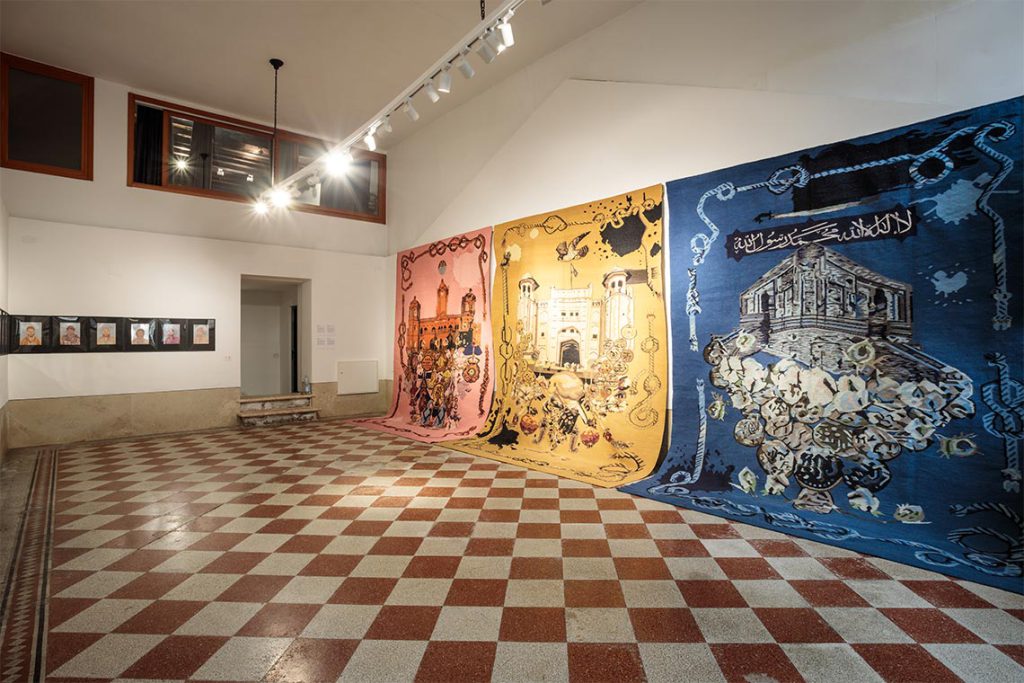
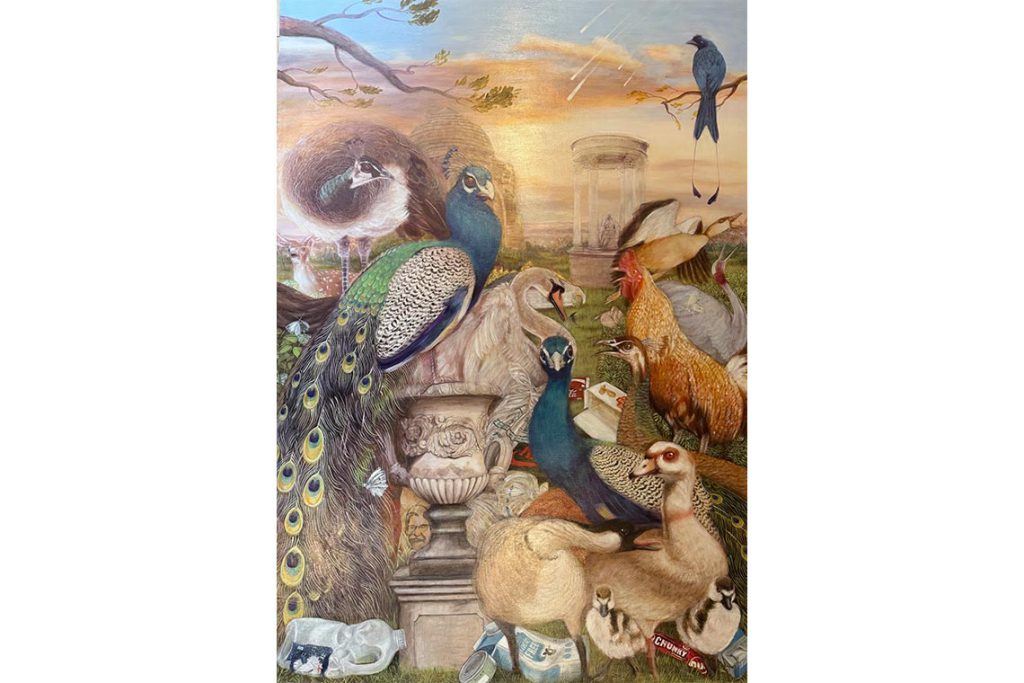
Most of the tapestries are colourful and visually anchored with a central architectural motif, like a Nis Valley Stupa, or the colonial Grand Post Office. So too are accompanying oil-on-board paintings from Butt’s Phantasmagoric series, which include fantastical birds, climatic and biblical chaos. Her signature use of the pointillist par dokht technique can be seen in two series of portraits which round out the show, paying loving tribute to the people of the land. She describes Men of Punjab as average men on the street, doing regular jobs like being tailors, barbers, gardeners or drivers. A parallel series Women of Punjab is a bit more personal, featuring the artisans who made the works with her. She explains how “I’m honouring them and making them into these icons and converting their faces into portraits and paintings.” Video footage on view, featuring the repetitive gestural patterns of things like embroidery, further underscores the labour that underwrites the enterprise.
Also on view in the rather glamorous, chequerboarded ex-pharmacy is a final body of work, featuring small jewellery pieces that are actually redesigned military medals which work to remind the viewer of the epigenetic violence that split Punjab. “They are very interesting, because every civilisation used these kinds of insignias to validate violence, to give it to the fallen and the soldiers as well,” Butt explains. Yet rather than featuring gemstones, they have geotagged Pakistani minerals like black quartz and a particular ruby shade that manifests only in the country. Incorporating goldsmithing was important to Butt because “anything that has been dismissed as craft and not fine art, I want to drag it up. Because I think my region is full of those aesthetic expressions, and they should be our art history. They are the references we should be taking forward.”
The Pakistan Pavilion is located in the Ex Farmacia Solveni
This feature first appeared in Canvas 123: Venice Special Issue
