

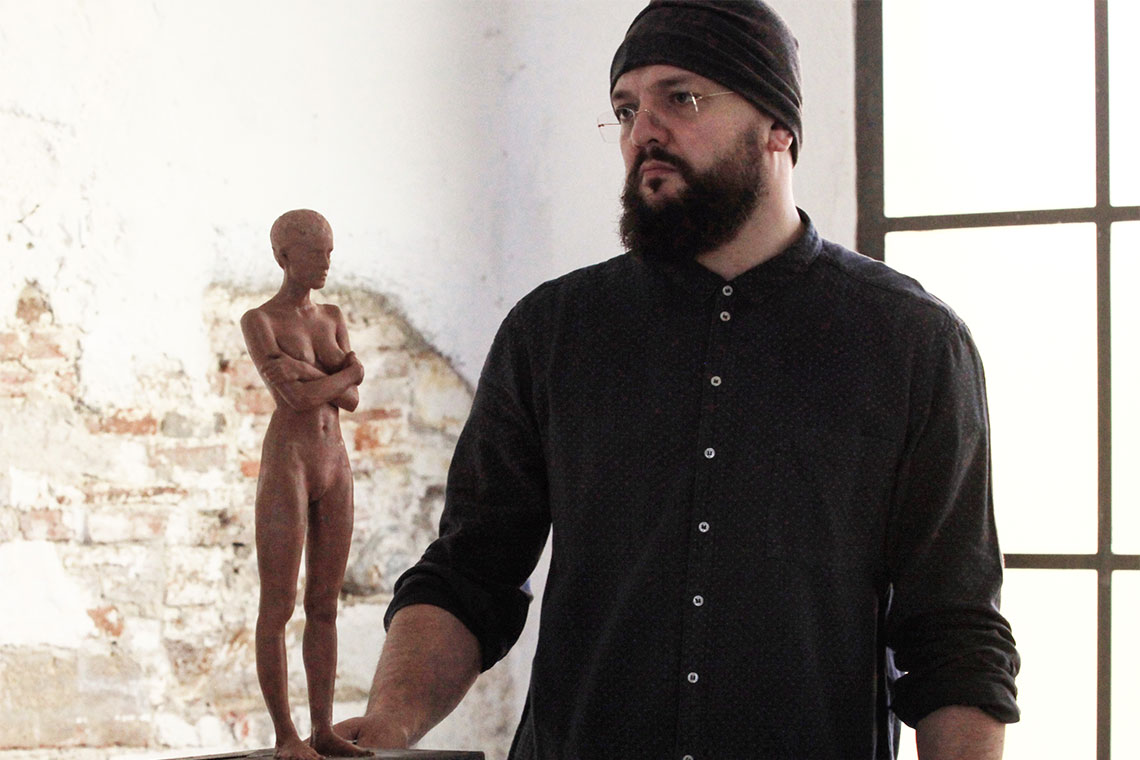
The artist represents the Pavilion of the Kyrgyz Republic with BELEK, an installation exploring water, nomadic memory and landscape.
Canvas: What themes or ideas are central to BELEK?
Alexey Morosov: Belek means gift in Kyrgyz, and central to the BELEK project is the concept of the gift as both an ontological category and a civilisational construct. However, I view this work not as a present, but rather as an offering. This distinction is fundamentally tied to the ideas of responsibility and sacrifice. The core theme of my statement is water which, for my people, is simultaneously a blessing, a burden, a responsibility and a sacrifice. Kyrgyzstan transfers about 85 per cent of its water resources to neighbouring countries, raising not just a question of distribution but also one of responsibility and offering. The BELEK project brings together water, the mountainous landscape of Kyrgyzstan and the nomadic cultural tradition, including play as a fundamental form of social communication and development. For me, this is primarily a conversation about primal matter – about how forms, including humanity as a manifestation of the formal world, emerge from water and earth.
My artistic thinking operates non-linearly – it develops like an avalanche. When I first started thinking about the project after learning the theme of the Biennale, there wasn’t a single idea or image. Rather, it was a gradual layering of imagery, employing a multi-screen principle similar to what you might see in the work of Peter Greenaway. For me, Kyrgyzstan is primarily the energy of collective action, an energo-frictional dynamic that is manifested vividly both in Kok-Boru, an ancient equestrian game rooted in deep antiquity, and in the socio-political life of the country.
How do you work with the idea of memory in a landscape that is constantly being shaped by change?
Over the last two hundred years or so, my country has gone through several fundamentally different forms of statehood – from khaganates and khanates to integration into the Russian Empire, then the Soviet Union and finally an independent nation state. Each of these eras meant not only a change in the political system but also a shift to a different technological paradigm and a new form of governance. Each also left its mark on the landscape, primarily through infrastructure. The most profound trace was undoubtedly left by the Soviet Union. We are talking about mountain tunnels, highways spanning high-altitude passes of up to 3500 metres, designed for an entirely different scale of economy and consumption. Today, this infrastructure exists within the context of a small country with a relatively modest economy, raising the question: is this legacy a resource or, conversely, a burden?
Do you think landscapes remember human intervention or do they simply adapt to it?
They live with it as a burden, as a stigma. With its exponential growth, humanity resembles a metastasis in many ways – processes that might look aesthetically convincing but remain destructive by nature. Human intervention always leaves scars. These are stigmas that remain on the body of the landscape. Sometimes they can be visually striking, even organically integrated into the environment, but that doesn’t change their nature. They forge a different event horizon.
At the same time, humanity has no alternative. We cannot seriously talk about returning to pre-Neolithic forms of existence. The issue is not about rejecting intervention, but about the degree of rationality behind it. The problem is that very often these interventions are driven by momentary motives, rather than actual necessity. I’m not sure what is more traumatic for the landscape, so-called ‘soft’ ecological design or brutal engineering structures like Soviet dams. Ultimately, both are deviations from nature’s original state, a form of imperfection.
Can you talk us through the material and technical framework of BELEK and describe the key elements that make up the work?
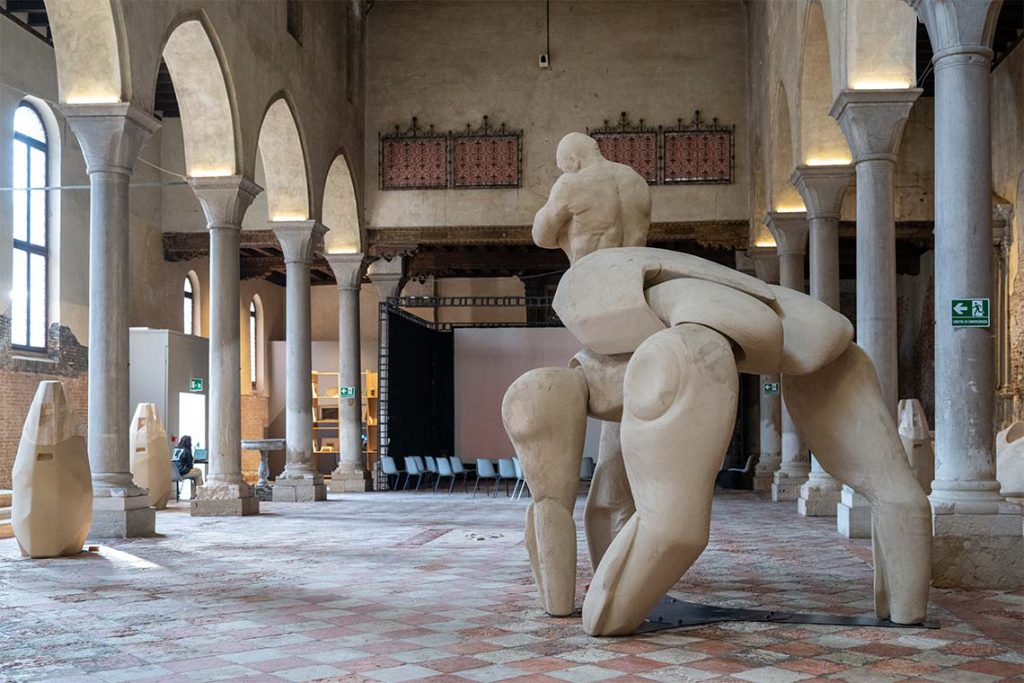
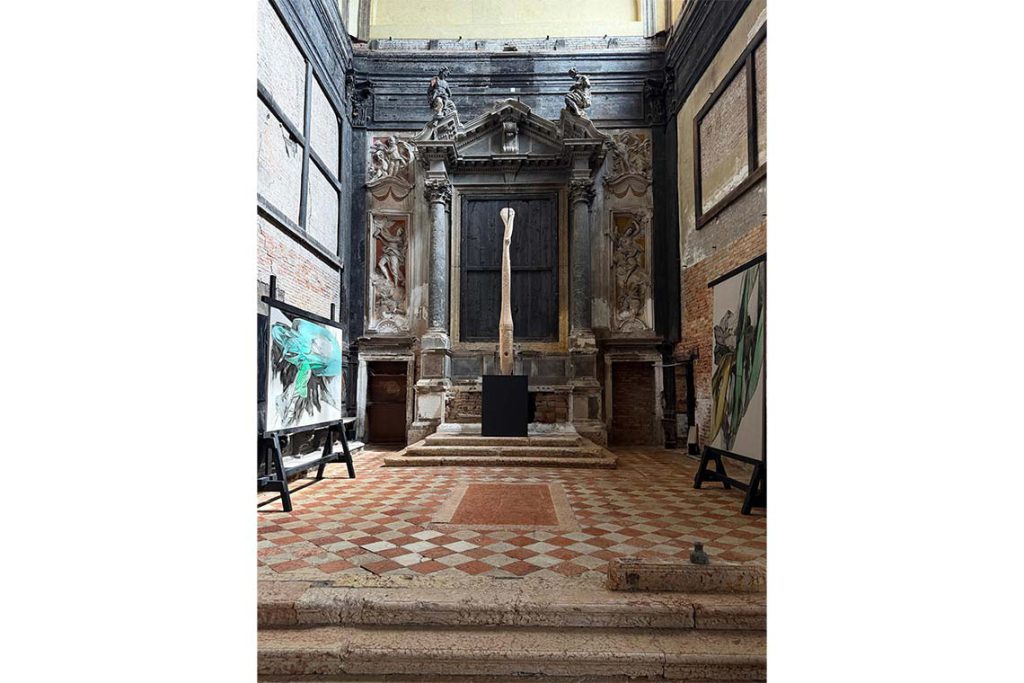
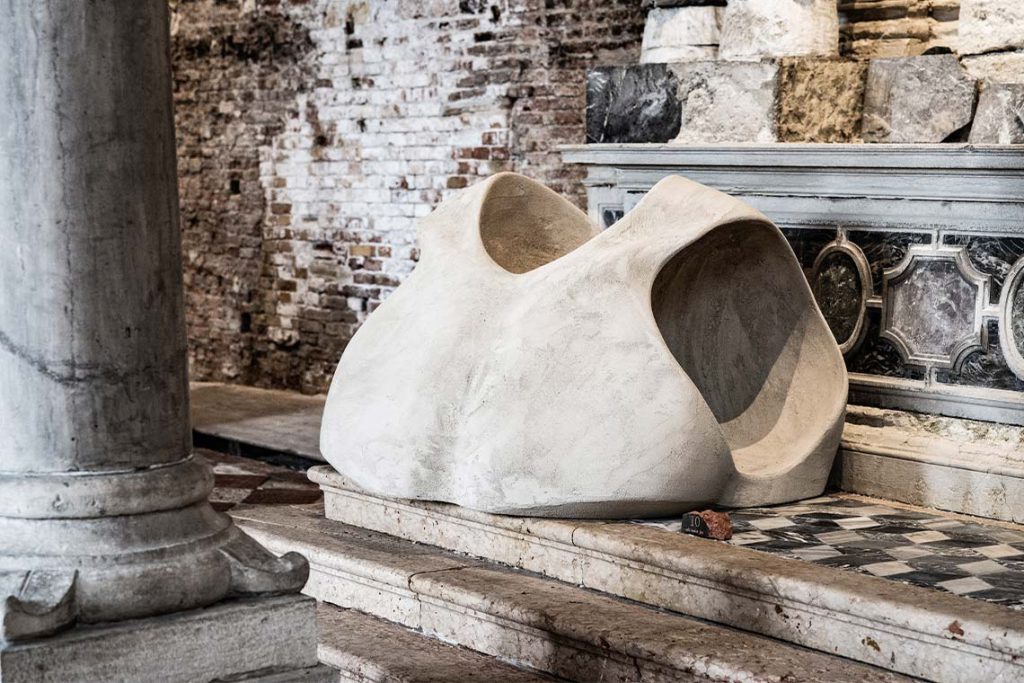
The exhibition is presented at the former church of Santa Caterina and consists of ten physical objects alongside a blackout structure that houses a central video fresco, positioned opposite the former altar area. BELEK was conceived as a unified, site-specific installation where architecture, video, sculpture, painting, sound and the movement of the viewer function as an interconnected perceptual system. The sculpture TULPAR_BATYR_II, installed in the urban space of the Campo dei Gesuiti, acts as an extension of the project beyond the pavilion itself, while TULPAR_BATYR_I, situated inside the former church, serves as the compositional axis of the entire installation.
The scale of the pavilion and the complexity of its historical architecture naturally steered me toward a modular sculptural language. I was inspired by megalithic structures, including the architecture of Luxor and Karnak, Nabataean constructions and the polygonal masonry of Cusco, as well as the raw-brick traditions of Central Asia and the stone balbals of the Eurasian steppes. I am particularly interested in parametric principles of form construction, solid modelling and complex curved surfaces. As a result, the plastic language of TULPAR_BATYR simultaneously preserves a connection to the monumental sculptural tradition while operating within the logic of contemporary engineering and digital form.
What does sculpture mean to you today, beyond traditional definitions of form and volume?
In our time, when art criticism has largely shifted toward journalism and art history toward publicism, it is not so much the ideas of form and volume that are changing but the very understanding of what can be called a sculpture in the first place. If, in the twentieth century, the key discourse in art criticism revolved around the subjectivity of Marcel Duchamp’s Fountain – whether a readymade could be considered art – today that discourse has shifted to “Undoubtedly this is art and moreover, it is sculpture”. Sculpture today is less an art object and more a way of thinking and organising space within a broader spectrum of perception.
Do you see any kind of dialogue between the landscapes of Central Asia and the architecture of Venice?
When I was studying in the architecture department at the Bishkek Polytechnic in 1992, one of the basic principles of constructing a city skyline was taught to us as the principle of contrasting jaggedness and calm. So, if the horizon line of the environment is a plain, devoid of contrasts and dramatic breaks – like in the Emirates, for example – then the urban development should be contrasting, with a dramatic silhouette, thereby bringing dramaturgy and harmony to the landscape.
In this light, it seems to me that the regular, generally Canaletto-esque urban line of La Serenissima would fit perfectly into the background of the Tian Shan mountains, which occupy half the sky in the landscape of my homeland.
What does it mean for you to have BELEK represented to a global audience?
For me as an artist, it is first and foremost an opportunity to present my vision of contemporary art to the widest possible audience, as much as that is possible today. Artists may not have direct tools of impact, but they do have influence – even if it is unobvious, it is real. In that, I see my responsibility and my right to speak.
The Pavilion of the Kyrgyz Republic is located at the Ex Chiesa di Santa Caterina
This interview first appeared in Canvas 123: Venice Special Issue
