

In her solo show Get Me A Stone, Nashashibi explores the power and finesse of Palestinian responses to subjugation.
When a 14-year-old boy in Gaza threw a stone at an Israeli army tank in 2000, he was shot dead. An Associated Press photograph of the incident became one of the most apt contemporary images of Palestinian resistance, in which stone-throwing has a long history. The poet Mahmoud Darwish captured the sentiment in his work Those Who Pass Between Fleeting Words (1988), whose narrator speaks to his oppressors: “From you, yet another tank – from us, stones”.
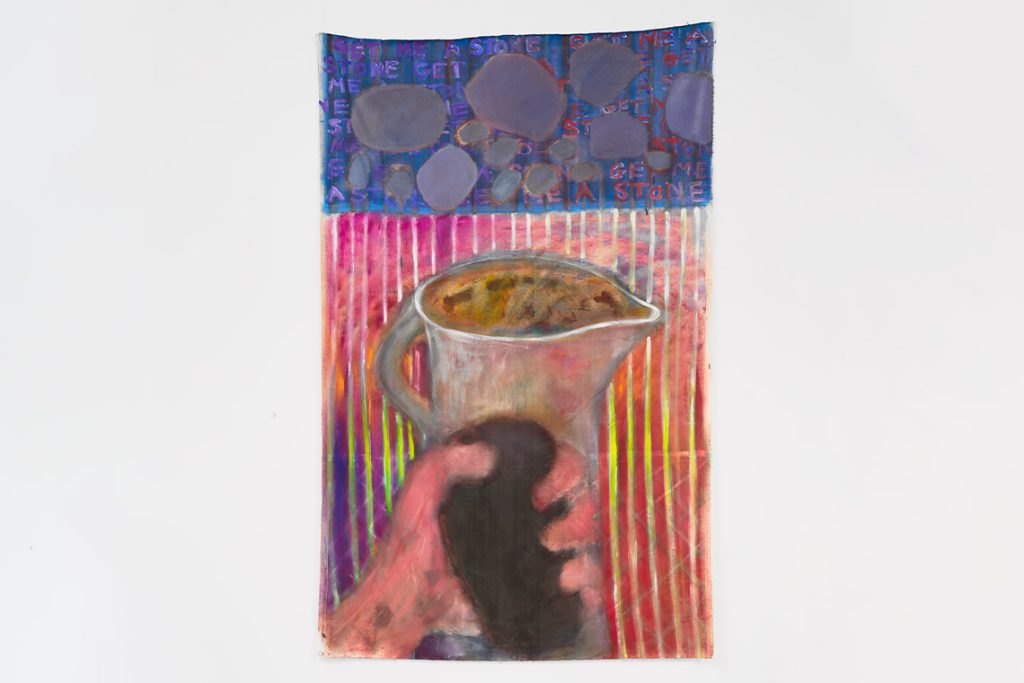
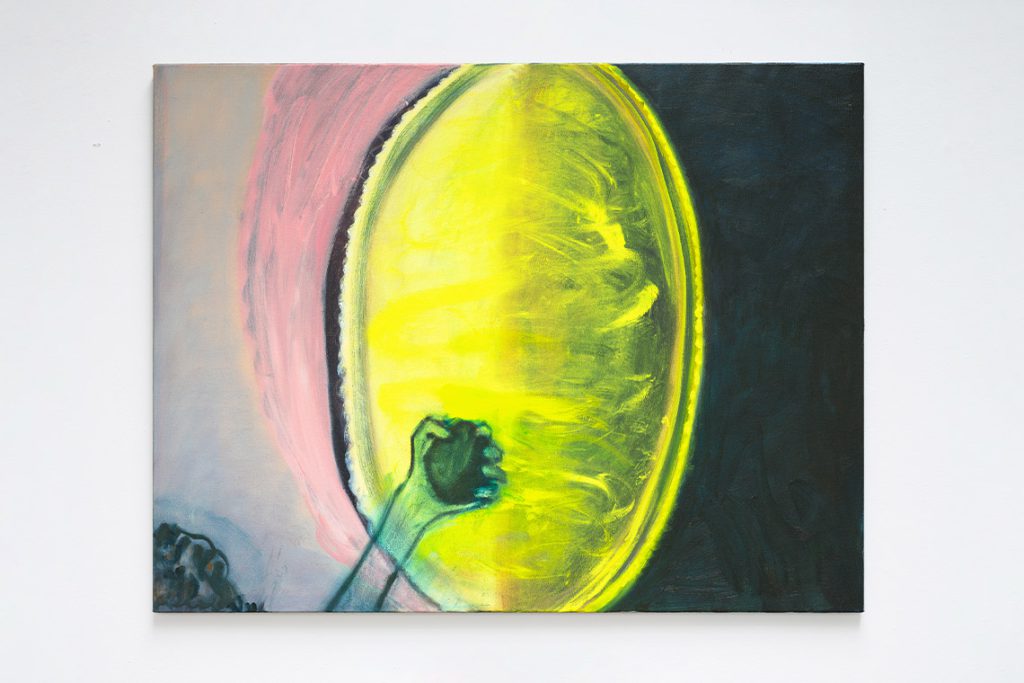
Stones also carry weighty significance for the British-Palestinian painter and filmmaker Rosalind Nashashibi, a Turner Prize nominee in 2017. One of her most recent paintings, Get Me A Stone (2026), shows a stone gripped in a closed, upraised fist – a stance of defiance and solidarity. In the background is a vase against what resemble a tablecloth, curtain and open window, making a peculiar juxtaposition of still life with political gesture.
The artwork features in – and lends its name to – Nashashibi’s current solo show at Artium Museoa in Vitoria, northern Spain. The exhibition features 18 impressionistic paintings on paper, linen and velvet, produced between 2021 and 2026. They include three other paintings of stones clenched in anonymous hands against still life tableaux – such as The Living Thread (2025), showing a bronze plate in the background. The curatorial text says the works reflect an “emotional and political engagement with the current situation in the Gaza Strip”.
London-based Nashashibi has Palestinian and Northern Irish heritage. Her father – born soon after the 1948 Nakba, which expelled over 750,000 Palestinians from their homes – grew up in Jerusalem but left to study in the UK. Nashashibi’s visits to Palestine have fuelled her artistic practice: her 18-minute video piece Electrical Gaza (2014) shows everyday life in the Strip and was filmed shortly before a seven-week Israeli siege that killed over 2000 people. This work now forms part of Artium Museoa’s permanent collection, as does the painting A Wider Kind of Love (2021), in which Nashashibi depicts two halves of a watermelon – a covert symbol of the prohibited Palestinian flag.
The artist’s new temporary exhibition evokes the role of stones for Palestinians, who have historically lacked the sophisticated war technologies held by their occupiers. Stones were thrown against British Mandate authorities in the 1936–39 revolts, while the First Intifada against Israeli occupation in 1987 is often recalled as a stone-throwing rebellion. Conceptually, stones also function as symbols of belonging for uprooted Palestinians. As fragments of rock from the earth, they are natural emblems of a land that has been stolen or occupied; as rubble from demolished villages or bombed buildings, they are the lingering remnants of tangible heritage that can reassert a sense of place.
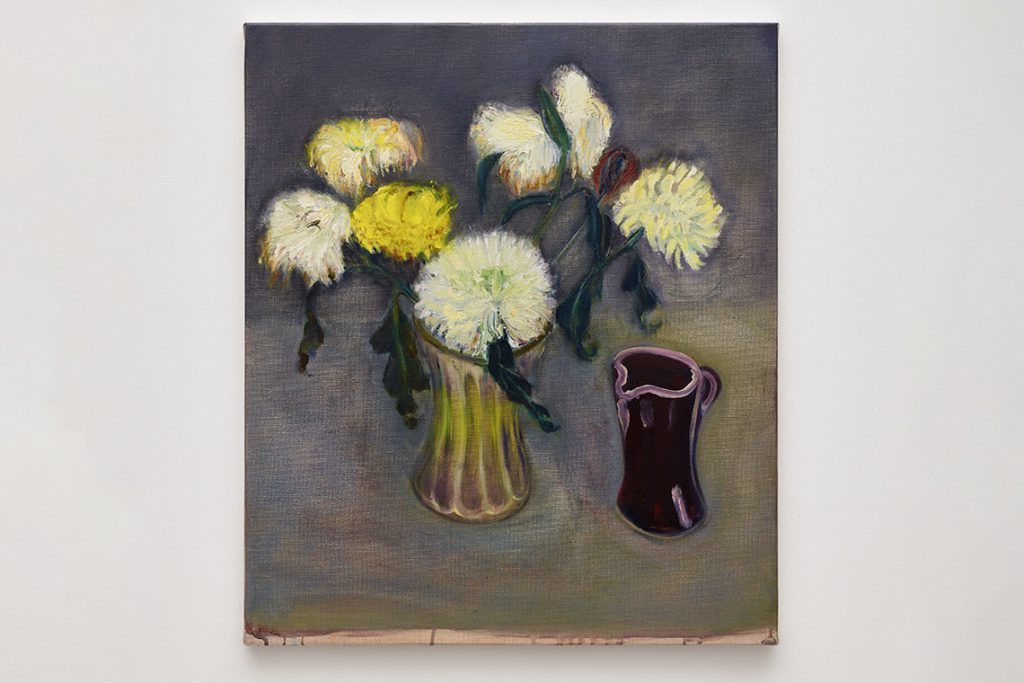
Nashashibi’s paintings in which stones feature are also, at their core, still lifes. Some include floral arrangements, like Chrysanthemums, Hand with Stone (2025) and Vase with Flowers, Hand with Stone (2025). Considered funereal in many cultures, chrysanthemums might evoke ideas of death and grief, but the intervention of a stone-wielding hand suggests something more insubordinate than just mourning. The flowers – also appearing in Remembering the chrysanthemums…(2024) – might even recall the all-female resistance group Zahrat al-Uqhawan (The Chrysanthemum Flower), who fought Zionist paramilitaries in 1948.
If such references are inferred, still lifes become a matter of life and death. Nashashibi, who was Artist in Residence at London’s National Gallery in 2020, here stages a confrontation with the form itself, reminding viewers that – despite its associations with cosy scenes of domestic objects – still-life painting has always been charged with social and political meaning, from arrangements of belongings that indicate wealth and hierarchy to commodities traded through colonialism.
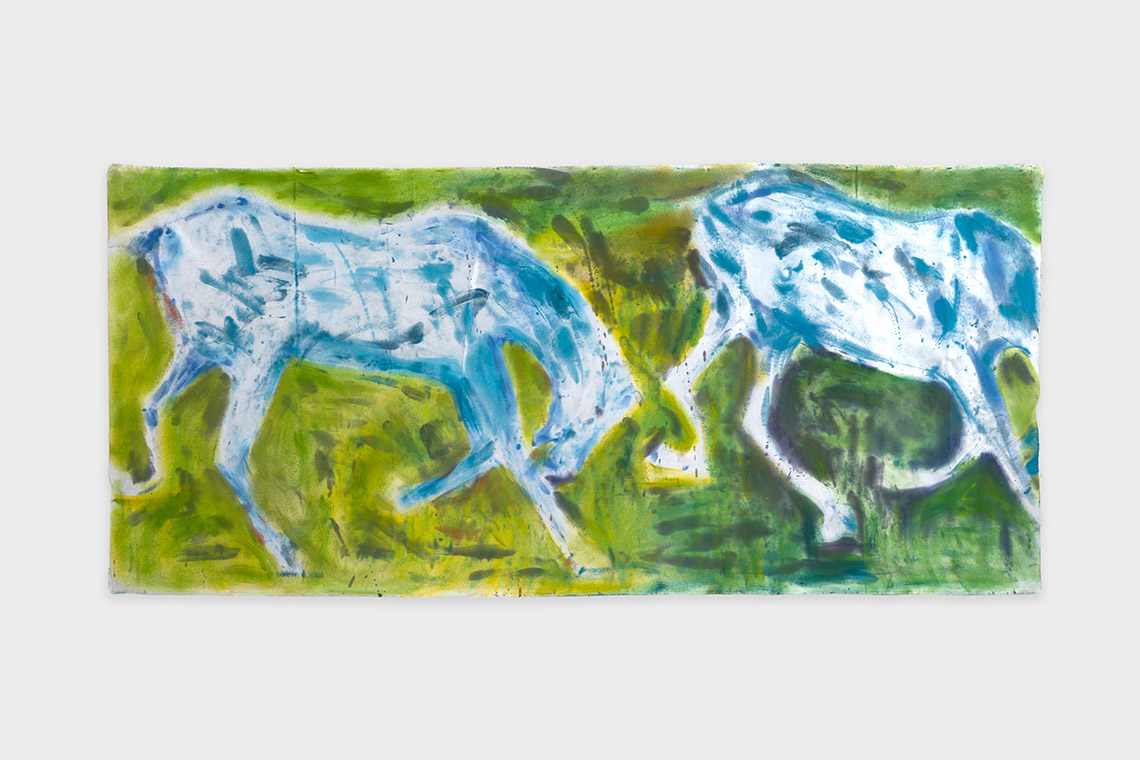
A similar reclaiming of form occurs in Nashashibi’s pastoral scenes. Three oil paintings show horses moving across natural landscapes. The artist’s horse studies are known to draw from Edgar Degas, while one might also think of George Stubbs or Eugene Delacroix. Conversely, Nashashibi’s horses seem more powerfully read within the Palestinian liberation cause: all three works are titled The Return (2025, 2026 and 2026), perhaps alluding to the legal and political claim for Palestinian refugees’ right to return to their homes.
Nashashibi’s work therefore subverts Western painting traditions – from still lifes to landscapes – by injecting meanings that seem to contradict political and aesthetic conventions, thus offering alternative visual dimensions. “They counteract the brutality of what we have seen in the genocide,” says the exhibition’s curator Catalina Lozano. “We have seen brutal images on social media but here there is an act of processing what has happened. Painting offers another type of image, sensation and idea.”
Indeed, the act of painting itself entails a materiality that, in Nashashibi’s case, might speak to the material conditions of Palestinian life. It is the same materiality signified by stones, which Nashashibi adopts as symbols of collective history, memory and identity, just as Darwish wrote of how “a stone from our land builds the ceiling of our sky”. Stones constitute material means of survival, but Nashashibi’s paintings also employ them as aesthetic devices that can interrupt one’s view of scenes otherwise accepted as convention.
Get Me A Stone runs until 1 November
