

VCUarts Qatar’s collateral exhibition at the Venice Biennale, أغرب إدراك | Aghrab Idrāk: Thresholds of Perception, looks at how interdisciplinary practices can sharpen our understanding of both our surroundings and ourselves.
Just off the Giudecca Canal in Venice sits the charming sixteenth-century Palazzo Cavanis, whose Venetian Gothic-Byzantine-style architecture is hosting VCUarts Qatar’s current showcase in Venice. Curated by Hesperia Iliadou, Director of the Museums & Exhibitions Study Society in Venice and Chase Westfall, Head of Gallery at VCUarts Qatar, أغرب إدراك | Aghrab Idrāk: Thresholds of Perception brings together ten interdisciplinary laboratories from VCUarts Qatar’s Institute for Creative Research. Each presents their faculty-led creative research, resulting in an exhibition that highlights the collaborative nature of the creative process.
From the ground floor, the sounds of Mapping Migration Memories by (IN)>Tangible Lab guide visitors upstairs, where the video portion of the installation is nestled between what looks to be an ornately carved, disused doorway. On the split-screen, two distant figures roam across the desert, moving in opposite directions and alluding to the historical act of migration on foot in Qatar, a tradition cut short by the discovery of gas. The creators have reenacted this movement by visiting the north and south of the country, recreating the migration as a means to extend living culture and memory while inscribing it into the future.
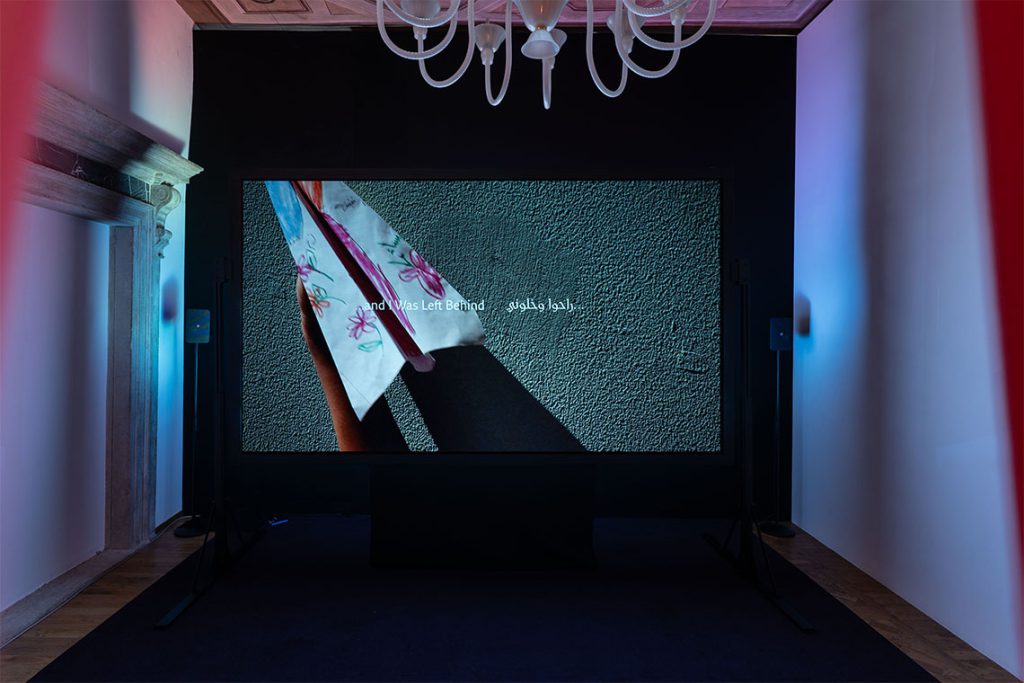
Behind a nearby curtain, a moving image work entitled … and I Was Left Behind by AlBokeh Lab further resonates with these not too distant yet perhaps too easily forgotten histories. Hands, rather than faces, are the main protagonists here. Maysaa Almumin, who led the project, was inspired by stories shared by her grandmother. Co-curator Iliadou tells Canvas: “It talks about women left behind in history, when men go to war, when they travel on business, journeys far away from us. Sometimes family members never return, and we are left behind to endure, to hold, to have the courage to continue.” The recent resurgence of war in the Gulf brought back these older memories of displacement from loved ones, a sentiment captured in footage showing paper boats travelling across hand-drawn seas or a grandmother attempting to repair the rupture of separation by the careful act of stitching.
Speaking at a symposium organised as part of the Venice Biennale collateral event with VCUarts Qatar and entitled Relational Ecologies: Perception, Mobility, and Collective Form, Dr Matteo Giannasi stated that “perception is not just something we do individually but also socially, it constitutes our sense of selves and community.” In أغرب إدراك | Aghrab Idrāk: Thresholds of Perception, there is a pervasive invitation to tune into what might not be immediately evident, an offer that chimes with the overarching theme of the Biennale, In Minor Keys, which encourages visitors to pay attention to the finer frequencies surrounding us.
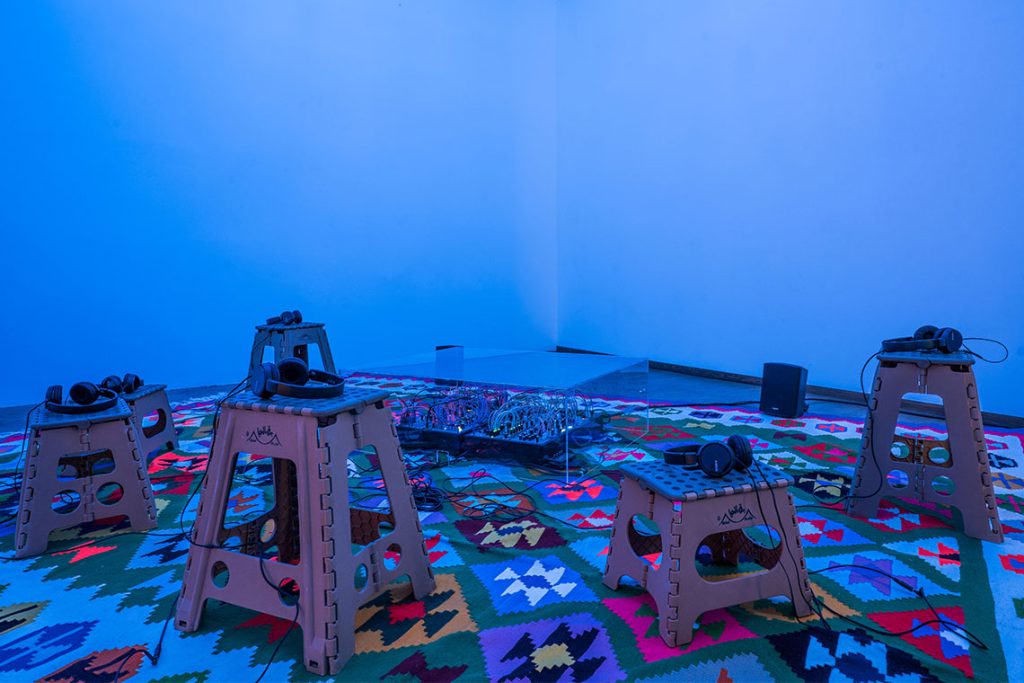
Sonic Jeel has taken over a blacked-out room in the Palazzo to present Sonic Fields, an amalgamation of sound recordings from across Doha, set up as a sound station atop a patterned carpet room and complete with shifting multicoloured mood lighting. Co-curator Westfall explains that the work “seeks to honour the variety and richness of that location by capturing the soundscapes that are a key part of the urban experience”, thus encouraging an attunement to what might be termed the ‘overlooked everyday’. A distinct yet complementary installation by Water with Water adorns a wall with superimposed photographic prints on fabric, some taken by professional photographers and others by project participants, found through a crowdsourcing initiative, with The Gulf Between Us intending to emphasise the plurality of life experiences across the Gulf.
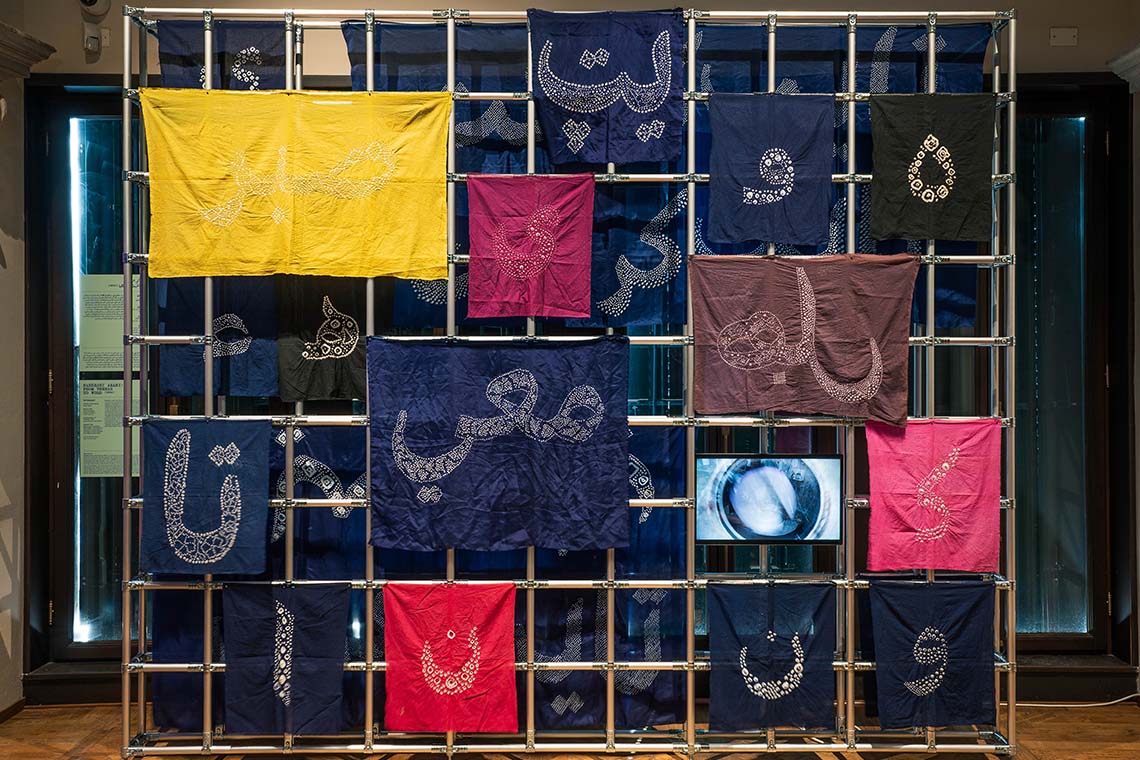
Amidst these multiple experiences remains an overt desire to further shared interests through interdisciplinary work. In one memorable large-scale installation, in which bars of light resembling lightsabers click into life to form Arabic script, xLab’s Preceding Emptiness sees this typeface begin to occupy the computational landscape in its own right, rather than adhering to Western alphabets. In Bandhani Arabi: From Thread to Word by TypeAraby, a series of hand-stitched Arabic letters on fabric dyed using the traditional bandhani technique from Bhuj in India, brings to light the long history of cultural exchange along trade routes. GA:MA lab, whose project Oceans & Lands: Drifting Senses and Knowledges delves further into the historical flow of goods, people and culture across the Indian Ocean, asked during the symposium: “What is global beyond empire and capitalistic encounters and national solidarities?”
Boost Lab’s Chrysalis, a cocoon-like fabrication designed to purify the surrounding atmosphere, brings the viewer back to elemental basics, attesting to the commonality of the necessity for clean air in an increasingly polluted world. So is the desire for connection, explored in Anthro-tech Atelier’s Whisper from United Geekdom, a multi-screen project flashing between different members of the community of gaming, cosplay and role-playing subculture of Qatar, while subverting monolithic cultural stereotypes of the region. Perhaps this speaks to a deeper concern underlying many of the project’s acts of resistance against disappearance and the fear of our own irrelevance as humans in the face of a rapidly changing world.
Alone in the last room, a small robot, no bigger than a dachshund and created by MeshLab, is affixed to a table. In a voiceover, the figure ‘narrates’ its experience, seeking to position itself as a natural evolution in the long human history of discovery and creation. The robot is unnerving, seeming very much alive with each tilt of its mechanical head. But it also appears lonely, with the future feeling particularly vulnerable here, as though the AI robot is itself uncertain of its place in this world, much like the humans it is being forced to interact with.
أغرب إدراك | Aghrab Idrāk: Thresholds of Perception runs until 22 November
