

How a robotic engineer uses ropes to reflect on our entanglement with technology.
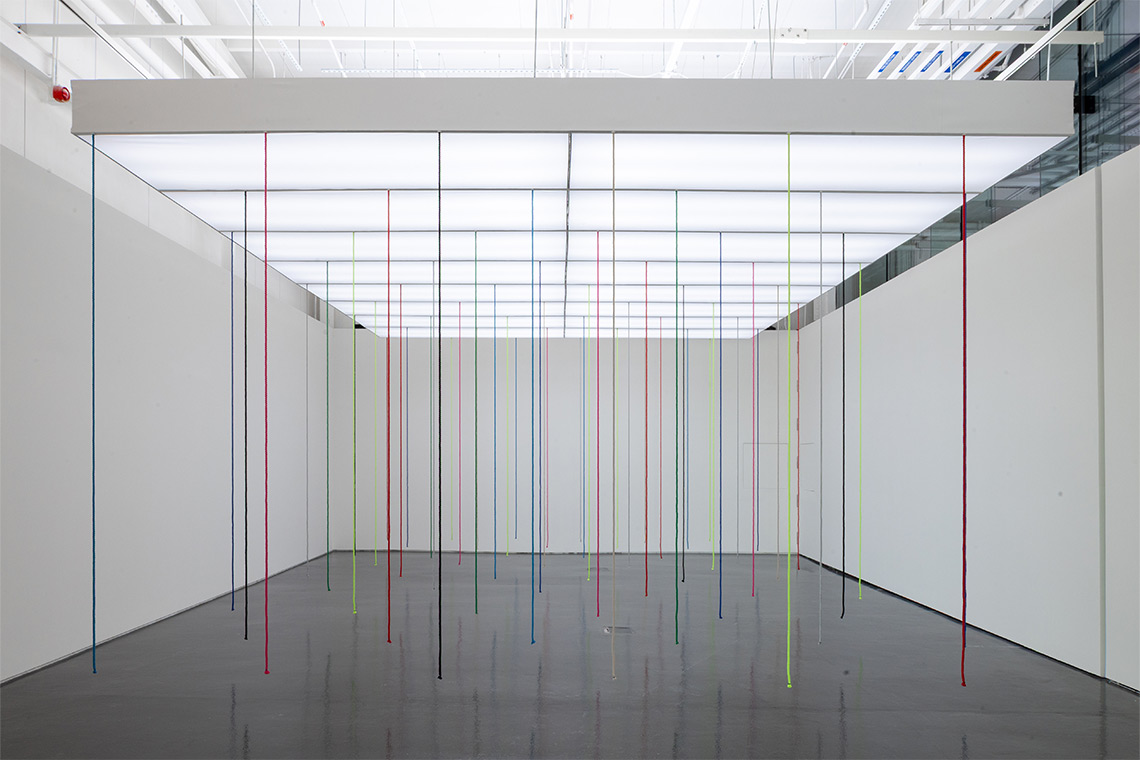
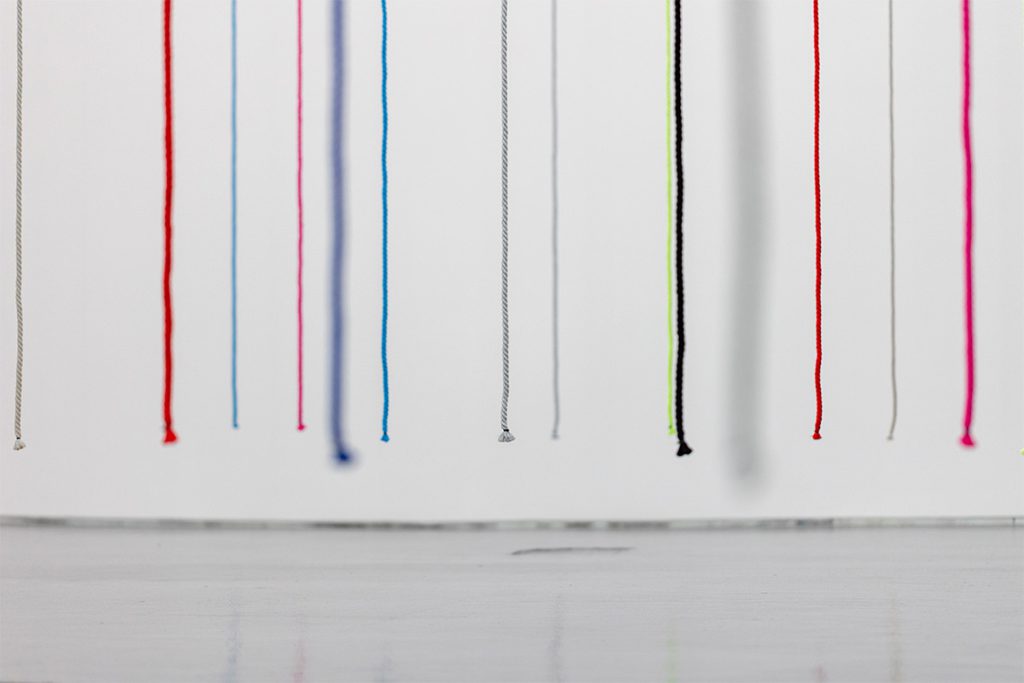
Tugging at the first rope does nothing. The neighbouring cords, dangling in neon greens, reds and pinks, as well as other, darker hues, are also unresponsive. With each pull, unseen springs above the luminescent ceiling flex and slacken, and apart from their almost imperceptible pinging, it is the the prerecorded birdsong that has the room.
Then, one of the ropes triggers a loud, digital crunch. It barely lasts a second but the game is afoot. The next rope sounds a similar crackle, but longer. The one after that, however, is more succinct. Going back the other way, the sound is the longest, loudest yet. Finally, the last rope in this chase triggers a cacophony of crackles and beeps. The ceiling lights flicker. The machine, or its algorithm, has been found.
This game of hide-and-seek is the essence of Dr Ahmad AlAttar’s installation at 421 Arts Campus. Human in the Loop (2026) was conceived as a reflection of our interaction with technology, the title coming from a phrase used to describe a computer model that needs human interaction. Here, however, there is another layer of meaning, signifying a person embroiled in a never-ending act. After all, the algorithm changes its hiding place immediately after being found, and the player must start over, tugging at the ropes until the glitch blares at its full length, until the ceiling lights flash and flicker.
“I built this resemblance between what we’re doing now and with mindlessly scrolling on your phone at the end of the night,” AlAttar says. “You’re kind of into it, right? You want to find it again and again and again. Remember, it’s actually distracting you from nature.” He’s right. The natural soundscape playing in the room is still loud and clear, but in the pursuit of the sound, the mind has completely filtered out the birds’ chirping.
A robotics engineer at the Dubai Future Foundation, AlAttar has become known for incorporating technology in his art. Last year, he presented Moss-Behaving (2025) at Mondoir Gallery, a work that blended real photographs of traditional architecture with AI-generated moss. His Sadu Bonanza (2025) at Art in Space, shown last year as part of the Merely Random exhibition, took on traditional Emirati weaving patterns in an interactive installation.
“As a kid, I was always doing creative things and crafts at home,” he says. “That was embedded in me. I was good at maths and physics, but the creative part was still strong in me. My class projects would always be the most colourful or the most decorative. But only when I finished my studies did I give myself the chance to really bring those two worlds together.”
His interest as an artist, he explains, has been in trying to find novel ways of interacting with the digital world, to create “phygital” experiences. “It’s a mix between digital and physics,” he says. “If it is purely screens and projection mapping, I feel so disconnected. Like it’s a separate world. But here, you are in it. It’s immersive, and there is something from the real world that you can pull and touch and hear. That’s the kind of art I like.”
AlAttar is constantly looking for ways through which to make tech more relatable. “The way I like to do tech art is to always connect it to something in our childhood, or culture. Culture is often thought of as the past, and tech as the future, but I always find a way to bring the two together, or modernise what is from the past. So, here, you’re actually playing a game that you’ve been very familiar with since childhood.”
Human in the Loop is the largest and “most complex” work that AlAttar has created. “It looks very simple and playful, but all the hard work is hidden above the ceiling,” he reveals, speaking of the spring mechanisms and wireless routers connected to each rope. When he was still developing the installation at home – a mess of wires overrunning his workspace – he had limited space and so confined the piece to a four by four grid, utilising 16 ropes.
“But here, because of what I was testing with wireless connections, I was able to expand it,” he says. The installation is assembled across a six by nine grid, with 54 ropes hanging in the space. Each of them is like a wireless mouse, AlAttar says, communicating with the installation’s hidden computer. “But what are you interfacing with? That’s the question,” he poses.
The metaphor goes beyond the infinite scrolling on social media. With the spread of artificial intelligence, Human in the Loop brings forth other questions about the way technology is influencing our cognitive functions and habits. “I’m trying to make you question who is in control,” AlAttar points out. That’s not to say that he is warning against these new technological advancements as a whole. Quite the opposite. He seems enthusiastic about AI’s potential, but also insists on a mindful approach in terms of how it is adopted and how it will continue to permeate across our daily lives.
Before he settled on the final version of the installation, AlAttar experimented with using ChatGPT in the project’s code. “It misbehaved,” he says. “Instead of hiding in one spot, it hid in two or three spots. I realised that I couldn’t connect it to pure AI. So I went back to something that’s a bit more hard-coded. But it was nice to try.”
Of course, there is an argument that presenting the installation with these quirks would have pointed out the unreliability of artificial intelligence, but AlAttar wanted to focus on the cyclical nature of our engagement with computers. He might, however, go on to incorporate ‘pure AI’ into subsequent iterations of the work. “I would love to give more freedom to the technology, to the algorithm,” he admits, “so it can kind of learn from our movement and decide what to do next.” He goes on to explain how he would like to explore that as a next step, to find a safer, more manageable way to connect AI to the installation.
“People play the game in different paces. And that’s one thing that could influence it. I think if we give full control, it can deceive you or do something else. Or if I programme it to never be found, it can run away from you all the time. If you’re there, you’ll just come here.
In which case you have to be much faster than the algorithm running around. That’s interesting.”
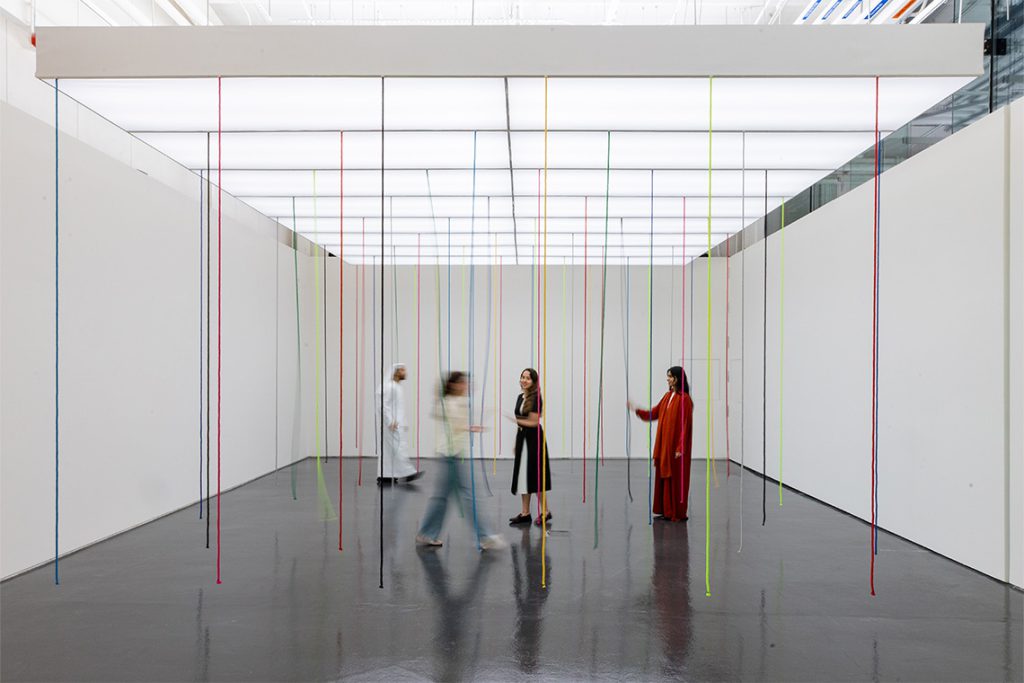
Nevertheless, AlAttar himself was surprised by how differently people interacted with the installation. Some, especially children, were not interested in trying to find the algorithm at all, and merely tugged at one rope after another, simply enjoying the process. Others referred to the digital map at the entrance of the exhibition, which hints at where the algorithm is hiding, trying to find the last rope with as few steps as possible.
“I want people to actually enjoy playing,” AlAttar says. “Even if they played and then left, it’s a win for me, because they had fun. They interacted, they enjoyed, they connected with something that they didn’t know about. Plus, when people do ask the questions and really think deeply about it, they will understand the idea behind it.”
Human in the Loop runs until 13 September
