

The curator of the Pavilion of the Republic of Kazakhstan discusses how a sensory approach expresses Kazakh cultural identity and historical experiences in Qoñyr: the Archive of Silence.
Canvas: How does the pavilion link to this year’s Biennale curatorial theme of In Minor Keys and what did you do to give it a uniquely Kazakh perspective?
Syrlybek Bekbota: The concept of In Minor Keys resonates deeply with Kazakhstan’s historical and cultural experience. A significant part of our twentieth-century history was marked by violence, displacement, silence and interrupted memory. These experiences have been preserved not so much in official narratives, but in the landscape, the body, sound and everyday cultural layers. When I first encountered the concept of In Minor Keys, I immediately thought of the Kazakh notion of Қоңыр (Qoñyr), a word that cannot be explained through a single meaning. Qoñyr can refer to a state, a sound, a way of being, and even a way of perceiving the world. It contains silence, restraint and inner depth, and is a way of reflecting on inner resonance through Kazakh culture. For us, the “minor” is not weakness or lack. It is another form of presence – quieter, but deeper and more lasting in its impact – and so was a natural response to the idea of minor keys and as a title for the exhibition.
Qoñyr clearly carries rich metaphorical meaning. How did these layers shape the way in which you curated the exhibition?
At first, Қоңыр (Qoñyr) emerged for me as an atmosphere or an intuitive feeling. However, as I worked on the structure of the exhibition, I realised that it was not simply a theme but also a curatorial method. For me, it became a way of working with what is difficult to express directly: with subtle, fragile and unfinished states. It creates a space where meaning is not explained immediately, but is gradually experienced and felt.
The exhibition focuses on quieter voices and accumulated memories. What inspired you to bring these elements to the forefront in the Archive of Silence?
Working with experiences that have not been spoken, but have not disappeared, is directly connected to my artistic practice. I am interested in invisible historical layers preserved in the landscape, the body and collective memory. For me, it is important not to speak about this loudly, but to find the right form and the right moment for these experiences to be felt and acknowledged.
How were you and the artists selected for the pavilion?
This pavilion was realised through an open call. I think this is very important, because such a format creates space for different voices and artistic practices, rather than representing only one institutional position. This approach made it possible to bring together artists working in different media and artistic practices within one conceptual space. At the same time, each artist has preserved their own visual and emotional language. In my view, an open call gives the best opportunity to show the complexity and multilayered nature of the contemporary artistic process in Kazakhstan.
The pavilion includes works by Ardak Mukanova, Gulmaral Tattibayeva and Natalya Ligay (ADYR ASPAN), Anar Aubakir, Asel Kadyrkhanova, Smail Bayaliyev, Nurbol Nurakhmet, Mansur Smagambetov and Oralbek Kaboke. How do you bring multiple artists together in one space?
The pavilion features artists working with installation, sound, video, sculpture and immersive media, with each work addressing the theme of memory and history in its own way. We did not aim for complete visual homogeneity. On the contrary, by preserving subtle differences and tensions between the works, we tried to connect them into a single statement. Some projects work directly with history and the archive, while others operate through atmosphere, sound or bodily perception.
How do the various media work together to tell a story?
Although the media belong to different disciplines, we approached them as interconnected layers of impact on the viewer. Sound plays a particularly important role because it works on a sensory level. Objects and installations, in turn, function as physical traces and carriers of memory. Together, they create an experience that offers not so much the reception of information as immersion into a particular state.
Movement through space and sound play central roles in the exhibition. Why are these sensory experiences important in Qoñyr?
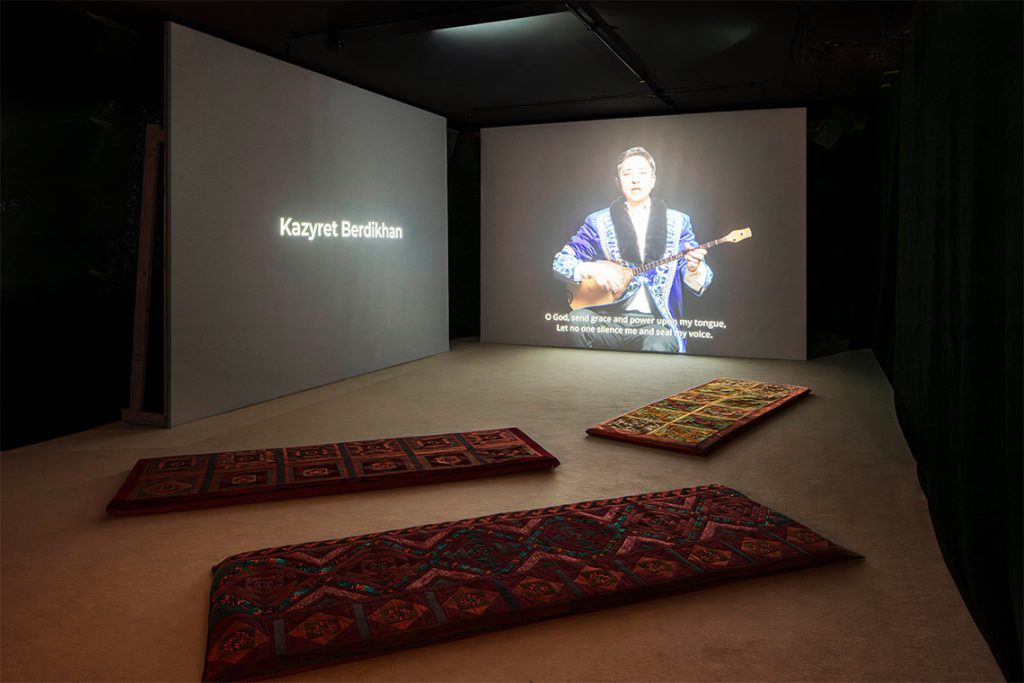
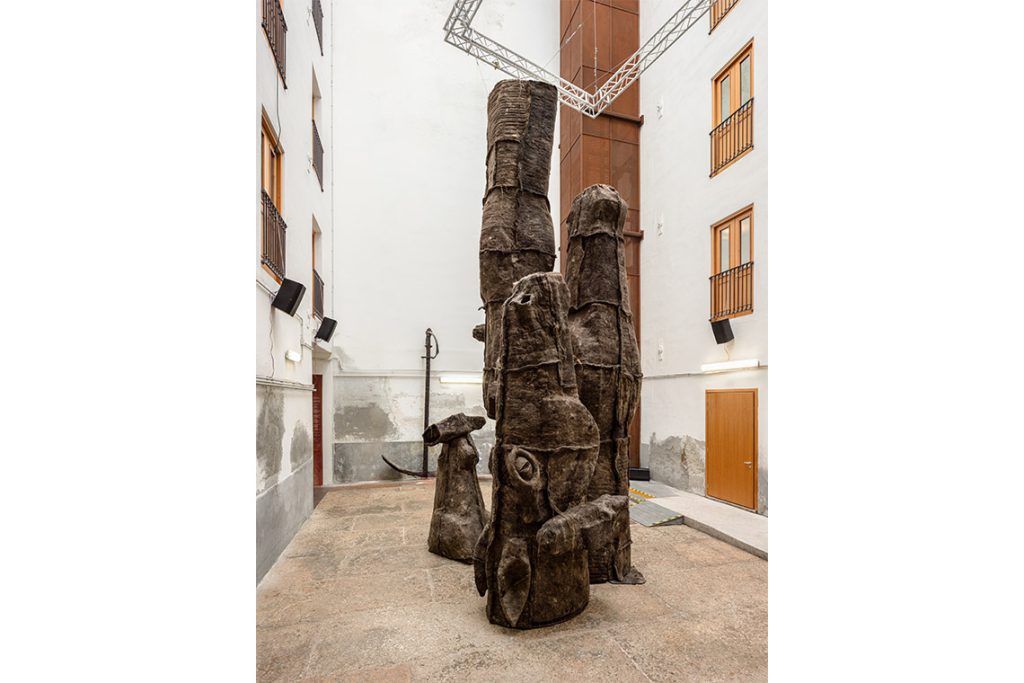
These elements appear in the exhibition through different media. For example, the material used in Smail Bayaliyev’s installation is itself an authentic object with its own history and nature. In my own work, the art of aitys, familiar to Kazakh society, is presented in the form of two-channel video art. In this way, traditional cultural codes are reinterpreted through new media and acquire new meaning in a contemporary context.
How did you navigate presenting traditional elements to an international audience?
I would avoid separating the creative expression of a particular people or society exclusively into the categories of ‘traditional art’ or ‘folklore’. Such a view makes it something detached from contemporary art and places it on the periphery. I believe that elements considered traditional should be perceived as a fully developed artistic language and as part of contemporary art.
What impact do you hope this pavilion will have on visitors, as well as on Kazakhstan’s cultural presence globally?
I hope that people will leave the pavilion not only with new information but also with a deeper sense of Kazakhstan’s culture. I would like a certain state or inner resonance to remain within them after the visit. I also believe that this project will help present Kazakhstan as a space with a complex history, a multi-layered identity and contemporary artistic voices.
The Pavilion of the Republic of Kazakhstan is located at the Museo Storico Naval
This interview first appeared in Canvas 123: Venice Special Issue
