

Where does Arab North Africa sit within a century of Pan-Africanism? The Barbican‘s ambitious new survey has more of an answer than it first appears – you just have to know where to look.
“Panafrica”, the curators of the Barbican’s sprawling summer exhibition tell us, is an imagined geography – a conceptual space without borders, held together by a century of shared struggle against colonialism and its afterlives. Across some 300 works spanning the 1920s to the present – paintings, sculpture, film, posters, journals, pamphlets – Project a Black Planet: The Art and Culture of Panafrica sets out to trace Pan-Africanism’s influence from the continent through the Caribbean, Brazil, North America and Europe. For Canvas readers, however, the show poses a question that it never quite answers directly: where, in this expansive cartography, does (majority) Arab North Africa fit?
The exhibition’s implicit answer is everywhere, and nowhere in particular. Egyptian and Moroccan modernists are threaded generously through the galleries – Inji Efflatoun, Abdel Hadi El Gazzar, Fatma Arargi, Gazbia Sirry, Omar El Nagdi, Farid Belkahia, Ahmed Cherkaoui and Mohamed Melehi – alongside contemporary figures including Kader Attia, Yto Barrada and Moataz Nasr. Yet the wall texts, which frame each section as a discursive essay, neither explicitly address the complex position of Arabness within the continent nor explore the fissures between Pan-Arabism and Pan-Africanism. The inclusion of Arab artists argues for their belonging; the argument itself is left largely unspoken.
That silence matters, because the question is neither new nor settled. Leaders Gamal Abdel Nasser of Egypt and Kwame Nkrumah of Ghana worked together in the 1950s and 60s to build the institutional scaffolding of continental unity, laying groundwork that would eventually produce the Organisation of African Unity. The 1969 Pan-African Festival of Algiers – celebrated in William Klein’s documentary, screening in the Barbican’s accompanying film programme – gathered African, Arab and diasporic revolutionaries in a North African capital. Since those days, diaspora-led Pan-Africanism has often centred Blackness and the Atlantic slave trade in ways that sit uneasily with the Arab-majority states north of the Sahara, to say nothing of the Amazigh, Nubian and Sahrawi communities within them. An archival gem gestures at these entanglements: an excerpt from a text by the Palestinian liberation movement Fatah, addressing African liberation struggles with the assertion that their histories are one and the same. It is a striking inclusion, easy to miss amid the density of archival material – conference reports, journals, record sleeves, pamphlets – that lines much of the exhibition. One just wishes that the curators – Antawan I Byrd, Adom Getachew, Elvira Dyangani Ose and Matthew S Witkovsky – had built more around it.
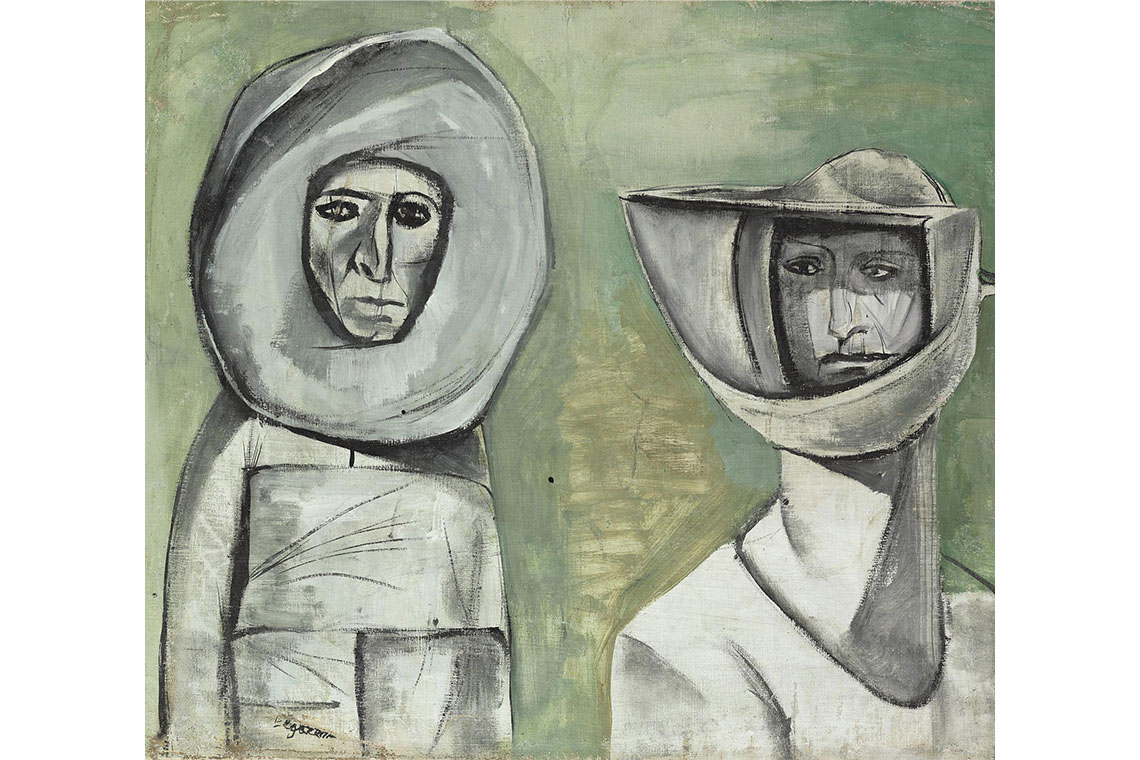
The works themselves make a more supple case than the curatorial prose. El Gazzar’s Shakhsan fi Malabes al Fadaa (Two People in Space Outfits) (early 1960s) is a highlight of the opening galleries, two figures in headgear that hovers between astronaut’s helmet and beekeeper’s hat, painted at the height of the space race and of African decolonisation. The Egyptian surrealist claims cosmic futurity for the newly independent peoples of the continent, decades before Afrofuturism had a name.
The Moroccan modernists form one of the show’s tighter clusters. Belkahia’s Cuba Si (1961), painted during his years in communist Prague, distils anti-imperial solidarity into a single anonymous figure, arms flung upward in protest – a work that connects Casablanca to Havana via the Bay of Pigs. A section on autonomy gives welcome space to the Casablanca Art School, where Belkahia (its director) and Melehi rejected the colonial condescension that had dismissed Moroccan painters as naïve, taking modern art into public squares through the Présence Plastique exhibitions. Nearby hangs Cherkaoui’s Alea (1965), its quasi-invented script fusing the Quranic calligraphy in which he trained with Tifinagh, the written form of Amazigh languages. In one canvas, Cherkaoui holds together the layered identities – Arab, Islamic, Indigenous – that the exhibition’s broader framing struggles to articulate.
The Egyptian women artists are the emotional core of the show’s Agitation section. Efflatoun’s Ahlam Al-muetaqala (Dreams of the Detainee) (1961), painted during her imprisonment under Nasser’s crackdown on politically active women, shows a woman gazing past prison walls, body confined but mind at liberty. Arargi’s Al Muqawma al Shaabeya (Popular Resistance) (1956) responds to the Suez Crisis with the urgency of an artist watching neo-colonial intervention unfold in real time. Sirry’s Ae’ela Nubiyya (Portrait of a Nubian Family) (1965) does still more strenuous work. One of 20 women artists dispatched by the Ministry of Culture to document Nubian temples before the Aswan High Dam submerged them, Sirry turned her attention instead to the Nubian people themselves – tens of thousands of whom were about to be dispossessed of their ancestral lands. Her matriarch and children meet the viewer’s gaze head-on, in front of a family home whose murals echo the mother’s braids and dress. It is a painting about an Arab-nationalist African state displacing its own African citizens in the name of modernisation, and it hangs – without commentary – in a show devoted to continental solidarity. Alongside these women hangs a 1989 ink drawing by Ibrahim El-Salahi – Sudanese, and thus a bridging figure between Arab and African modernisms – whose calligraphic abstraction was forged in the Khartoum School and its offshoot Madrasat al-Ghaba wa al-Sahra, the School of the Jungle and the Desert, a name that proposed in itself a synthesis of Islamic and African elements.
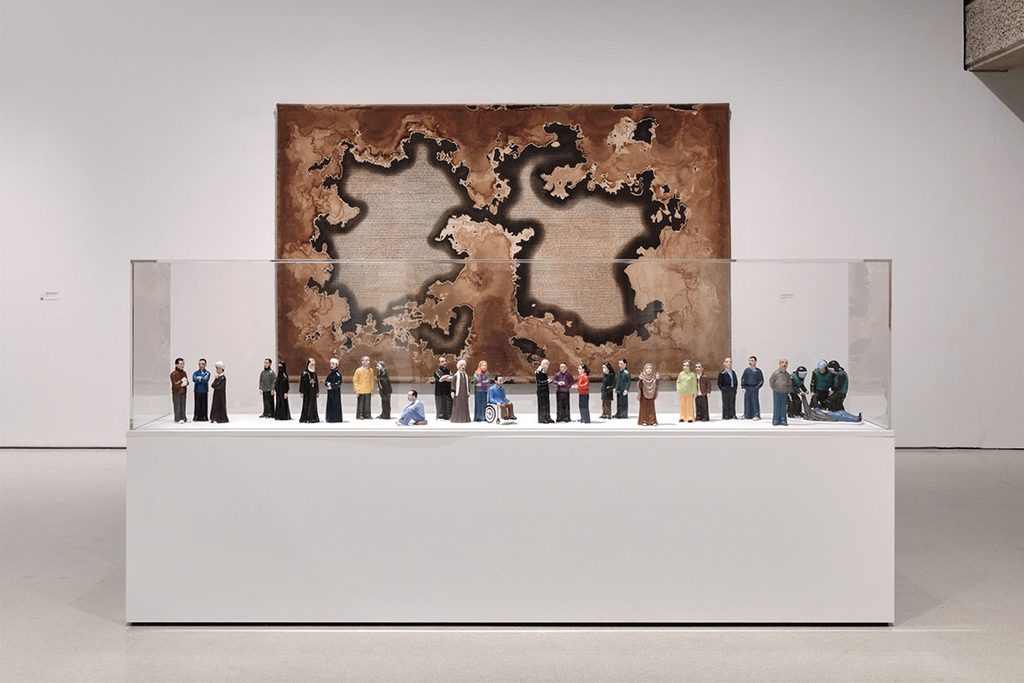
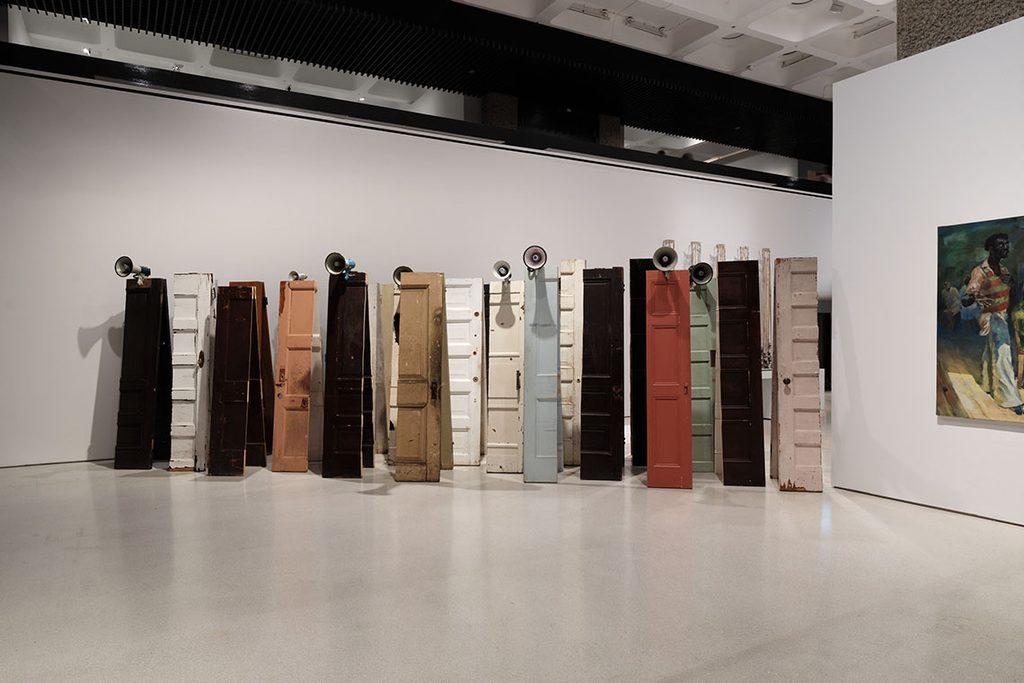
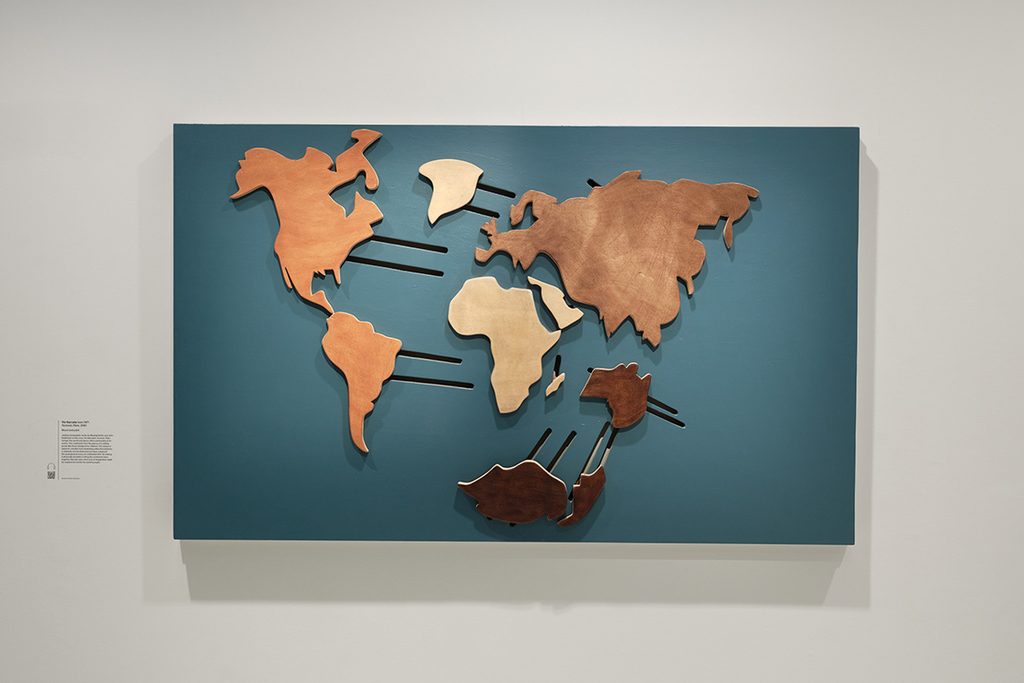
Contemporary North African voices carry the political charge into the present. Attia’s Asesinos! Asesinos! (2014) – salvaged doors sawn in half and hinged into A-frames, bristling with megaphones – renders a protesting crowd as silent architecture. Barrada’s Tectonic Plate (2010) remakes the world map as a children’s sliding puzzle with Africa fixed at its centre, inviting viewers to imagine the continents – and their peoples – reunited. Most affecting is Nasr’s Elshaab (The People) (2012), an assembly of small clay figures representing the crowds of Tahrir Square, where the artist’s family home stood. Look closely and you find, among the throng, a woman in a hijab raising both hands in the V-for-victory sign – that universal grammar of protest, here unmistakably Egyptian, unmistakably Arab, and wholly at home in a Pan-African exhibition.
The exhibition book, however, does not evade the fissures. Sophia Azeb’s essay ‘Mapping the ‘Arab’ in Pan-African Political Cultures’ dwells on the contradiction at the heart of Nasser’s own record. He displaced tens of thousands of Nubians to build the Aswan High Dam even as he professed continental solidarity, covertly sheltering Patrice Lumumba’s children in Cairo after the Congolese coup and issuing a 1961 postage stamp that placed Lumumba’s portrait inside the outline of Africa. Azeb finds the same tension resurfacing at the 1969 Algiers festival, whose manifesto never once invoked Arab identity, language or culture, instead presenting Algeria and the festival itself as an entirely African undertaking – Arabness written out of the very event that a mostly Arab nation was hosting – and in the culture clash that met visiting Black American revolutionaries, such as Ted Joans’s lurid, Orientalist verse about sexual encounters with Maghrebi women or Sun Ra’s quiet admission to his Arkestra that “many of the Egyptians did not appear to be his people”. She describes Arab-African political culture as “phenomenological”: a series of fleeting, spontaneous encounters resistant to any fixed cartography. Where the walls of the exhibition say little of the ruptures, the exhibition book spells them out. Inevitably, though, very few gallery-goers will read it.
Still, there is something kind of radical in the exhibition’s refusal to police Panafrica’s borders. By gathering Cherkaoui in the same space as Wifredo Lam, and Efflatoun in the company of David Hammons’s African-American Flag, the walls perform an argument that the catalogue makes explicit but the galleries themselves decline to voice: that the largely Arab north was never peripheral to the Pan-African project but present at its festivals, its congresses and in its anti-colonial struggles – and present, too, in its contradictions.
Project a Black Planet: The Art and Culture of Panafrica runs until 6 September
