


In an iconic collaboration, Hublot and Jeff Koons unite their experimental approaches to push the boundaries of contemporary horology.
In 1980, a timepiece appeared at the Basel Watch Fair that revolutionised the world of horology. Named the Hublot – French for ‘porthole’ – it featured a gold casing radically paired with a vanilla-scented rubber strap. Before then, rubber was considered a disposable, utilitarian material, suitable only for cheap mass market sports and diving watches. The Hublot brought rubber into the realm of luxury, forever changing the face of watchmaking. It was a material innovation that remains at the heart of the Hublot brand’s DNA, under the concept ‘The Art of Fusion’, which pairs traditional craft with unexpected new materials like coloured ceramics and engineered sapphires.
Also in 1980, an unknown 25-year-old artist opened his first solo exhibition, placing found vacuum cleaners in the storefront window of New York’s New Museum, then located on 14th Street and 5th Avenue. Like the Hublot, which scandalised the purists of the Swiss luxury watch industry, the works were met with scepticism at the time, dismissed as a gimmicky rehashing of Marcel Duchamp’s readymades. The artist was Jeff Koons, who would go on to become one of the most commercially successful artists of our time.
A collaboration between Koons and Hublot, then? Let’s call it a match made in rubber-inspired heaven. Both icons and visionaries in their respective fields, they have come together to produce two remarkable limited-edition timepieces. The Classic Fusion Balloon Dog presents a new frontier where contemporary art meets horology, while the MP-14 Origin pushes past the heavens themselves to consider the cosmos and the very nature of time itself.
During the three years that watchmaker and Hublot founder Carlo Crocco was developing the materials science behind the Hublot, Koons introduced his Inflatables (1978–79) series, which juxtaposed vinyl inflatables – cheerful flowers and bunnies – with sleek mirrors. These elements would go on to be fused into his Statuary series (1986), including the iconic metal Rabbit, which took that rubber and made it reflective. After a period of experimenting with readymades, this segued in turn into the Celebrations series (1994–2000) of playful balloon animals cast in mirror-polished steel for which he is best known.
There is something awfully elegiac about the balloon animals, in the way they index a unit of childhood time: the inflation, the anticipation, the delight, the slow wrinkling and deflation. Once you look beyond the scaled-up shininess, Koons’s balloon animals capture the same elusive emotional quality, fixing them in time through immense, if invisible, technical precision and control. Fittingly at a time when the line between contemporary art and wearables is increasingly shrinking, the Classic Fusion Balloon Dog transforms these monumental works by scaling them down to the size of a human body.
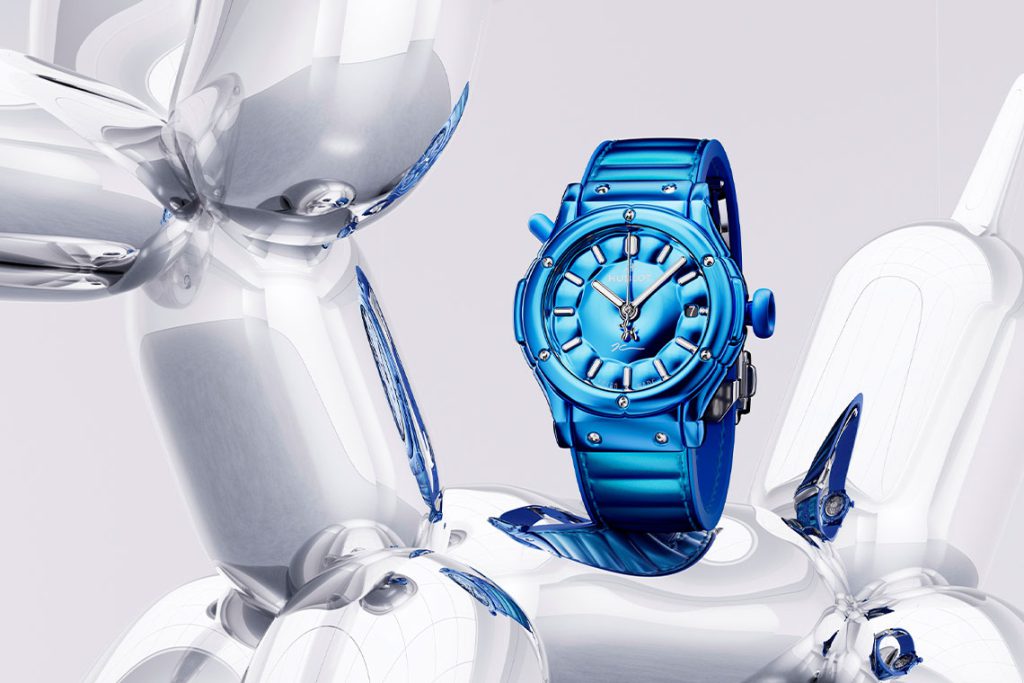
Reinterpreting the Balloon Dog involves more than just an aesthetic reskinning. Rather, the architecture of the Classic Fusion was wholly re-engineered to suggest the convex inflated volumes and inherent tension of Koons’s visual language, as if the watch itself were cast with human breath. Every element was revisited to seem softer and rounder, from the puffed-up dial and sculptural casing to the domed sapphire crystal and titanium screw heads. There are small, irreverent details too: a flexible balloon tail at 10:30, a balloon-like crown and a tiny balloon dog counterweight on the seconds hand. Available in mirror-polished steel and polished, anodized aluminium in red or blue, the watch is presented in Balloon Dog-inspired packaging limited to 200 pieces per edition.
In 2005, Hublot revolutionised the watch industry a second time with the Big Bang. Previously, cases were largely cast from a single metal but they pioneered an unprecedented ‘sandwich’ modular architecture that allowed disparate materials to be juxtaposed: Kevlar, ceramics and tungsten magnesium, among many others. In 2009, the brand shocked the industry further by opening its own foundry for metallurgical innovation and experimentation, leading to the creation of the Magic Gold alloy, the world’s first scratch-resistant 18-karat gold. Then, with 2006’s Big Bang All Black – a watch not designed to tell time but to tell others who you are – Hublot brought watchmaking into the realm of conceptual art.
Part of the brand’s Exceptional Timepieces collection of experimental, boundary-pushing horology, the MP-14 Origin takes us back to the fraction of a second after the Big Bang known as cosmic inflation, when everything began to expand. Spanning avant-garde mechanical concepts and unconventional time architectures, the collection might be understood as deep space exploration but for horology. As such, the piece marks a significant technical milestone for Hublot, with the debut of its first automatic central tourbillon, a rare, tiny spinning solar system-like mechanism that neutralises the effects of gravity. While the universe’s nucleosynthesis resulted in heavy hydrogens, the MP-14 Origin’s fusion of high jewellery and timepieces includes sapphire, titanium and gem-set white gold architecture. The name, meanwhile, harks back to Koons’s own origin, in a humble storefront on 14th Street. Then as now, as Koons once famously said: “This is the time for Jeff Koons”.
