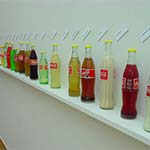

Coca-Cola is a familiar thirst quencher across the globe, its ubiquity making it a universally recognised product. However, a closer look reveals that Coke bottles, though seemin gly identical, differ subtly from country to country. These variations in taste and appearance highlight the simulacral nature of the Coca- Cola bottle—a semblance of an imagined universal ideal.
The concept of a global “Coke” accommodates local tastes, not as a genuine acknowledgement of the “local” but as a calculated consumerist strategy to expand its market. Instead of promoting truly local drinks, Coca-Cola’s presence suppresses local flavours, propagating a hegemonic, universal taste. In India, particularly in the early 1990s, Coca-Cola targeted the aspirational postcolonial middle class through advertising campaigns that marketed not merely a drink but a lifestyle. This strategy cemented
Coca-Cola’s popularity as an “up-market” product, emblematic of global modernity. This incursion of multinational brands into local markets reflects a form of neo- colonisation, marginalising smallscalevendors who produce and sell homemade drinks like sherbets. These vendors, often resourceful and inventive, repurpose discarded branded bottles to package their beverages. Despite limited technical facilities and economic constraints, local recycling practices thrive out of necessity, embodying an “intuitive logic” where nothing is wasted—everything is collected, redistributed and valued.
Press release from 1×1 Art Gallery
Image: A shelf displays 54 Coke bottles collected from various countries, each labeled with the nameof the local drink it contains. These drinks are recreated using recipes sourced from their respective countries. Image courtesy of the artist