

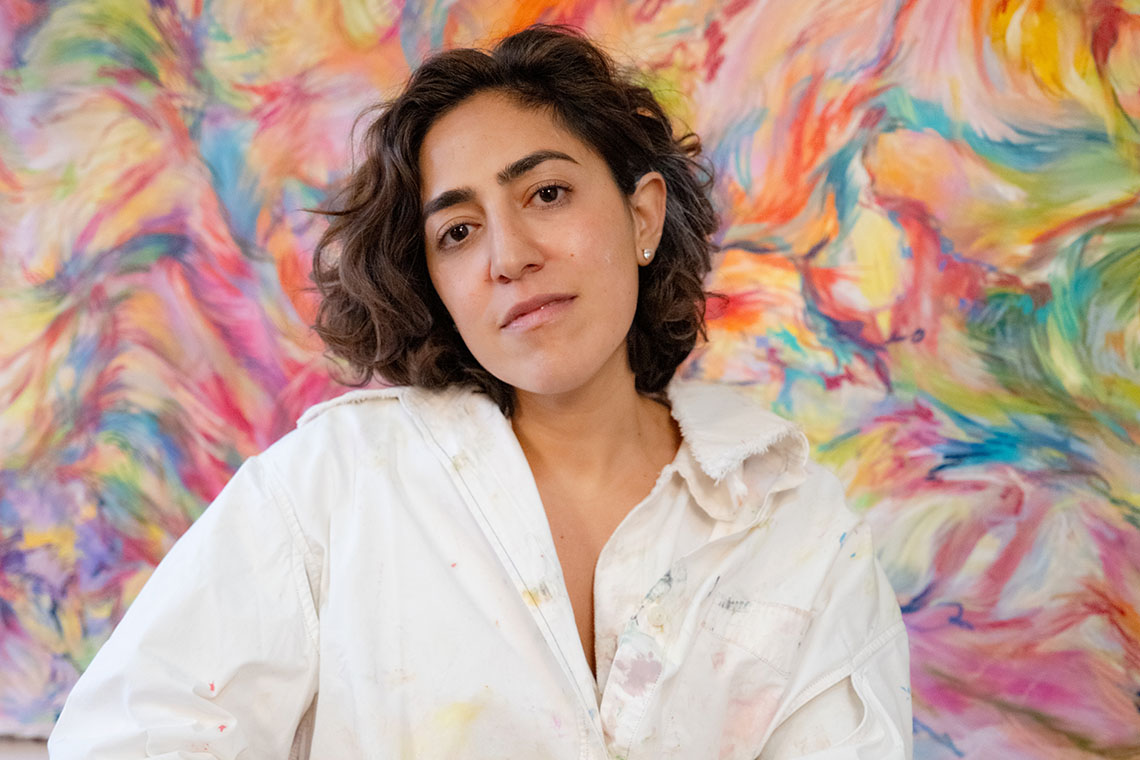
The artist shares how her flower-filled upbringing shapes her creative enquiry into colour and light through paint, in an attempt to connect to the divine.
Canvas: How has your painting practice come to be what it is today and how does the concept of legacy inform your work?
Shooq AlShawi: My parents were florists and so, growing up, we were surrounded by flowers. I would paint them over and over again without realising how meditative that was. I had a deep fear of death until I met the divine through my practice. That’s when faith became a lived experience and the depth of time really made sense. The more I sat with the flowers, seeing this cycle of life and death repeat over and over again, it became something really beautiful. That’s where all the colours come from, from this place where the eternal exists, where the soul is present. When I was pregnant with my daughter, I was in a meditation session, and the instructor kept asking what was coming up for me. The word ‘legacy’ kept coming through, without my fully understanding it at the time. Legacy has become my showing up for things, understanding something that’s beyond me and honouring this painting practice that existed before me and which I carry forward.
How is faith present in your paintings?
I’ve always been deeply inspired by divine movements, but it took time before that was fully apparent in my paintings. In my earlier works, it exists without fully letting you in. More recently, it’s just cracked open, and I don’t think it can be packed up again. This is another way I connect to this idea of legacy, which is the faith that exists within myself. I believe every artist has some form of faith within them. When you paint something, you have faith in this unknown that you’re trying to bring out onto a canvas.
How do your titles further connect you to this faith, such as Spiralling Into the Infinite (Diptych) (2025) or The Birds Are Praying (The Veil) (2026)?
The titles come to me and just make sense. The Birds Are Praying is from seeing birds across the bridge at sunset while cycling my kids home. I tell them that the birds are praying, and now they’ve started saying that. It’s about this faith in something that exists outside of ourselves in the everyday, not belief in one specific thing.
Are the colours in your work inspired by specific flowers or are they accidental?
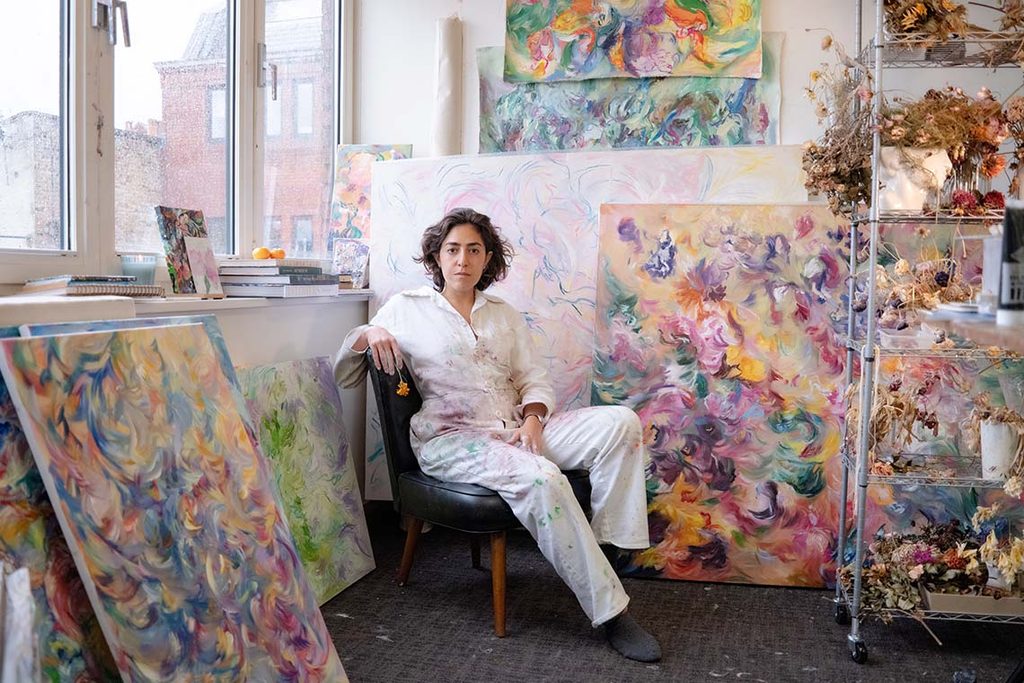
I see everything through the lens of faith. Flowers appear along my path, whether they are collected, bought or gathered, they always deeply inform the work and act as silent witnesses to the process. I have towers of dead flowers in my studio that just stay there and become part of the story.
How do people initially react to your paintings?
I think you react to a work like a mirror into something deeper within. So everyone will naturally have a different reaction. The work is made to invite slow looking. There’s an ongoing questioning of how much space exists between the paint, the canvas and the viewer. To me, colour is an expansion of light and space, which can be used to tap in into further dimensions of the soul’s existence. I want it to speak initially for its depth, where you can feel like you’ve fallen into the work.
Your paintings are physically rather imposing. Is scale important to your practice?
The painting process is a physical outpouring of energy for me. I’ll use my body and just run at the canvas. I’m constantly covered in paint. In some works, you can see the fight with the canvas, and in others, where I had to let go and come at the canvas eyes closed. I’ve tried to trick myself into making smaller fragments of paintings, but it’s not the same.
Are your diptychs part of that exploration?
The more recent ones started as an effort to control the scale. But then I’d start another painting in response to the first one, because if you put too much into one painting, it just becomes nothing. Then the two paintings would come together and become something bigger that you can’t separate, like an energy field. That just can’t happen on a small scale, where I feel like I’m restricted.
Where do you see your practice going from here?
In my current residency programme at Turps in London, there has been a peeling back of colour. The tones have become more baroque, more mature. There was definitely a restraint in the amount of flowers I brought into the studio. Some colours are more present, like the red from these poppies in a field I would cycle by, or blue from the sky right outside the studio, where I would bring my canvases to paint. Some fundamental principles of Islamic art are coming through more overtly, such as the circling of the square. I’ve been repeating myself with this constant circular brushstroke, which has implanted itself without my even noticing. There’s also a lot of canvas left unpainted in these new works. Maybe this is my way of leaving this space for the divine. I’m allowing gesture to take centre stage along with a strong intention of stretching the paint and seeing what it does, in keeping with this idea of legacy.
