

At 80, Kazakhstan’s pioneer of tapestry looks back on over half a century at the loom – and admits she always wanted to be a painter.
For an artist celebrated as a founder of the Kazakh school of tapestry, Batima Zaurbekova makes a disarming confession. “I always dreamed of being a painter,” she tells me, a few steps from the more than 80 works assembled for her 80th birthday at Almaty’s Abylkhan Kasteyev National Museum of Arts of the Republic of Kazakhstan . Her teachers at the Alma-Ata Art School, from which she graduated in 1969, warned her off the loom: “They told me, don’t do tapestry, it takes so much time. In the time it takes to make one tapestry, you could make ten paintings.” She did it anyway – working in dense Gobelin, woven on a vertical loom – influenced by a village childhood among flat-woven carpets and by her mother, Bibikhan, a seamstress who sewed national costume. What carries across both disciplines, she suggests, is an instinct for colour. “Everyone can learn to draw,” she says, “but to see colours, to understand them, that is something given to you by God.”
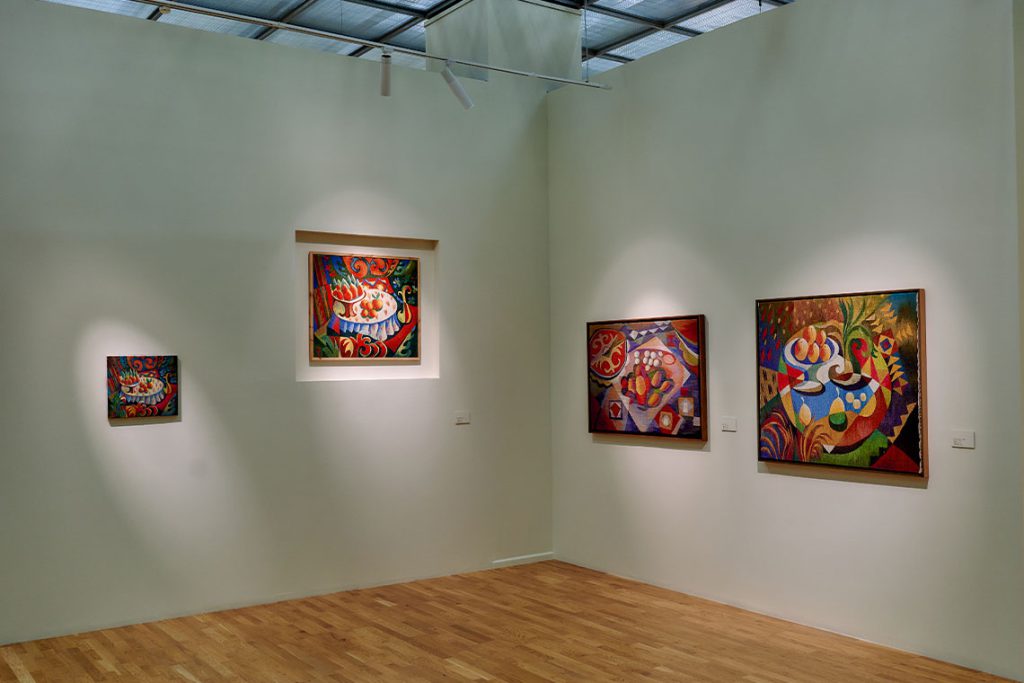
Threads of Heritage, curated by Alina Fedorovich with Natalya Bazhenova, head of the museum’s department of Kazakh decorative and applied arts, makes that pull between brush and thread one of its themes. Several images appear twice, as an oil and as a tapestry – Still Life (1978), which depicts a fruit-laden table among them – so that you can watch a composition migrate from canvas to loom. Around that table, the yurt interior dissolves into contrasting planes of colour and rhythmic lines, closer to stained glass than to felt, so that the domestic space seems almost to sound. It is typical of an artist whose tapestries are conceived in dialogue with lived space – the yurt, the carpet, the curtain – and whose compositions have the flavour of musical improvisations.
The title is apt. For Zaurbekova, it gathers up “our past, our way of life, our history” – a summary, she says, of all of it. Bazhenova reads it more literally. Thread is both the raw material of tapestry and its result, she points out, and each strand stands for a single life: “Each thread represents a person’s life. Each person threads their own life, their own art, into it – and this is the foundation of everything.” The weave itself, as she describes it, forms a cross – a vertical of spirit meeting a horizontal of material life – and from that crossing the whole fabric grows. It is a fitting frame for an artist whose work has always been about continuity: between generations, between craft and art, between the yurt and the museum wall.
The show unfolds across three halls of a museum whose Soviet-era architecture feels a world away from the sleek Almaty Museum of Arts that opened across town last year, to which I owed my last visit to the city. In the first hall, beneath an atrium, a pavilion built for the occasion evokes the Mausoleum of Khoja Ahmed Yasawi in Turkestan, with footage of Zaurbekova’s weaving projected on to its walls. The choice speaks volumes to local visitors: commissioned by Timur in 1389 to honour the twelfth-century Sufi poet whose Turkic-language teachings helped carry Islam across the steppe, the turquoise-domed shrine – never finished, and a Unesco World Heritage Site since 2003 – is Kazakhstan’s foremost place of pilgrimage and a touchstone of national identity. It recurs throughout Zaurbekova’s oeuvre, most notably in a 1990s series devoted to Turkestan and the Silk Road, made as the newly independent country set about reclaiming its past.
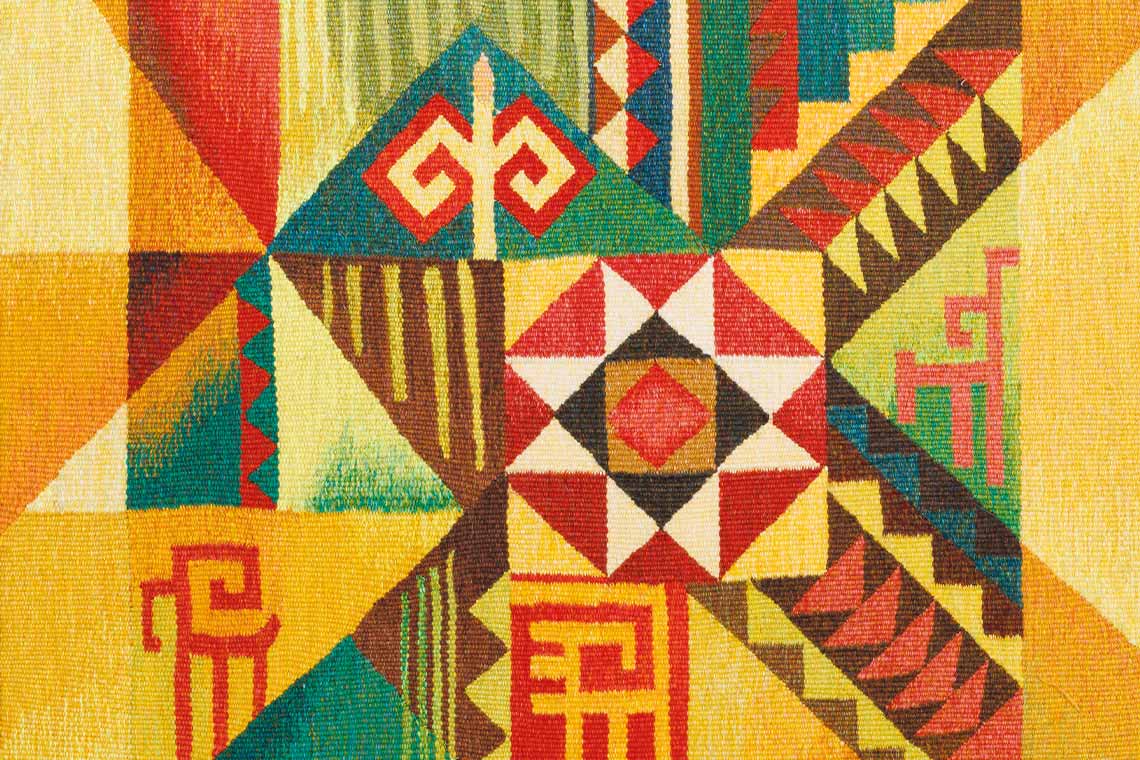
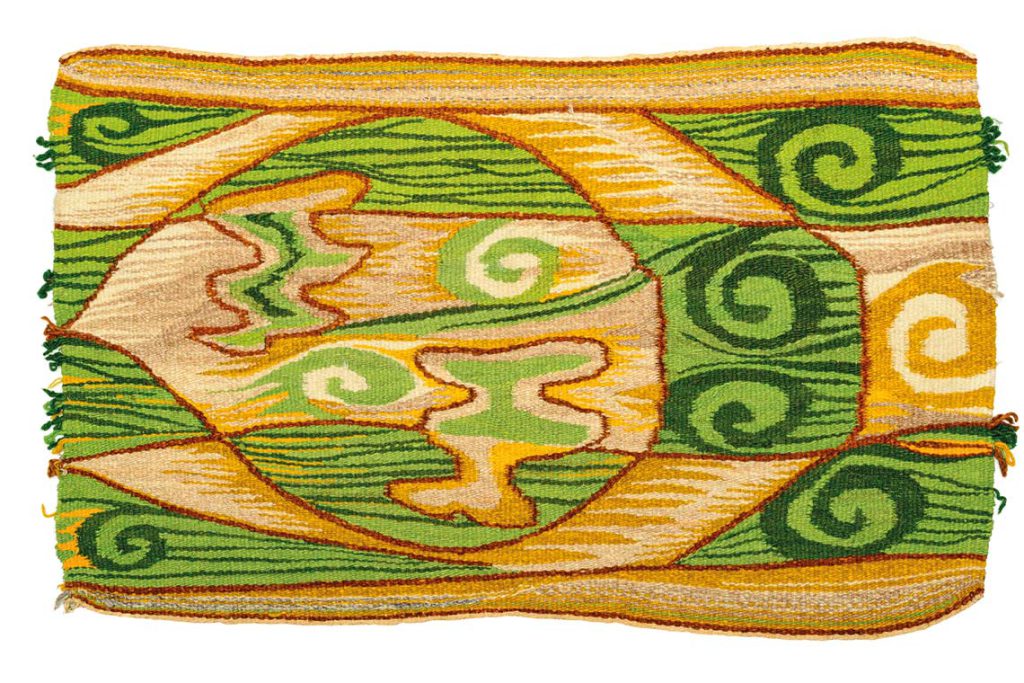
Around the edges of the room, the museum’s permanent displays of felt and pile carpets, leather goods, carved wood and ceramics set her tapestries in conversation with the folk objects that fed them. Quraqs (2015), Bazhenova explains, takes its name from the patchwork quilts her mother made. Woven into its patchwork are symbols drawn from ancient petroglyphs, among them the arkhar, the wild mountain sheep that Bazhenova calls a calling card of Kazakhstan. Zaurbekova’s compositions never drift far from traditional Kazakh ornament or from the cultural memory it carries. Ornamental Rug, made in 1969, the year of her graduation and first solo exhibition, is the earliest work on show – and her newest sits not far away.
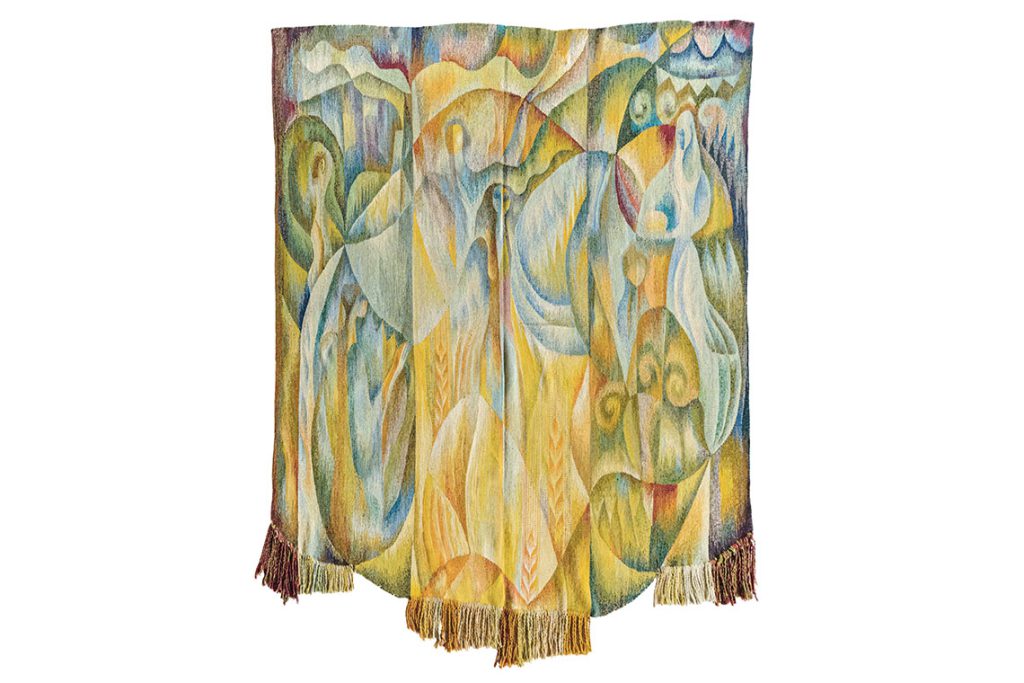
The second hall is given over to the works themselves, grouped thematically in an open plan. The hang is varied – some pieces framed, some suspended against a backdrop of warp threads, as if still on the loom – and several, including Madonna of the Steppe (1980), can be viewed from both sides. The latter is a highlight: a woman in Kazakh dress distilled into a vertical structure somewhere between an arch and an inverted dome, her outstretched ‘wings’ opening like a cup, the whole suggestive of a Tree of Life. Threads left trailing beyond the tapestry’s edge give it a deliberate air of incompletion, as though the form were still growing. Mountains recur across this gallery, a legacy of Zaurbekova’s birthplace, Merke, alongside cityscapes of Astana and Almaty. Bazhenova points out an undulating line that ripples through many compositions like a sound wave; in her youth, Zaurbekova played the bayan (a kind of accordion).
One work whose title piqued my interest was Kazakhstan (1977). A yurt, sheaves of wheat, figures bound together in shared labour: this is harvest iconography, its colours muted because, Bazhenova explains, artists then drew their yarn from the state carpet factory. Did Zaurbekova feel pressure to tone down her Kazakh subject matter? “No,” she says. “I was free to do whatever I wanted.” The only obligations were thematic exhibitions – Mother Earth, she recalls, was made for an anniversary of the republic. Her real influences lay elsewhere. “I did not like Soviet realism,” she says; before sitting down to work, she would leaf through her books of the Impressionists.
Bazhenova offers a more nuanced view. “The spirit of socialism is present in almost all of the works of that time – it was the spirit of the time,” she explains, while insisting that “there was no pressure on the artist”. Their answers gave me pause for thought. After the terror of the Stalin years – forced collectivisation, the execution of the Alash Orda intellectuals – Soviet pressure on Kazakh culture became quieter but no less persistent: a bureaucratic campaign of Russification under which national cultures were tolerated chiefly in a folkloric register. Tapestry, rooted in craft and ornament, may simply have been the kind of national expression the system found least threatening – a question that the exhibition might have done well to explore.
Where Zaurbekova does describe hardship is after 1991. “Everything disappeared,” she says. The Ministry of Culture stopped buying, the art factory that had supplied commissions shut down, and the artists’ union fund closed. She kept working regardless, building a collection nobody was purchasing. Something of a rescue came in 1997, when a Turkish businessman invited her to Istanbul to teach tapestry, a medium barely known there. Ironically, it was in Türkiye that she finally became a painter, producing 35 landscapes in a month for an exhibition; seven had sold before it even opened. “They had 120 galleries,” she marvels. “We didn’t have any here.” The sea – something else absent from Kazakhstan – entered her work too, in tapestries such as Gifts of the Sea (2004).
The final hall turns to womanhood. A shanyrak, the crown of the yurt and a fixed feature of the building that the designers have turned to their advantage, hovers above portraits of women in the saukele bridal headdress and the kimeshek worn by married women. Alongside are archival photographs, a documentary shot in the late 1970s over a month at the artist’s home and at her mother’s, and a loom on which a weaver periodically sits and demonstrates the craft. Here the interpretation thins: the film and photographs come with little context, a shame given how much story they hold.
The show’s real coda, I feel, lies back in the first hall, in Transitional Season (2026), that newest work, in felt and appliqué, which Bazhenova tells me was started only weeks before the doors opened. Its place beside the museum’s old felts distils the whole exhibition: an 80-year-old artist still returning to, and building on, the folk forms she grew up with.
Asked what she would tell young artists navigating the digital age, Zaurbekova is disarmingly candid. “If AI makes everything, what are we going to do?” she asks. “I don’t understand it myself.” Threads of Heritage offers something of an answer: a loom, worked slowly, thread by thread.
Threads of Heritage runs until 8 November 2026
