

The current edition of Amman Design Week focuses on the layers of heritage in the Jordanian capital and demonstrates how the objects around us are never silent.
The Hangar at Ras El Ain was built in the 1930s to house the generators that powered a young and quickly growing Amman, its steel trusses still carrying a faintly ecclesiastical industrial air. It makes an apt and spacious anchor for the fourth Amman Design Week, which returns after seven years away under the theme Accumulations and with the voices of over 220 regional creatives. Their works, by turns fleeting and permanent, drift out of the Hangar to parks, disused street corners and resurrected heritage buildings, and as far as Hellenistic ruins in the valley or at the edge of the Red Sea – activating these civic pockets with design of every temperament, from the plainly useful to the archival, conceptual, experimental, interrogative or devotional.
Much of the work comes from practitioners experimenting well beyond the conventions of their own disciplines; architects thinking as artists and artists taking up the parameters of space and use, or designers treating everyday objects as surfaces for storytelling. Leaving room for such experiment underpins the approach of architect Faysal Tabbarah, this year’s exhibitions’ curator, who has arranged the selection along a sliding scale of design that is “entirely functional, vaguely functional, or provocatively functional”.
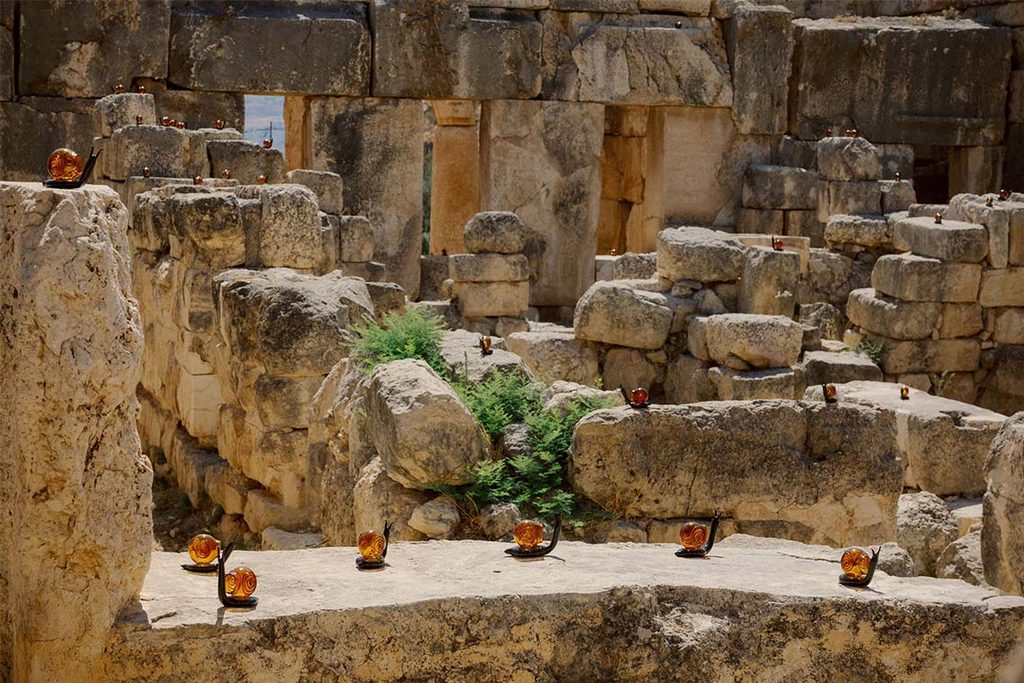
The most monumental reach of that scale lies at the edge of the capital in the valley at Iraq Al Amir, where small snails and figs of blown glass have found their way into the ruins of Qasr Al Abd. Settling among the colossal limestone blocks of the Hellenistic palace is the installation Ahl Al Bayt (the ‘People of the House’) (2026) by Dima Srouji, whose practice has long dwelt on archaeology and the ethics of excavation. In Amman, she began with a diary from 1904 describing the abundant waters of the valley and imagined the landscape itself as the palace’s first inhabitant, the life of its springs and creeks returning in glass to a building thought never to have been completed.
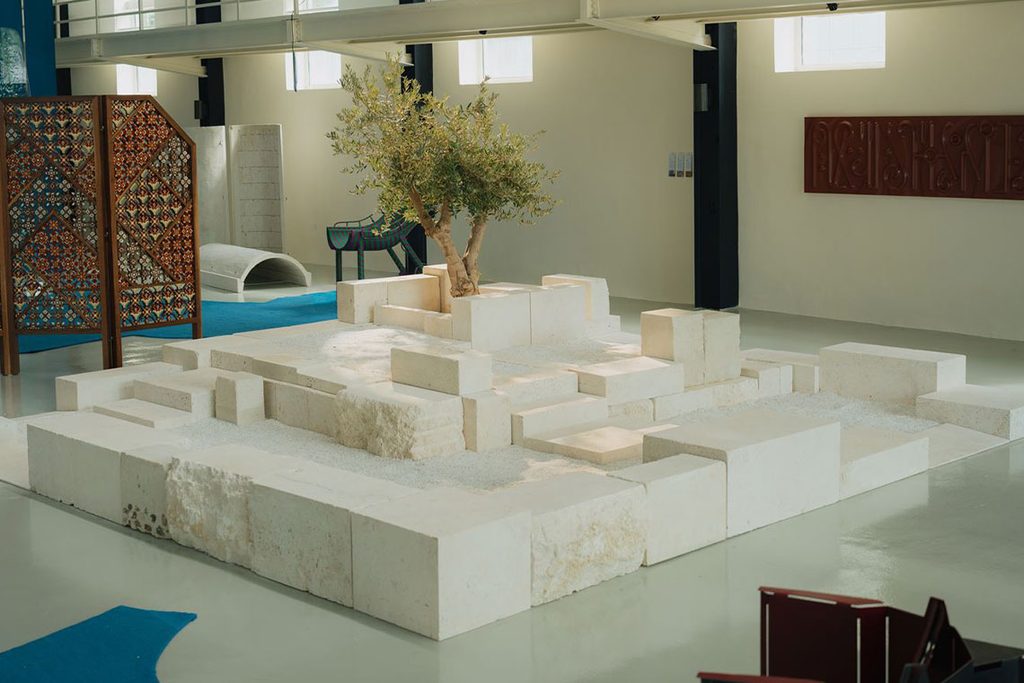
Back in the city, Amman’s past in antiquity resurfaces also in Ras El Ain Park, where Civil Architecture’s Folly (2026) threads a canopy of glazed tiles, made with ceramicist Sama El Saket, between the trees. Its roof is scattered with tiny clay figures that look freshly excavated, although the architects describe them playfully rather as ambiguous caryatids. Inside the Hangar, Laith Matarweh and Hanan Salameh’s Al-Mastaba (2026) reverses the gesture with a bench of stone and concrete speculated as a future ruin, with gaps left open for weeds to grow through, as Éditions Levantine reflects on Mesopotamian tablets inscribed with artful cuneiform through a configuration of mirrors in marquetry and reflective steel.
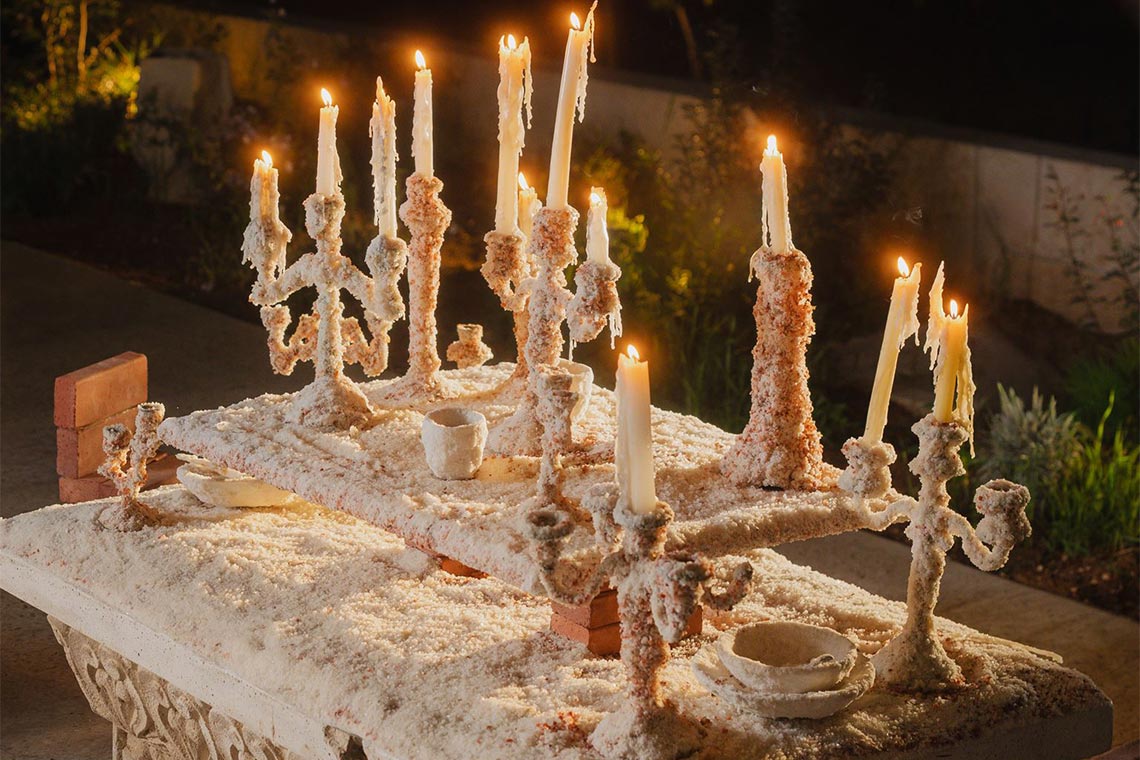
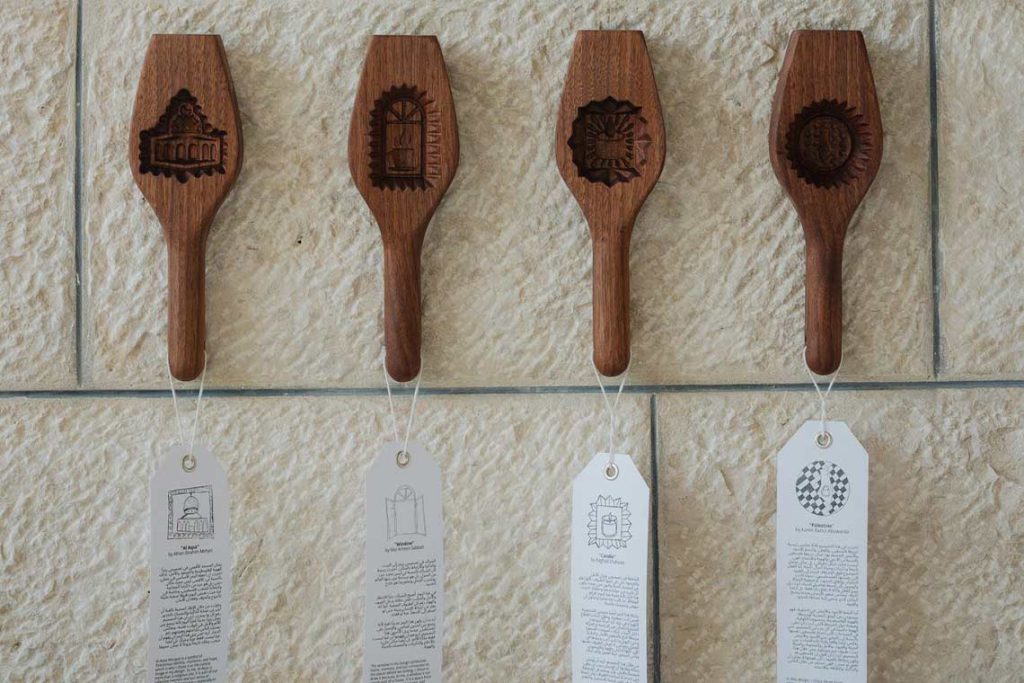
Meanwhile. at Darat Abu Adnan, Faissal El-Malak dresses the iron swirls and diamond-shaped grilles of the rear windows with colour and geometry, which in part appear like an Ionic column rendered in stained glass. Built in the 1950s for the Abu Hassan family and one of the few heritage homes still standing in Jabal Al Lweibdeh, the house has been restored for this edition, its rooms treated as an archive of domestic life. The work installed here answers in kind, with Kinda Ghannoum’s carpets billowing gently in the arched loggia at the entrance, their pixelated motifs carrying a handicraft into a digital visual language, while the hand-carved maamoul moulds of SPOCs for Gaza Design Studio hang by the kitchen. Out in the garden, Farah Tajeddin’s candleholders of Dead Sea salt seem to melt slowly on a rock. “They hold light but also carry the material and memory of a landscape,” she says, adding that the commission drew her to move between utility and sculpture at a more object scale than the experiential scale at which she typically works.
The restoration is one of several ways in which the week means to outlast its 16 days, its organisers describing it as a year-round cultural and creative ecosystem. Folly will remain in Ras El Ain Park long after the event, as will L.E.FT Architects’ Ard Al Sahn (2026), which carries a mosque’s forecourt across the road, turning an overlooked junction into an active public square with stone offcut prayer rugs that double as paving.
For a design week (or two) built around accumulation, these are the works that will keep accruing, gathering wear and the habits of a neighbourhood long after the programme has ended. Tabbarah describes the framework he gave designers as a question of how daily practices, environments and cultural memories “come together, entangle”, and the most legible trace of that thinking sits in the captions, where each work appears beside an archival image chosen by its maker, offered “to suggest that none of our work comes from nothing”. “Everyone’s work is built on an idea, an object, an artefact, a piece of oral history that informs what we do today,” continues Tabbarah. The Hangar is curated to allow that lineage to be felt and interacted with, unfolding loosely from a room that he likens to a material inventory towards a final space given over to the ground and to playful re-narrations of history. He estimates that only around a quarter of what is shown has reached production, the rest presented as prototypes and seed projects, lending the exhibition the character of a working archive, more so than merely a transient showroom of products and objects of design.
Amman Design Week runs until 17 October
