

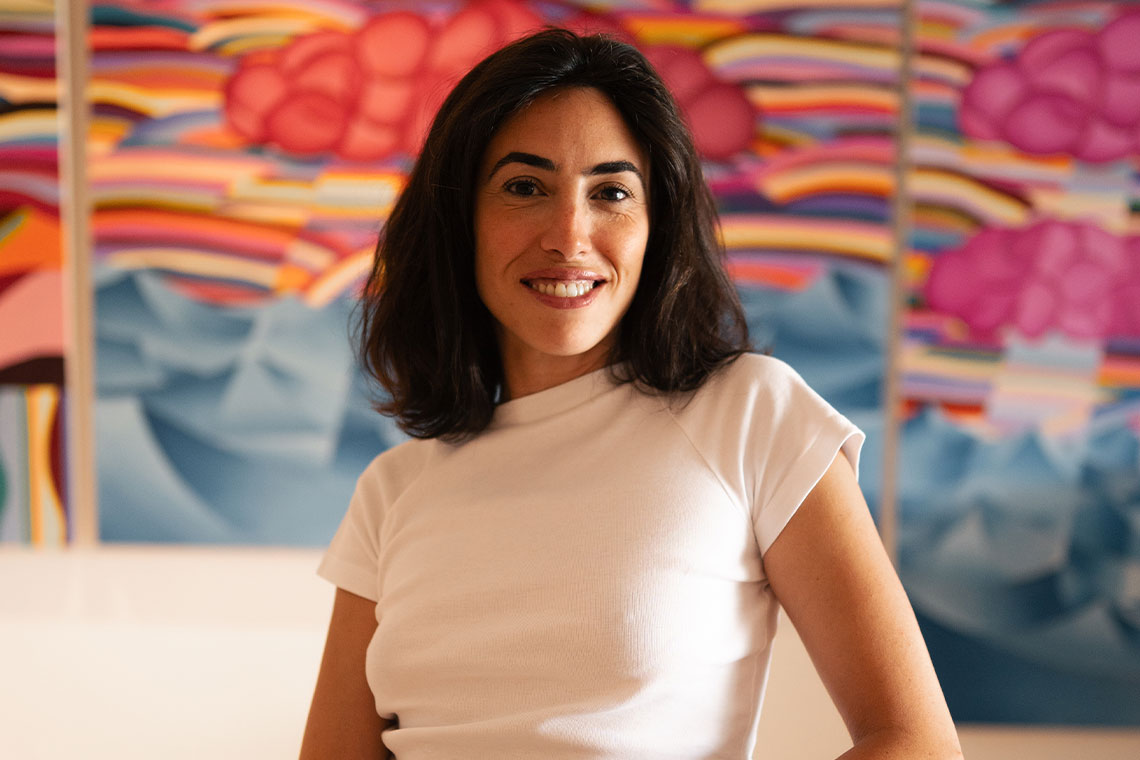
The artist approaches colour intuitively, using it as a means of experimentation, harmony and freedom in her practice.
Canvas: You trained as an architect before pursuing a career as an artist. What prompted that shift?
Radia Lamrani Karim: My mother is an architect, so I have always been surrounded by this world, and she taught me many things about architecture and art. I studied interior design and architecture in Paris and then went on to an internship in New York with Amale Andraos’s firm called WORKac. That’s when everything changed for me. I was spending a lot of time in museums and galleries and became passionate about art because I discovered how free artists are. This aspect really touched me. I grew up in Morocco, and as a woman, I had never experienced this kind of freedom before. I had always drawn since I was young, making drawings and creating things, but my parents would say, “Radia, study architecture. It is safer. It is more secure.” Then, during the pandemic, on the first day of lockdown, I don’t know why, but I just started painting and I have never stopped. I had been working as an architect in Paris for four years, but when I started having clients and developing projects with my art, I decided to leave my job and become a full-time artist.
How does your background in architecture continue to inform the way you approach your art?
Painting is often a direct relationship between the artist and the canvas, but architecture encourages you to consider things more globally. It teaches you structure, precision and attention to detail. I think this influence appears in my desire to create immersive experiences. I don’t only want people to look at my paintings,I want them to enter a different world.
Does colour play a role in how you see and experience the world?
I have always played with colours and I love textures, painting and different combinations. The way I use colour comes from my desire to experiment. I like showing people that unexpected combinations can work together. Sometimes people tell me, “I never imagined these colours could exist together” and I love that reaction. Maybe colour has also been a form of rebellion against the conformity I experienced growing up. There were many expectations about how a woman should behave and what she should become. Through colour, I found a way to express myself and show that being different can also be accepted.
When starting a work, how do you select your colour palette?
I experiment a lot. I might begin with one palette, but if I do not feel that the colours work together, I replace them until I find the I mix them with red, but if it’s not working then I might try pink instead. It is always a process of trial and error. I can spend three weeks working on one painting, even if people do not see all the layers and decisions behind the final result.
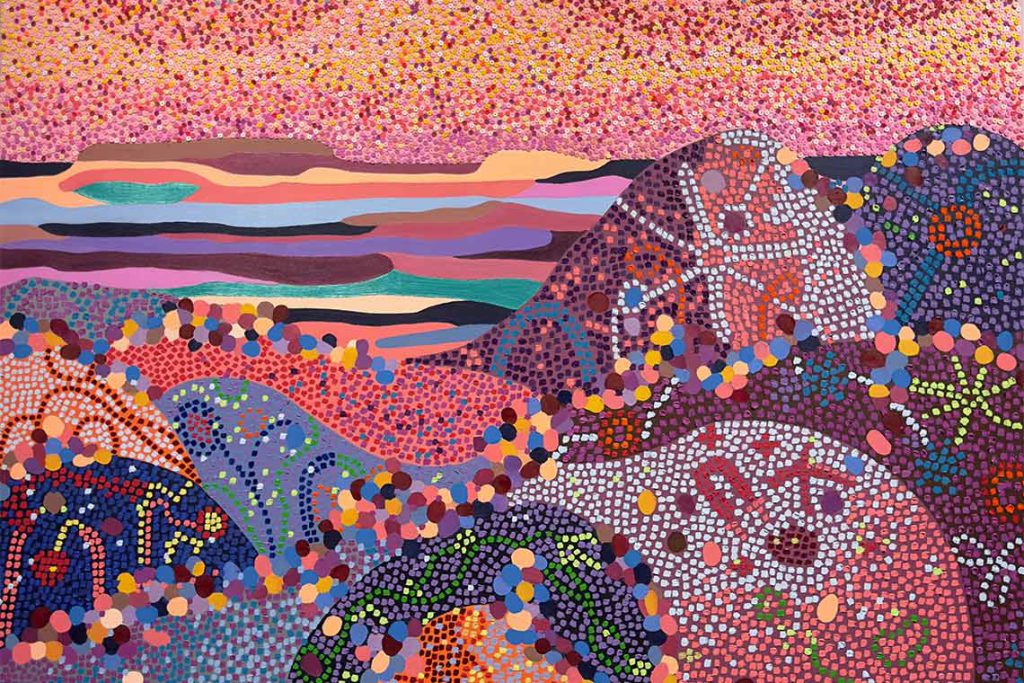
In works such as MÉDITERRANÉE (2025) and Within the Red Moon (2025), tiny dots accumulate to create vast landscape-like scenes. How do these different visual languages work together?
I always begin with drawings on paper. I usually start small because it is easier and faster, and then I project the drawing onto the painting. With the small pearls or dots, I am interested in creating volume and depth. I always try to bring something new because I do not like repeating the same thing. For me, art is about experimentation. I am always trying to discover new shapes, new ways of creating and new possibilities beyond the two-dimensional surface.
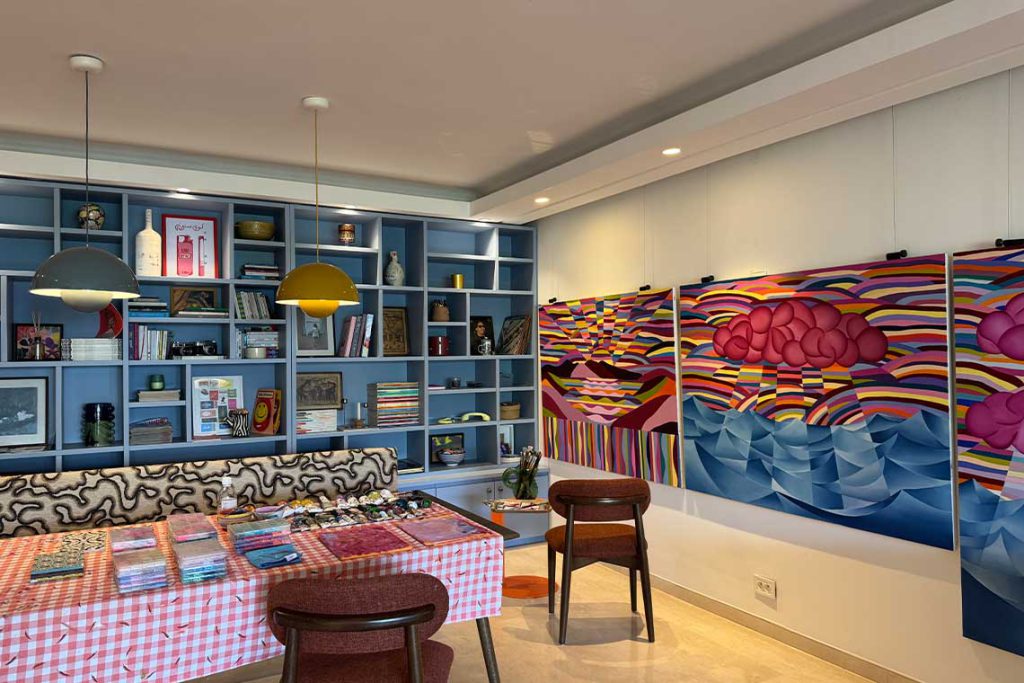
Earlier this year, you presented a site-specific installation as part of the second chapter of the group show Painting in the Exercise of Art at 1-54 Marrakech. Could you talk us through the process of creating the work?
Loft Art Gallery invited me to make a site-specific installation for the exhibition. I created Floating Mountains (2025). I wanted it to have the feeling of floating, almost as if the forms were suspended, with soft, wave-like shapes and different gradients of colour. The colours create a calming atmosphere, while the movement of the forms gives a sense of being surrounded and protected. I wanted people to experience a feeling of safety and immersion. It is connected to my paintings but transformed into a three-dimensional experience where people can walk around and engage with the work differently.
What are you currently working on?
I am developing a series entitled Every sunrise begins with new eyes (2023–). I started working on this three years ago, after leaving my job and searching for a new perspective. The title means that even if something feels difficult today, it can change tomorrow. You’re never permanently stuck in one situation. The series is about believing in possibilities and that you can create change in your life and move towards something better.
