

In Paris, Menart Fair interrogates the meaning of home against a busy art week and turbulent city.
Running from October 23–25, Menart Fair – exclusively dedicated to galleries representing artists from the MENA region – returns for its 7th edition, centred on the existential query: “Where is home?” Belonging, territory, exile, diaspora, a point of return: the concept oscillates between heritage and future, between the shifting status of existing in the world.
Founder/director of Menart Fair, Laure d’Hauteville is an art consultant and curator specialising in the MENA region. In 1998, she founded Beirut’s first modern and contemporary art fair, which ran until 2005, and subsequently created the Beirut Art Fair (2010–19). She developed Menart Fair in 2021. “It was created to give artists from the Middle East and North Africa a genuine platform for visibility in Europe – not by transforming them to fit a Western perspective, but by allowing them to be seen and understood for who they are, where they come from, and within the contexts in which their practices have developed,” she explains. “Whenever possible, I want the galleries to come directly from Beirut, Damascus, Tunis, Algiers, Dubai, Abu Dhabi, Riyadh, Tehran or elsewhere in the region. I want the artists to arrive in Paris with their own voices, their own references, their own histories, without having first been filtered through a European reading. That authenticity is extremely important to me.”
D’Hauteville is well aware of current challenges. “I am moved by the presence of galleries and artists coming from countries experiencing extremely difficult circumstances,” she says. “When a gallery comes from Damascus to Paris today, for example, this presence means something beyond participation in an art fair. It says we are here, we continue to create and we have something to say to the world.”
She refuses also to put forth a reductive depiction. “In a region experiencing wars, conflicts, economic crises, displacement and profound social transformations, continuing to create, exhibit, travel, exchange and bring artists together is already a powerful act.”
The fair brings together 34 galleries from 18 countries, showcasing more than a hundred artists (58 men and 47 women). It takes place during Paris Art Week, a decisive moment within the international art market, enabling local visibility while collectors are in town for the city’s extensive art offer. This year was an odd moment, however, as the protests roiling France created a fraught backdrop: Art Basel Paris and some Paris-based galleries were closing early in anticipation of unrest over the weekend.
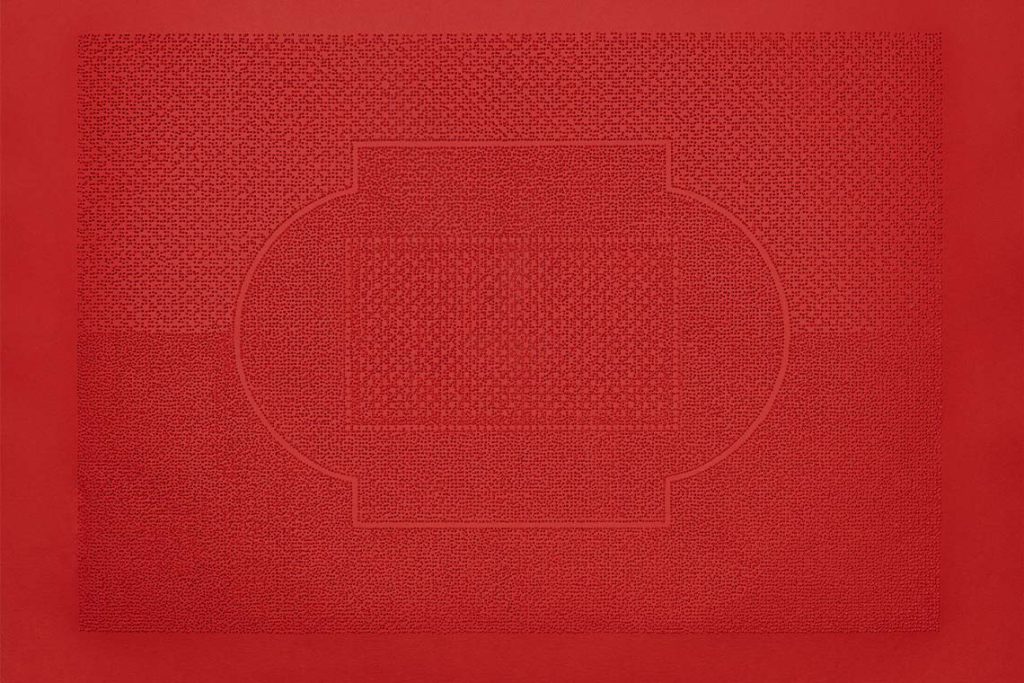
Menart opened as scheduled, with the fair being held on two levels at a space in the Marais. On the downstairs floor, visitors encounter Shiva Zahed Gallery, opened in Istanbul in February, where the eponymous Iranian founder showcases artists from her native country. Here, there are perforated geometric art works by Reza Lavassani from the series Khayyam, in which Islamic iconography is hand-done on rectangles of cardboard (and even on a flattened pizza box). Zahed notes that, though framed here, the works are extra beautiful when backlit and light shines through the tiny holes. Nearby, Zahed is showing Mahsa Karimizadeh, whose cropped pencil drawings from 2024 spotlight a tense torso – the artist was dealing with cancer – which function as studies for black-painted foam sculptures from 2025 featuring the folds of her body.
Nearby, at Galerie Bessieres Art Contemporain, Lebanese photographer Serge Najjar’s stunning images are inspired by Russian Constructivism (His Instagram bio tellingly states “It is not about what you see but how you see it.”) He turns angled architecture into a stark geometric backdrop with shapely windows and high-contrast shadows. His work will be part of a show at the Institut du Monde Arabe in Paris next March.
Just behind this booth, at Kalim Bechara Art Gallery from Lebanon, Lebanese artist – and associate at Christie’s – Mira El Khalil shows a startling oil on canvas work, Holiday Inn Beirut from 2026. The huge building is seen sinking amid the sea, the blue-green waters lapping against the submerging grid of dark windows. This painting was accompanied by two others, of a portrait and a couple.
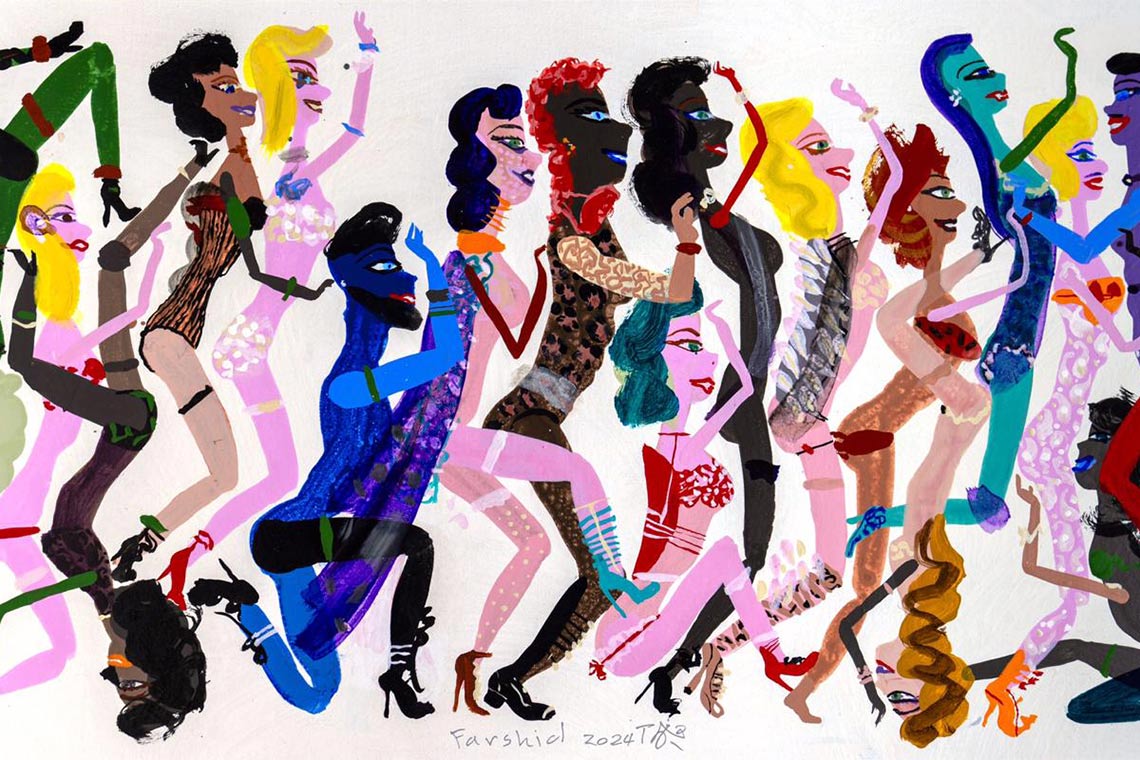
Upstairs, under a luminous skylight, Negah Art Gallery from Tehran is showing Iran-born NYC-based illustrator Farshid Shafiey’s joyful Head over Heels series of shimmying bodies in vibrant colours. Further in, at MS Art Gallery from Beirut, Tony Mhanna – a mechanical engineer by trade – has dramatically photographed swathes of fabrics floating in grand abandoned staircases in Beirut, in his series WRAITH. These photos shared wall space with colourful graphic rugs from Hala Salem.
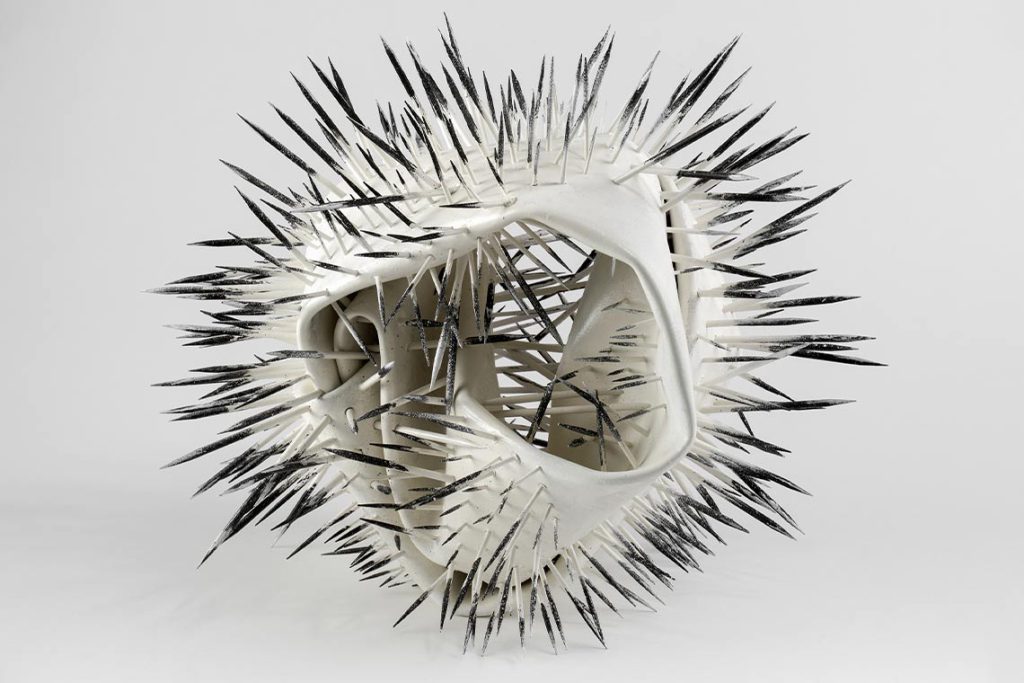
The Project Room, curated by Wassyla Tamzali, features 12 artists living and working in Algeria. In her introductory text, Tamzali cited Etel Adnan on beauty as “that fusion of talent and thought”. Amongst the dozen artists, Mounir Gouri’s poetic Routes cousues (2017), includes four framed groupings of four ceramic plates, each with tiny holes connected by black thread like constellations.
Despite the turmoil, in Paris itself and in the world at large, the fair is a place that holds space for creativity. As d’Hauteville asserts, “The MENA region should not only reach European audiences through the vocabulary of crisis, war or geopolitics. It is also a region of immense creativity, humour, beauty, intellectual energy, youth and imagination.”
Menart Fair runs until 25 October
