Every age is shaped by the crises it confronts. Ours is marked by intensifying logics of separation: identities are increasingly set against one another even as our interdependencies become harder to ignore. The eighth edition of Jaou Tunis takes shape within this tension. The idea of the archipelago, which gives this edition its form, draws on Édouard Glissant’s archipelagic thought: a way of imagining the world through relation, multiplicity and difference. The archipelago allows singularity and interdependence to coexist. Islands remain distinct; currents and crossings place them in relation.
For Jaou Tunis, the archipelago offers a way to think relation without flattening difference, while recognising that movement and passage are never equally available. Since its inception, Jaou Tunis has created encounters across artistic practices, disciplines and geographies. This edition extends that approach through collaborations that remain distinct in their terms and positions.
The eighth edition brings together the Kamel Lazaar Foundation, the Centre d’Art Contemporain Genève and the Art Explora Foundation. At its centre are two major exhibition projects, each approaching questions of movement, relation and belonging from a different perspective.
Becoming the Ocean, jointly curated by Lina Lazaar and Andrea Bellini, marks the first presentation of the Biennale de l’Image en Mouvement outside Switzerland. Sixteen works by artists from Africa, the Arab world,Asia, Latin America and their diasporas have been commissioned by the Centre d’Art Contemporain Genève and KLF for Becoming the Ocean. The works engage political, historical, ecological and technological questions while drawing on other forms of knowledge, spirituality and care.
Undertow / Contre-courant, curated by Amanda Abi Khalil and Danielle Makhoul in collaboration with Art Explora, turns specifically towards the Mediterranean and the forces that move beneath its more familiar narratives. Taking the undertow as both image and method, the exhibition follows histories of circulation, exchange, colonisation and exile alongside more intimate experiences of crossing, waiting, displacement, hospitality and memory. It considers the Mediterranean
not as a unified cultural space, but as one shaped by radically unequal conditions of movement and access, and by the lives, knowledge and histories carried between its shores.
The two exhibitions do not seek to resolve these perspectives into a single position. Like the archipelago itself, they remain distinct while entering into relation. Across the edition, works, sites and partners retain their specificity. Their encounter is grounded in Tunis, where the biennale is conceived and articulated.
Through exhibitions, performances, conversations and public programmes, Jaou Tunis 2026 considers how movement, access, identity and belonging are being reconfigured, and the forms of relation those shifts enable or constrain.
Press release from Jaou Tunis
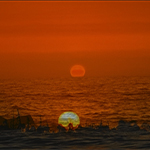
Image: Sarah Zeryab. Notes On Camp أول الرصاص، أول الحجارة (still 3), 2026. HD, single-channel video, 40 minutes . Image courtesy of the artist