

Through multiple layers, Nada Elkalaawy reveals a world shaped by personal histories, memory and loss in her current exhibition at Lawrie Shabibi.
To remember is, in some way, to negotiate with loss. Some hold on to certain images, feelings and fragments of experiences as their meanings shift with time. For her first solo show in Dubai, Nada Elkalaawy presents a body of work in which figures and objects are obscured, reworked and brought into renewed visibility. The title of the show, The Butterfly’s Burden, references the Palestinian author and poet Mahmoud Darwish’s eponymous book, articulating the tension between ephemerality and emotional weight. The butterfly, being a delicate, light creature, carries the paradox of a life that seems too heavy for its fragile wings.
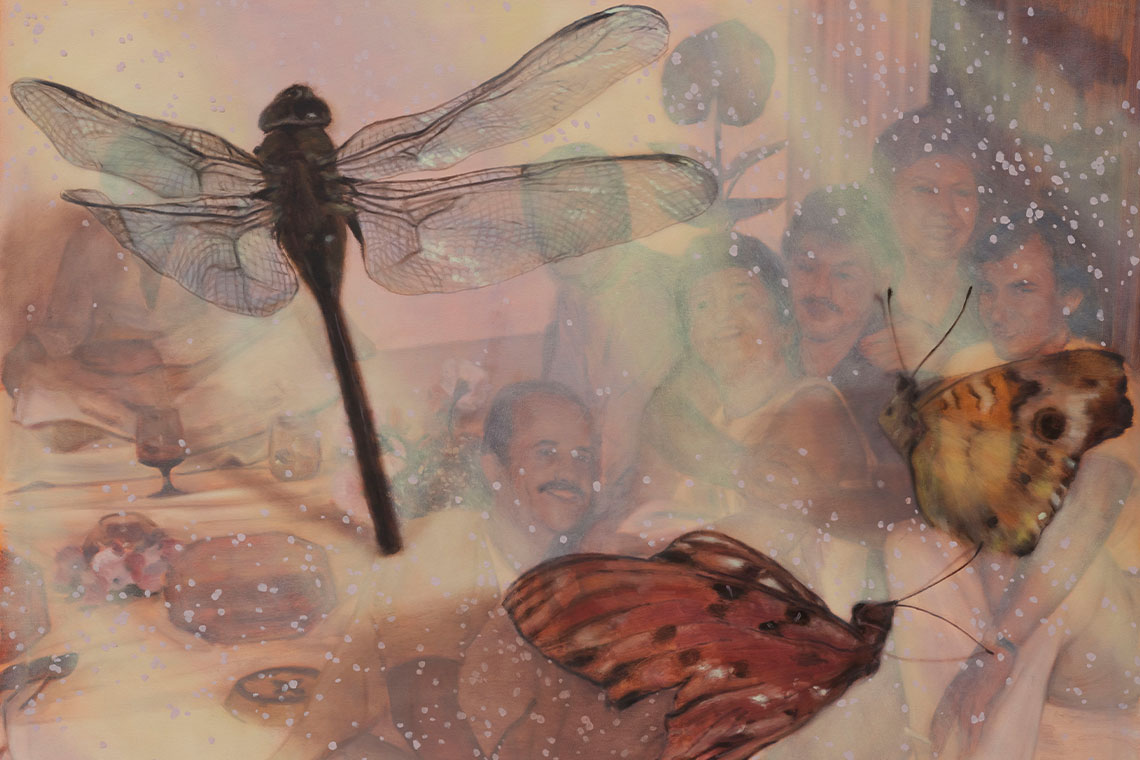
What is particularly intriguing in Elkalaawy’s paintings is the need to dig deeper and learn more about the process of creating these works. In a large-scale oil painting entitled The Butterfly’s Burden (2026), a dragonfly scaled larger than its organic size, along with two butterflies, holds the foreground of the work. In the background is what seems to be a reference to a photograph of people enjoying dinner. In this specific scene, there is a sense of yearning for moments and a longing for those that are no longer present. In a conversation with Canvas, Elkalaawy explains how, while developing this body of work, she was contemplating the dualities of life and death, grief and hope, and the ways in which these experiences intersect.
Who are the figures in the works, and how do they find their way onto the canvas? The process is less straightforward than simply transferring a photograph into paint. It begins with drawings and sketches, which help the artist establish the composition and scale of a work, sometimes bringing together several visual sources in a single image. In a separate room a series of eight charcoal sketches presents this process, where fragments of figures and objects that exist in the larger paintings appear more hyper-focused, forming a detailed blueprint of what the objects might look like when examined in detail. The choice of photographs is often guided by unexpected details – an unusual crop, a blur, an accidental shadow or the texture of a photograph that has aged over time.
The mental collages that Elkalaawy constructs through her use of online resources and personal family albums are particularly compelling, connecting disparate images through a process of selection and reinterpretation to create scenes of her own. Thinking about how these images are gathered also raises a broader question about who gets access to them. While the internet may appear to offer an open repository of images and information, the ability to navigate these resources, encouraging particular histories and drawing from them, is not available equally to everyone.
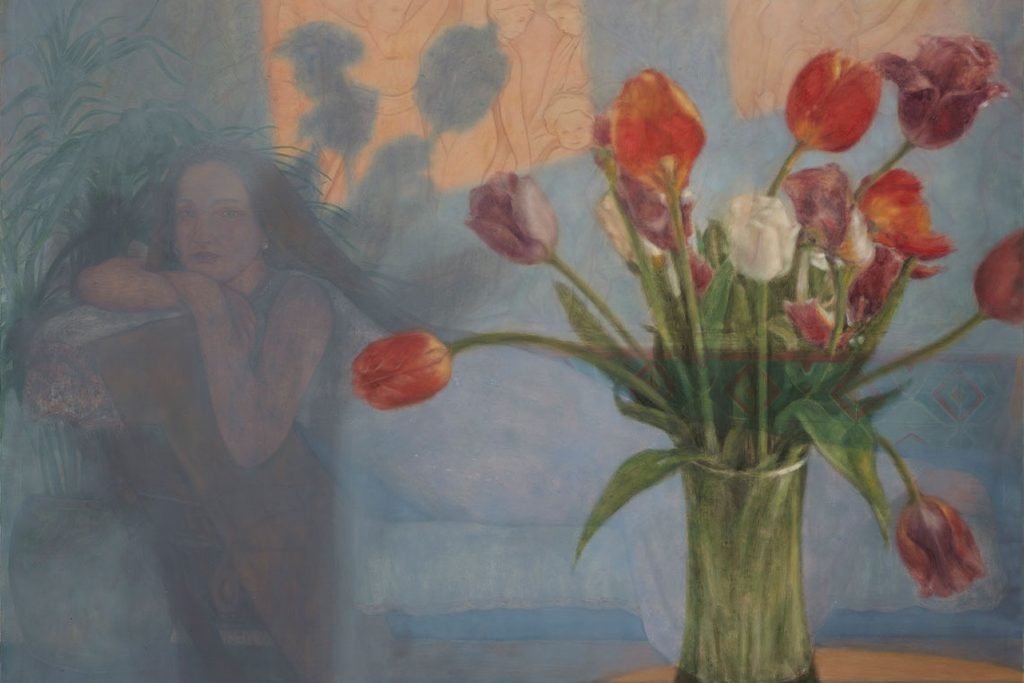
Light filters each painting in a way that allows time to shape the atmosphere of the works. In Nerida, A Second Spring (2023–26), an intimate domestic scene centres on a vase of vibrant tulips and roses, which contrasts with a woman lying comfortably on a sofa, her gaze directed towards the flowers. The white roses carry the suggestion of a new beginning, with the vivid tulips lending the scene energy that gestures towards what might lie ahead. In contrast, the woman’s expression seems to settle into a more subdued register, as though acknowledging the darkness of the present even as the flowers offer the possibility of something new.
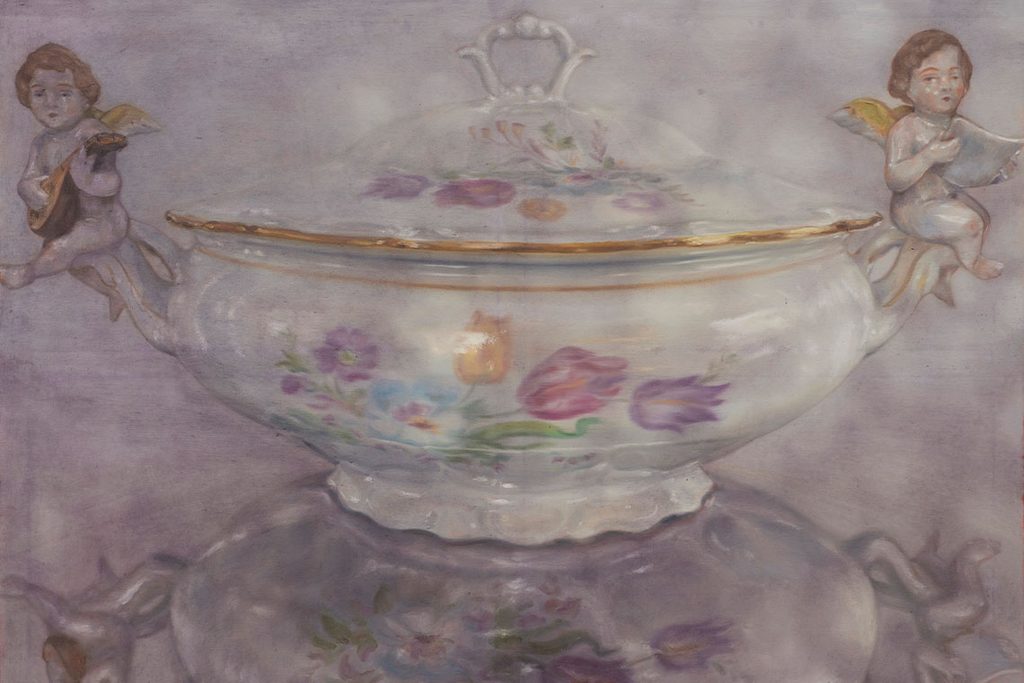
The objects throughout the paintings are familiar to the eye, mostly seen in homes, such as mid-twentieth century figurines. Although silverware and dinnerware have practical uses, many are kept primarily for decoration. A veil of purple hues envelops a porcelain tureen in Porcelain Apparition (2025), where two baby angel figurines lend the composition an unsettling delicacy, complicating the familiarity of the object. The surface appears clouded, almost as though it might be wiped or scratched away to bring the objects into focus.
There is something ritualistic about the way in which grief is revisited, its weight shifting each time it is given form. For Elkalaawy, painting becomes an inward practice rather than an exercise in documenting or archiving memories. In her paintings, emotions are given a space to surface, recede and reemerge, finding room for transformation within the very act of remembering. Like the butterfly, suspended between fragility and metamorphosis, these paintings suggest that what has been lost does not disappear entirely but assumes new forms within the present.
The Butterfly’s Burden runs until 23 November
