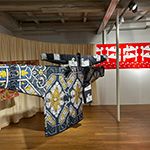

The exhibition Nine Moons Over a Cotton Field follows the historical import routes of the raw material that built the industrial might of modern Łódź, tracing their course from the late nineteenth century to the collapse of the city’s textile empire after 1989. While the prosperity of the West relied on Atlantic markets, the fortunes of the “Polish Manchester” became largely intertwined with the territories of Central Asia—present-day Uzbekistan, Kazakhstan, and Turkmenistan. This strategic dependence on Eurasian raw materials, lasting for more than a century and interrupted only briefly during the interwar period, remains a relatively unexplored chapter in the history of Polish modernity.
The origins of the historical relationship with Central Asia can be traced back to the American Civil War, which cut Łódź factories off from cotton plantations powered by slave labour across the Atlantic. The ties between the two regions were further strengthened by the fact that, until 1914, both were part of the Russian Empire, and after the Second World War they functioned as fraternal regions on the same side of the Iron Curtain. These connections were multilayered: they encompassed Polish participation in the Russian imperial conquest of the region and attempts by Łódź factory owners to establish their own plantations there, as well as the deportation of Poles to the Soviet Union and the unobvious community of experience between women caught up in an oppressive economic regime—from the cotton pickers to the textile workers in Łódź. This dynamic reflects the emergence of global modernity as an entanglement of modernising practices, colonial ambitions, and various forms of forced labour.
The exhibition centres on cotton as a plant, a resource, a raw material, and a commodity. Its cultivation as a monocrop and its industrial processing played a crucial role in shaping modern political, social, and infrastructural processes of colonial capitalism. Equally important in the show are the cultural artefacts, discourses, and visual imaginaries that, over the course of a century and a half, formed a complex and shifting relationship with this material. For this reason, the exhibition also devotes considerable attention to the realms of art and visual propaganda which was employed in the pursuit of transforming the region into a cotton monoculture.
The exhibition approaches such historical and artistic patterns through a multilayered, essayistic narrative.
Photography and film, especially, played a crucial role in shaping ideas of cotton modernity. At the exhibition, they are presented both as historical documents and as critical tools. On the one hand, we present nineteenth-century photographs by Leon Barszczewski, a Polish geographer and ethnographer who pioneered the exploration of the region, helping to pave the way for a Russian takeover of its resources. On the other, we show works from the 1930s and 40s: photographs by the documentary photographer Max Penson, which convey the monumental and totalising dimension of Soviet modernisation, alongside the work of the German-Jewish photographer Lotte Jacobi, who documented everyday life and working conditions on the ground, particularly those of Uzbek women and children.
Here, too, the materiality of cotton comes to the fore. In the form of nitrocellulose—a key component of photosensitive film—cotton lay at the very foundation of early photography as its material support.
Of equal importance is the often-ambivalent role played by the Soviet and Polish avant-gardes in shaping the visual culture of cotton modernity. Artists such as Alexander Rodchenko, Varvara Stepanova, and Dziga Vertov, alongside Władysław Strzemiński and Karol Hiller, were initially fascinated by the new dynamics introduced by mass machine production and technological acceleration. Their search for new forms and rhythms became an attempt to forge an artistic language capable of expressing the emerging reality. However, their avant-garde approach was co-opted by the totalitarian regime as visual propaganda designed to obscure the realities of exploitation, violence, and political terror.
As a counterpoint to the totalising colonial and modernisation project imposed on the region, we invoke Indigenous traditions from Central Asia in the work of contemporary artists Saodat Ismailova and Aziza Kadyri. Inspired by this realm, the title of the exhibition refers to the nine moons motif found on suzani, traditional hand-embroidered textiles that form an integral part of women’s dowries in Central Asia. This symbol is meant to bring prosperity and cosmic balance.
The title also points to the role women played in the history of cotton cultivation and textile production, emphasising that this is, above all, a narrative of their labour, emancipation, and resistance. For this reason, the exhibition brings together a number of women’s biographies, including the Uzbek shock worker Tursunoy Akhunova and Black activists Angela Davis and Audre Lorde, who in the 1970s observed the realities of Soviet cotton cultivation through the lens of the history of American slavery. Equally significant is the 1971 strike by women textile workers in Łódź, who demanded better working conditions and higher quality raw materials. The protest directly linked the situation in the factories with the realities of distant kolkhozes. The life of the first director of the Central Museum of Textiles, Krystyna Kondratiuk—who experienced forced labour in Kazakhstan, one of the backbones of Soviet cotton production— provides a symbolic arc for the exhibition.
From the very beginning, Russian expansion into Central Asia was driven by the pursuit of land and the water needed for cultivation. The aim was to fulfil an age-old dream of transforming desert into fertile land. These monumental environmental and infrastructural transformations, undertaken from the late nineteenth century onwards, constitute one of modernity’s largest projects in the “taming” of nature. At the same time, the resulting ecological catastrophe— including the emergence of a toxic, saline desert in place of the Aral Sea—is a consequence of the tragic imbalance inherent in an extractivist model of relations with the territory. The exhibition explores these processes by bringing together archival materials, contemporary research, and artistic interventions.
The year 1989 bound the two regions once again through a shared experience. With the collapse of the Soviet political and economic regime, both Poland and Central Asia faced the challenge of navigating a new capitalist reality. While Poland was swept by “wild” privatisation, Uzbekistan remained dominated by a state-controlled cotton-growing system based on forced labour, which later led to an international boycott of the country’s raw material. We present photographic and film documentation of these systemic abuses by the documentary photographer Timur Karpov, alongside works by Dilyara Kaipova and a series of photographs by Umida Akhmedova, which trace the omnipresence of cotton in visual culture and public space.
Expanding on this narrative are new artistic commissions by Veronika Hapchenko, Tytus Szabelski-Różniak, and the duo JP I (Jana Shostak and Piotr Adamski). These works shed contemporary light on the historical mechanisms and trajectories explored.
The exhibition features artworks, photographs, and archival materials from:
Nabi Agzamov, Raikul Ahmatova, Umida Akhmedova, Janina Baranowska, Leon Barszczewski, Angela Davis, Khudaibergen Devanov, Jan Glijer, Juliusz Grot, Veronika Hapchenko, Karol Hiller, Langston Hughes, Saodat Ismailova, Anna Ivanova, Lotte Jacobi, Bruno Jasieński, JP I (Jana Shostak, Piotr Adamski), Aziza Kadyri, Dilyara Kaipova, Oleg Karpov, Timur Karpov, Jerzy Krawczyk, Audre Lorde, Shukhrat Makhmudov, Almagul Menlibayeva, Stanisław Notarjusz, Max Penson, Stanisław Poznański, Alexander Rodchenko, Zohra Saed, Varvara Stepanova, Władysław Strzemiński, Tytus Szabelski-Różniak, Anna Świrszczyńska, Viktor Turin, Dziga Vertov, Marek Włodarski (Henryk Streng), Julita Wójcik, Zaza Zakhidov, Antoni Zdebiak
Curators: Dorota Jagoda Michalska, Łukasz Mojsak
Curatorial text from the Central Museum of Textiles in Łódź
Image: Installation view from Nine Moons Over a Cotton Field. Łódź and Central Asia. Photography by HaWa. Image courtesy of the Central Museum of Textiles in Łódź