

For its eighth edition, Jaou Tunis turns to the Mediterranean as a site of connection and division, addressing histories of migration, displacement and exchange.
The city of Tunis was once deeply connected to water. Situated on a gentle slope with a lagoon separating it from the Mediterranean, it is 15 kilometres south of the historic port of Carthage. The waters of the lagoon, Lake of Tunis, brushed close to the edges of the medieval city, offering a watery border for fishing and salt production alongside trade and transport access to the sea.
Over recent centuries, the city’s relationship to water has eroded. The French Protectorate undertook major engineering works during the nineteenth century, dredging channels, constructing embankments and reclaiming land from the lagoon. Then, twentieth century road, rail and canal infrastructure further cut the city of Tunis from coastal waters once so tied to its daily life. Over recent decades, further areas of Lake of Tunis have been reclaimed for ambitious business park and housing developments, much of which remains empty or unbuilt, in part due to the financial crisis.
Since the 2011 Jasmine Revolution, new strategies of green infrastructure and ecological restoration have been folded into development plans, but any reconnection to the Mediterranean must be cultural and social as well as physical. This year’s Jaou Tunis Biennale, its eighth edition, addresses that relationship to water and worlds connected across and through it with a three-pronged programme that emphasises collaboration, interconnectedness and passage.
Framed as the Archipelago Biennale, after Édouard Glissant’s preference for archipelagic over continental models of place and identity, Jaou Tunis seeks to celebrate relational rather than fixed or nationalistic identities, value exchange over didactic explanation, and understands multiplicity as a strength rather than a breakdown of order. It is a cultural approach akin to the lagoon’s historic role as a liminal zone of human and natural coexistence, and as a point of passage to places beyond, counter to the modernist programme that today cuts the medina off from the Mediterranean. Tunis is a place of encounters, with ideas and artists joining from across the world, especially Global Majority nations and those sharing the Mediterranean coast.
Suitably for a festival built on coming together, two key partners share the programming responsibilities. While their Swiss home is being refurbished, the Centre d’Art Contemporain Genève presents the Biennale de l’Image en Mouvement – titled Becoming The Ocean – within the 19th-century military barracks of the Qishlat al-ʿAttārīn at the heart of the souk. At the B7L9 Art Centre, the Art Explora Foundation presents Undertow / Contre ; Courant, a travelling exhibition of twenty artists within a framework considering the movement of forces under the water, where directions and power dynamics may differ from patterns and passage seen on the surface. Together, the exhibitions feed into a wider confluence of talks, concerts and events overseen by Jaou Tunis.
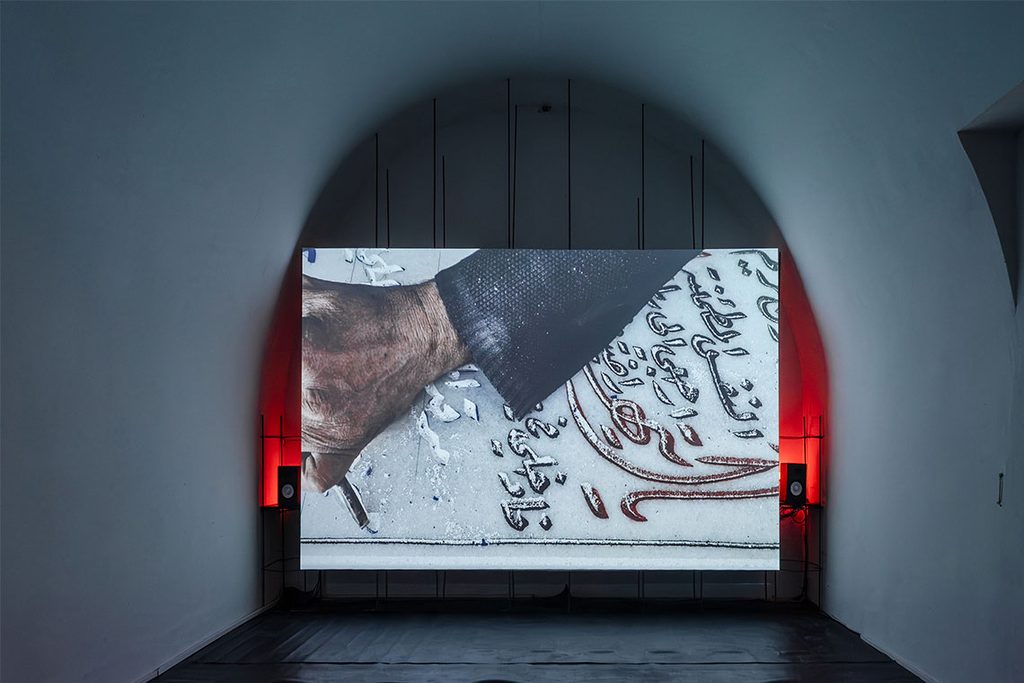
As one may expect in a venture seeking to connect, a shared empathy is present. For BIM, Sarah Zeryab’s nonlinear Notes on Camp (2026) is a portrait of both the Yarmouk Palestinian refugee camp in Syria, and also that of Ali, who was born, raised and murdered in the camp. Dogs and cats clamber through the ruins of a place devastated during the Syrian civil war. Violence, displacement and murder are registered not through direct testimony, but in the smashed remains of cemetery graves.
Younès Ben Slimane’s Super 8 film Grounds for Mourning (2026) is also sombre. In a study of the penal colony architecture of the Îles du Salut, French Guiana, the film observes nature reclaiming these spaces as if embarrassed by the inhumanity they once contained. Since 1971, the three islands have been under the authority of the French National Centre for Space Studies, and the artist also documents the Guiana Space Centre, 16km away on the mainland.
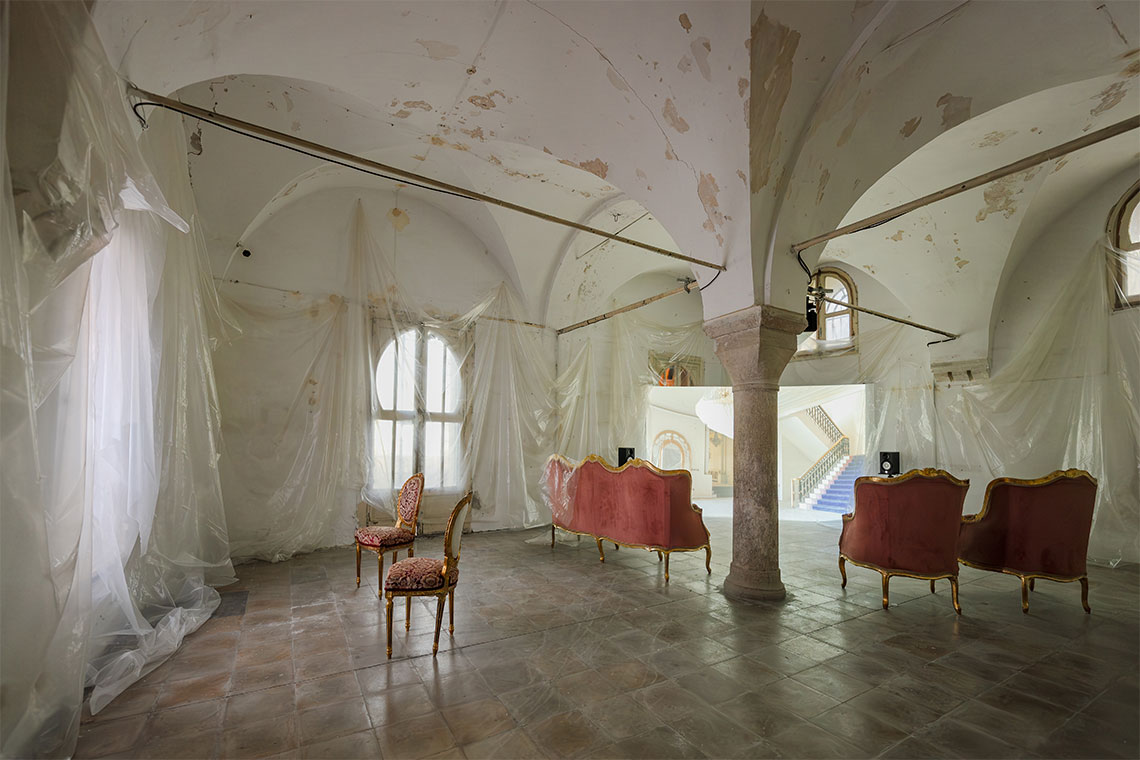
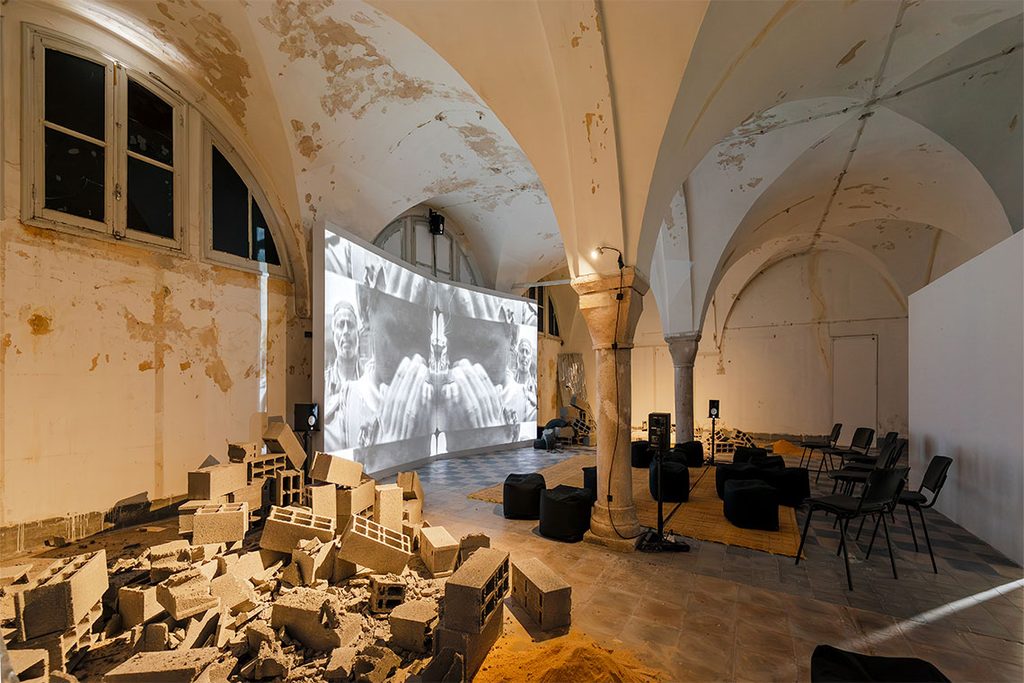
BIM takes its staging seriously. For a biennial focused on the moving image, BIM has long constructed sculptural settings and worlds that allow the ideas of its films to escape into the wider gallery. Leena Habiballa’s Unstrung (2026), breaking apart the aesthetics and structures of Sudanese militarised culture, is set within a landscape of rubble. The domestic setting within Zein Majali’s Shroud House (2026), with walls and furniture wrapped in polythene, seems to leak into the vaulted gallery – a simple gesture that draws audiences into the mystery unravelling on screen. Tunisian visitors watch Hildegard Titus’s Mbwiti (2026) from wooden school desks and benches, assuming the position of someone forced to learn about their own homeland through film and archival documentation after migration and dislocation.
The Undertow exhibition is designed to pack up into a single container for a tour that has previously called at Tangier, Athens and Barcelona, and picks up themes of movement, migration, loss and empathy. Badr El Hammammi’s project Thabrate (2010-18) reproduces audio cassettes created in the 1970s and 80s by Moroccan immigrant workers to send home. Here, visitors can listen to correspondence, while family photographs are printed onto the plastic casings, reminiscent of images and documents that may be compacted into the boxes to be sent back alongside their voice.
Majd Abdel Hamid’s Muscle Memory (2024) uses an embroidery practice inherited through his Palestinian heritage to create miniature tributes to Beirut, the city that has offered the artist refuge. The small geometric exercises could be maps of home, Beirut, or the mind, here set against a series of photographs documenting minute everyday moments. Randa Maroufi’s 2023 poetic film Bab Sebta is a drone-like document from above, theatrically recreating semi-legal processes and negotiations between border control and people smugglers in Ceuta.
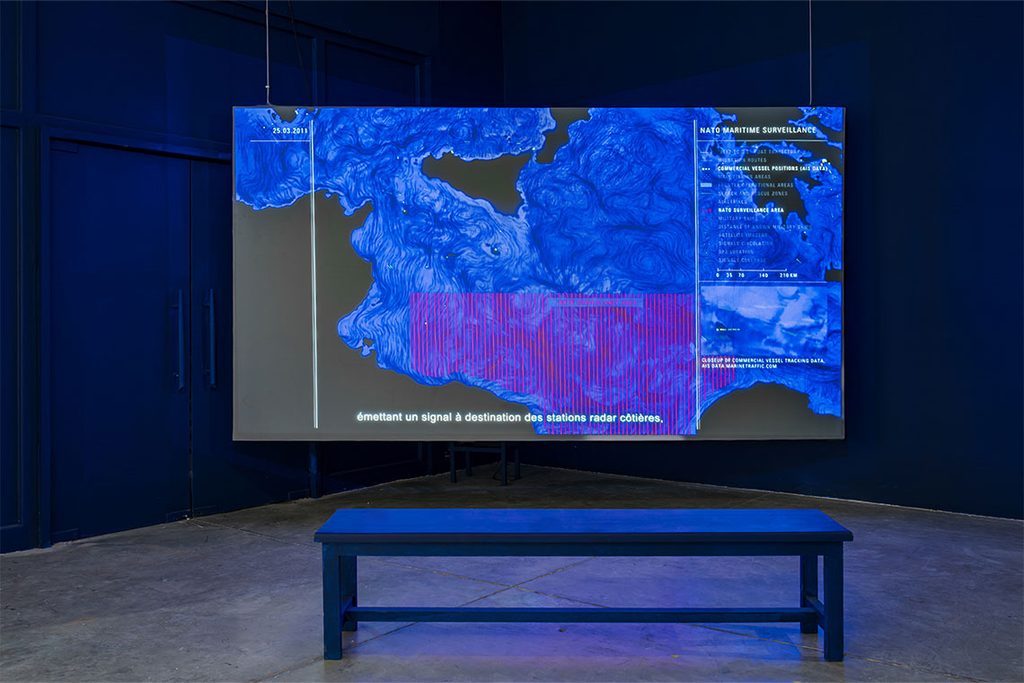
The exhibition theme of movements that occur under the surface – spatially or politically – is explored through two investigations of violence. In Marseille Overflow (2022), Lara Tabet recorded polluted Mediterranean waters containing Marseille’s sewage, making visible a form of environmental violence usually hidden from view. With Liquid Traces: The Left-to-Die Boat Case (2014), Forensic Oceanography also makes visible that which would remain secret. A diligent analysis of air, water and media around a small rubber boat that in 2011 left Libya for Sicily with 72 occupants reveals how militaries watched on from aircraft as the vessel drifted for two weeks without fuel. Nine survived.
The B7L9 Art Centre is located in Bhar Lazreg, a northern neighbourhood of Tunis in which sub-Saharan migrant communities have for two decades settled in search of labour within nearby wealthier and tourist districts. In 2019, the Kamel Lazaar Foundation could have located its first permanent venue in one of Tunis’ more affluent districts. Instead, it chose Bhar Lazreg in the hope of creating meaningful local impact and outreach. B7L9 also hosted some of the many performance and musical events offered through Jaou Tunis: Enrico Dau Yang Wey’s glacier I preset was a sound and voice performance imagining memory as glacial folds, while a screening of short films documenting Palestinian lives was accompanied by a round-table discussion and workshop exploring how land and soil contain memory, concluding with a DJ set.
DJs and musicians are central to Jaou Tunis, a festival that is not just interdisciplinary, but purposefully so in order to reach and connect with as wide a range of local audiences as possible. As such, the concert programme featured international performers including textural electronic musician Yasmine Hamdan, UK jazz flautist and saxophonist Shabaka Hutchings, and emerging Tunisian pop superstar Soudeni. A series of keynotes and conversations brought interlocutors from across the region to dig deeper into ideas and themes within curations and works, extending discussions beyond the exhibitions. A wider performance programme brought performances and dance to theatres, churches and art spaces across the city.
Jaou Tunis seems to relish its complications. An easier biennial would see a sole pop-up exhibition at a single site, with a nod to local heritage as backdrop to contemporary art headline acts. Here, however, the Centre d’Art Contemporain Genève and Fondation Art Explora have collaborated with host Kamel Lazaar Foundation for a fluid exchange of ideas, new commissions, meaningful engagements with people and place and a month of richly programmed, diverse events.
This is not easy, but in organisation it perhaps speaks to the conceptual themes: the archipelagic emphasis on relation and interdependence, and the oceanic metaphors of Becoming the Ocean and Undertow, reaching into shared forms of humanity and the narratives or circulations that occur beneath the surface. As such, there is no single outcome from such a complication of culture, but a rich circulation that will outlast the month-long programme, perhaps encouraging renewed engagement with the Mediterranean and beyond – and Tunis’ own coastal histories and futures.
Becoming the Ocean runs until 22 November
Undertow / Contre ; Courant runs until 31 December
