

The artist shares insights into her approach to materiality, colour and transformation, discussing the ideas and research behind her solo exhibition Two Horizons at the Cultural Foundation in Abu Dhabi.
Canvas: How do you decide which material is best suited to a particular idea or sculpture?
Shaikha Al Mazrou: I’m interested in the poetics of material itself. I use a very rigid marble that is then carved under water jets to depict water, and that transformation of material is something that I’m constantly exploring. It might appear minimal in its aesthetics, but it carries a heavy poetic core.
When developing a new work, how do you move from an initial thought to a finished piece?
I like to start with the words, and it’s something that I always impose on myself. So, when I’m given a proposal or a commission space, there are always words that drive the process and which might not necessarily be present.
What role does colour play in your sculptural practice?
Colour is one of the most difficult aspects of my work. I always try to put on a painter’s hat, and for me, as someone who’s always interested in material, I find myself battling colour. It’s a space that I constantly negotiate. It takes a lot of trial and error, and I love failing. I think failure is one of the most important processes as artists seek to redefine, relook and stand up again and look at colour again.
How do you approach material experimentation, and what draws you to exploring the possibilities of industrial materials?
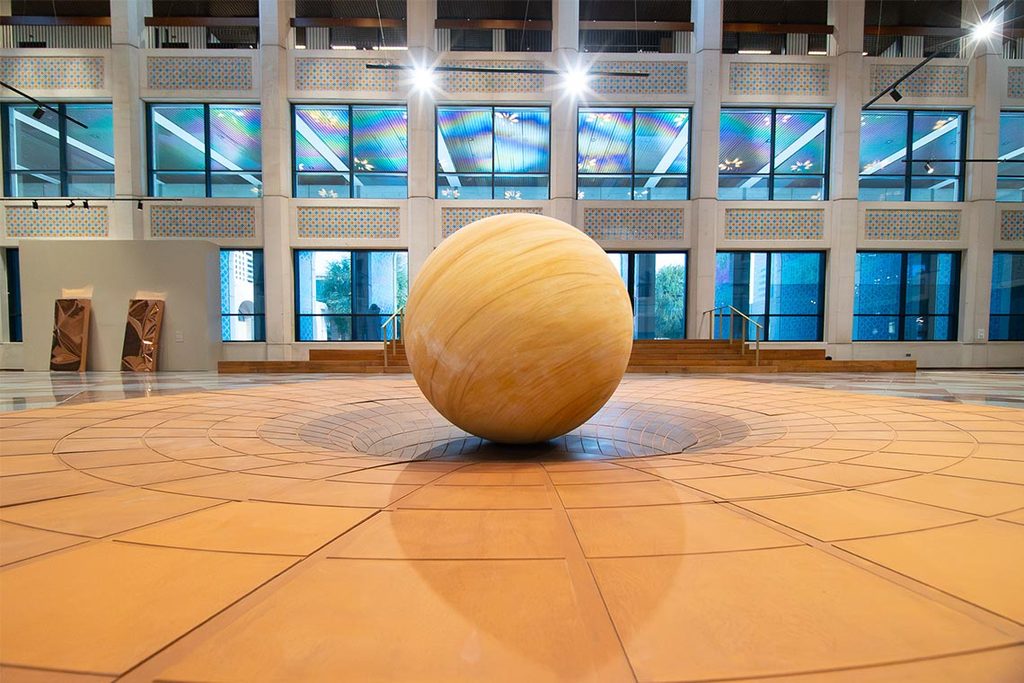
What fascinates me is how far a material can be pushed to its maximum capabilities. It’s quite interesting to see the transformation where the material starts to behave totally differently in a white cube space. The deceptive qualities of the material are something that I have always been curious about. Industrial areas and places are quite an interesting space to navigate, where I find myself hungry to learn more about materiality. I’m always stumbling upon a fabricator that sells sheets or a marble company that is polishing a surface. I would say this notion of transformation is constantly recurring in my work.
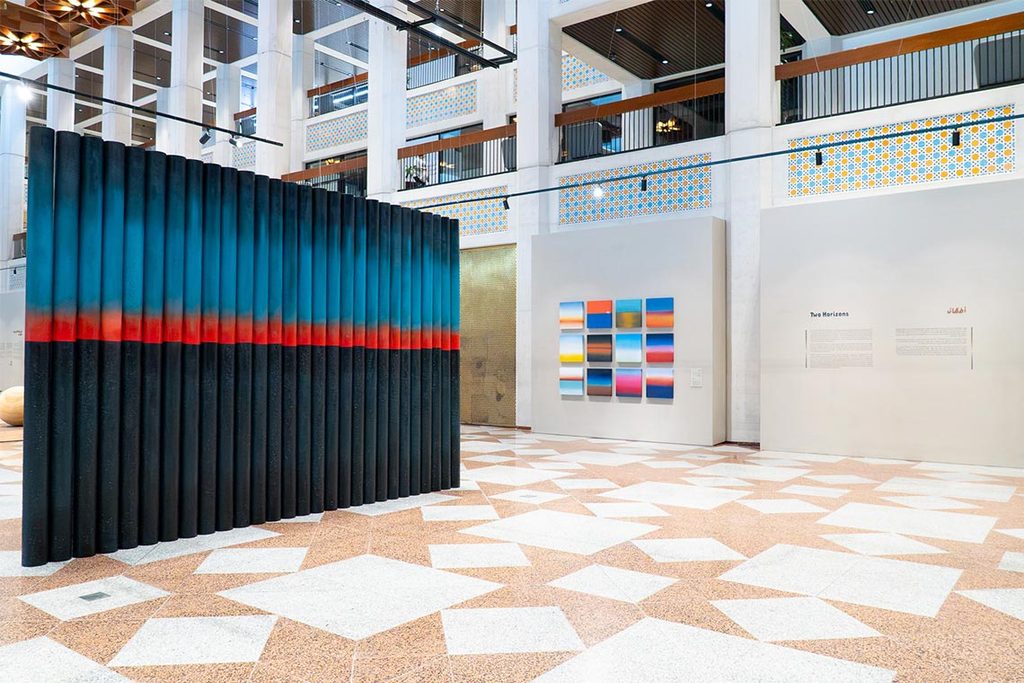
In Fragmented Horizon (2026), part of your solo exhibition Two Horizons at the Cultural Foundation, you use oxidised aluminium poles to create a horizon within the architecture of the atrium. What interested you in translating the horizon into a physical structure?
Whenever I look at the horizon, I always question its distance, and there is this eagerness in trying to understand how far it is. It also comes from a poetic point of view. I was quite heavily inspired by a book that I read by Swiss physicist and Alpine explorer Horace-Bénédict de Saussure, which examines the idea of falling, particularly falling vertically. Whenever I look at the horizon, whether from a standing position or from an aerial perspective, such as when I’m on a plane, I find myself thinking about this idea. I’m always drawn to the colours of the horizon and the way they remain in a constant state of change. I wanted to fragment that experience because, as humans, we tend to perceive things as a straight line, whereas in reality they are never linear. With this particular work, I wanted to convey that sense of fragmentation.
Some of the works in the exhibition are inspired by historical research and scientific instruments, such as the cyanometer. How do you approach research, and how does it find its way into your artistic practice?
As artists and researchers, or even scientists, we’re always on a quest to understand what we’re looking at. The cyanometer in particular is one of my favourite works in the show. As humans, we try to define what we look at. A specific drawing made in 1786, which is a study of the sky, reveals a gradation of blue. We try to understand the colour of water by defining it as teal, blue or turquoise, but when you really think about it, water has no colour. Water is clear – and I think we try to constantly romanticise what we look at, what we research, and that is something that I am also very eager to project in my own practice.
In the section The Archive of Impermanence, we get a glimpse into the different processes and materials that shape your practice. What does the idea of an archive mean to you, and how does it function within your work?
We, as artists, tend to express ourselves through material, whether it’s a painting, a sculpture or a photograph, and that practice in itself is archiving an idea, a thought, an experience. Whether we think of it as an archive of thoughts or an archive of materials, it is almost impossible not to consider the notion of archiving when we make, as the act of making itself is a form of archiving.
Two Horizons runs until 18 July 2027
This interview is in partnership with Cultural Foundation Abu Dhabi
