

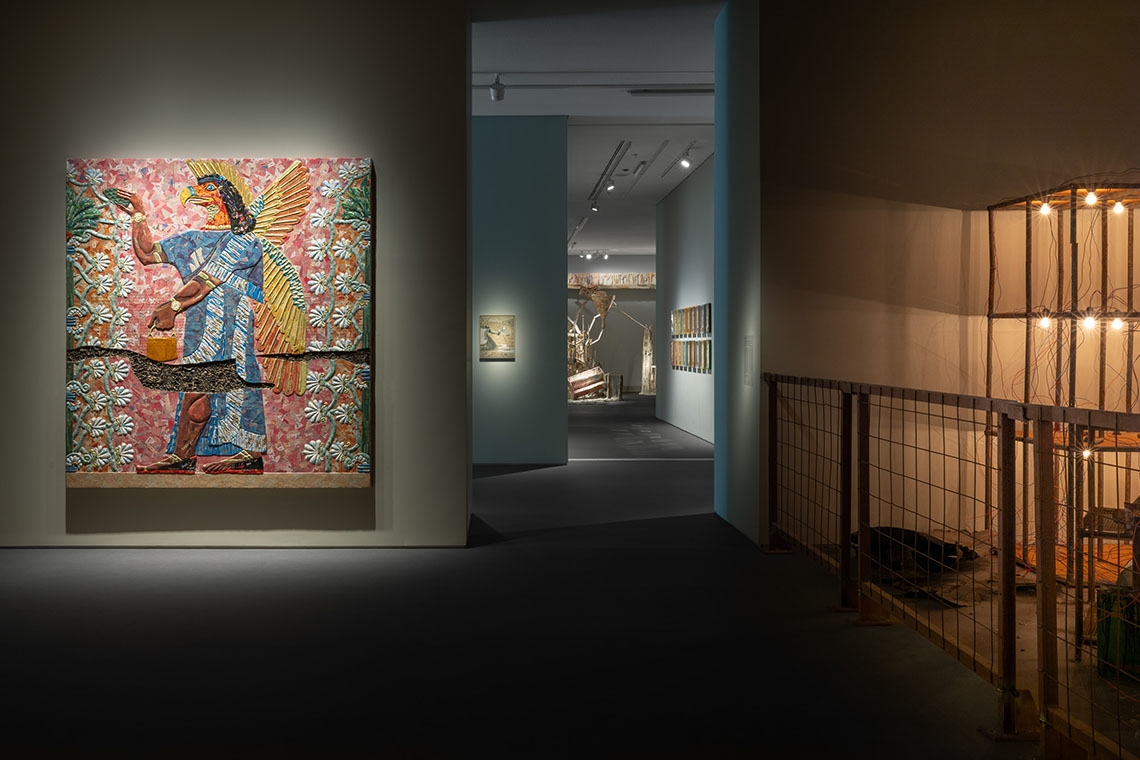
The National Museum of Contemporary Art Athens (EMΣT) explores Greece’s position across the Mediterranean and with its eastern neighbours through a new collection show.
Where am I? Google Maps will immediately inform me. I could alternatively ask a passer-by, or just read the signs. As a Turkish-born New Yorker who is a frequent traveller, I perpetually self-address this question of place, perhaps as much as somebody else often sliding it by me: “Is Türkiye east or west, really? Do you consider New York home?” For many in this melting pot of the world, the question of origin is an open forum – in which a verdict is merely plausible – rather than an austere monologue or an imposing oratory.
The National Museum of Contemporary Art, Athens (EMΣT)’s new exhibition, South by Southeast: Re-Orienting the Collection, raises a similar enquiry about Greece. Geographically positioned on the south-eastern tip of Europe, the Greek nation state bolsters the ethnographic roots of European history, culture, and bureaucracy (even this sentence has over a handful of words from Ancient Greek). The ways in which its identity self-operates and engages with the rest of the world arise heftily from mythic or evident traits of Hellenic antiquity, and the show – curated by Katerina Gregos and featuring some 50 global artists – opens the institution’s grounds to underline the 5000-year-old civilisation’s cultural, commercial, and geographical ties to its neighbours on the other side of the fence. With 100 or so artworks, the expansive outing explores this hermetically sealed legacy’s connection to its neighbours, including Türkiye, the Balkans, North Africa and the Gulf, as well as to the region’s nomadic cultures.
With the subtitle Re-Orienting the Collection, the effort also documents the institution’s reckoning with its methods of contextualising its position in the country’s cultural landscape. If museums carry the torch in ushering their environment to expanded ways of looking at both past and present, EMΣT suggests it is timely to consider if Greece is on the periphery of the European continent or also spills more widely, further east and south. Through new entries and longstanding works, the collection is reshuffled to connect the dots between the country’s distant and near past, from the Byzantine legacy to Ottoman rule and up to the recent migrant crisis.
Ascending to the museum’s second floor, a heartwarming melody welcomes the visitor before any sight of an artwork. Next come Maria Papadimitriou’s photographs of the Roma community in the north of Athens, showing children, trucks and piles of rubble in large-scale brightly lit shots. Then the artist’s video, titled T.A.M.A. Sentimental (2002) reveals itself as the lingering source of the music. The clarinet of Romani Greek musician Giorgos Mangas, who is the subject of the three-minute video, echoes with a twisting energy and unintentionally soundtracks the views of the bustling Kallirois Avenue outside. Tourists populate the street with their cameras in between making their island-hopping plans, most of them from the very ‘West’ that the show is aiming to reorient Greek ties to by stripping the country’s heritage of a solely Western reading.
This transitory and romanticised nature of the nation’s relationship with the rest of Europe through tourism and immigration continues in the main galleries with a medley of Greek and international artists. A 1990-dated neon sculpture by the Greek-American sculptor Chryssa is dedicated to New York’s Chinatown; Italian-Greek Arte Povera pioneer Jannis Kounellis’s hefty mixed-media sculpture of shoes, burlap and coats from 2000 weaves a creative dialogue between two Mediterranean nations; and Greek-American feminist doyenne Lynda Benglis’s 1973-dated video offers a slice of feminine intimacy.
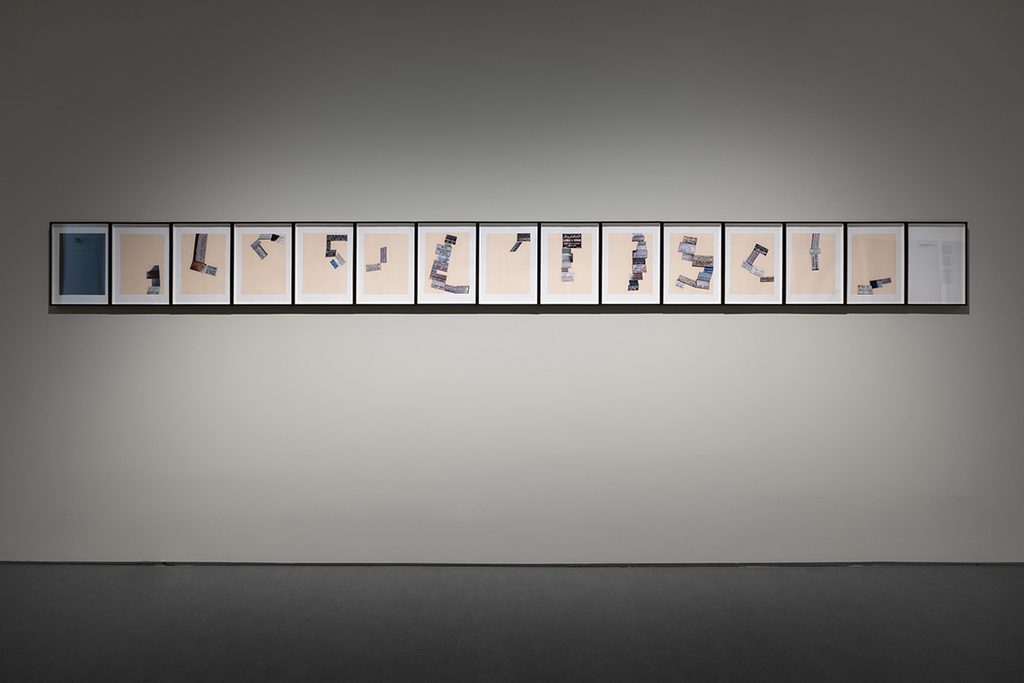
From here, the show moves to the various social turmoils after the 2004 Athens Olympics, mainly the financial crisis of the following decade and the ensuing migrant crisis. Lebanese artist Rabih Mroué’s 12-piece grid of handwritten notes, entitled The Crocodile Who Ate the Sun (2015), re-scribbles one of many leaflets dropped by Israel onto the artist’s town during the Lebanon War. The flyers document different people’s handling of the same note in the artist’s handwriting with signs of touch, play and anxiety. Walid Raad’s photographs of anonymous doctors’ signatures, shot by the fictional medic Dr Fadl Fakhouri, lead the way to Michael Rakowitz’s recreation of a piece of Iraqi antiquity looted during the US invasion through newspaper and food packaging – a stormy recent past that swept across a group of nations not far from Greece is put into context with the country’s own turbulences.
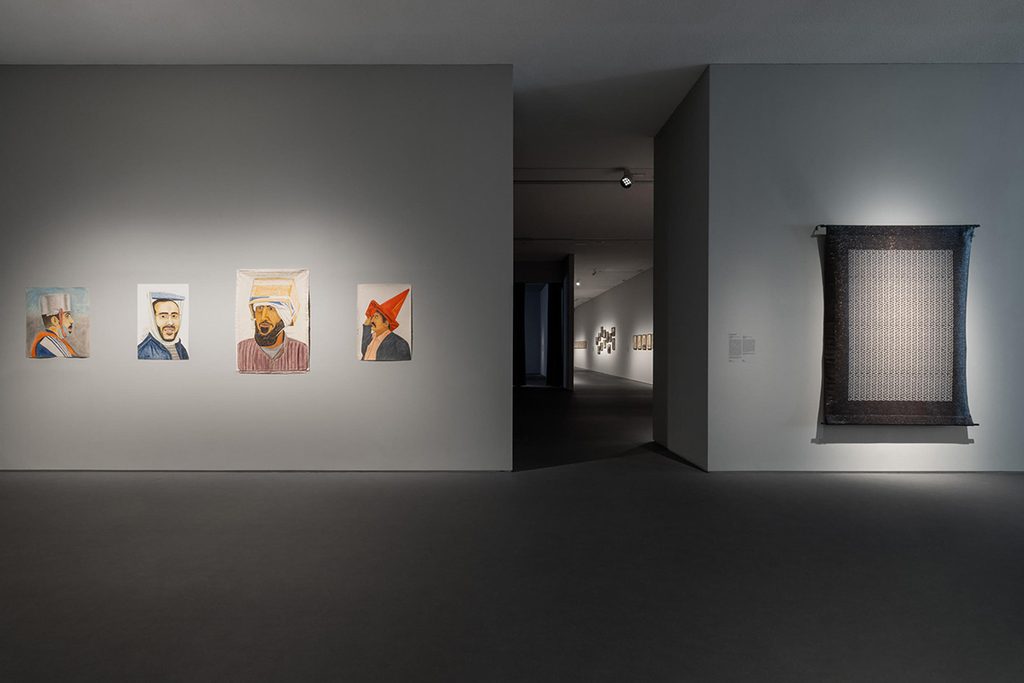
Bouchra Khalili’s magnetic tape wall hanging, The Weaver (2022), exhibits the knotted paths between the show’s grounds and its surrounding radius in all its inclusivity. The Moroccan artist’s draped tapestry is woven with the type of magnetic tape used in videos, such as those made by Swiss feminist video artist Carole Roussopoulos, who is inspirational in Khalili’s statement, as well as Morocco’s own tapestry tradition. The collaborative production between Roussopoulos and her life and work partner Paul Roussopoulos, who was a Greek refugee in Switzerland, is punctured into Khalili’s own enquiries about the legacies of the artist’s hand, whether in her tightly montaged film installations or here in images’ tactility, woven into a physical composition.
The show’s overlap with the summer season – whether intentional or by chance – also coincided with the arrival of around five million tourists in July, most of whom spread out to the islands via Athens. How many of those visitors crossed paths with the show is unclear, but there surely is some promise in raising a few questions for those who did about where they thought they were, or if there even is a definitive answer.
South by Southeast: Re-Orienting the Collection is ongoing
